
Robots that deliver, clean and patrol will need buildings that can recognise them and control where they go. That is the problem Singtel and GovTech Singapore signed a memorandum of understanding (MOU) on 26 November 2026 to work on at One Comcentre, Singtel’s new headquarters in the Orchard Road district, which is due for completion by the end of 2028.
The tool is the Open Digital Platform (ODP), software that GovTech and JTC Corporation co-developed for Punggol Digital District. GovTech calls One Comcentre an initial private-sector deployment of ODP, and the first building to run a telco-enhanced version. Singtel will develop ODP-based solutions for the site, and GovTech says it is open to other industry partners joining the same model.
For most people, the change would show up inside the building. Tenants and staff would work alongside delivery, cleaning and patrol robots that are cleared to use lifts and enter controlled areas, and security teams would get live video from a robot sent to check an alarm. The partners say the aims are better efficiency, security and tenant experience, and an approach that other Singapore buildings could adopt. It is early: the MOU commits the two sides to deploy ODP and explore these uses, and the building is not yet finished.
What the platform does, and what it does not
ODP is an integration layer. It lets building-management systems, district cooling, lifts, security systems, sensors, video analytics and robots from different suppliers exchange data through common interfaces, and brings that data together in operational dashboards and digital twins.
GovTech draws a clear line around it. ODP does not replace the systems connected to it, does not make operational decisions on its own, and is not itself an artificial intelligence system. AI-enabled applications can connect through it. The “open” in the name means interoperability: only authorised systems connect, through defined interfaces, and the data and controls are not publicly accessible.
Where it already runs
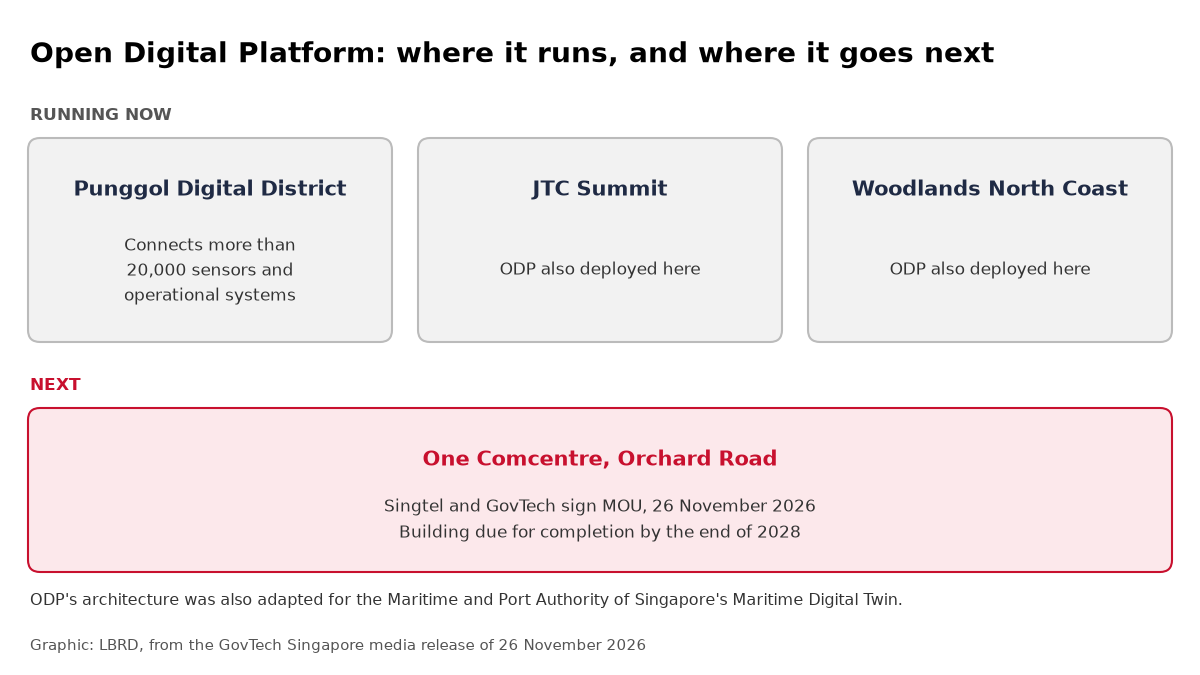
At Punggol Digital District, ODP connects more than 20,000 sensors and operational systems. JTC’s facilities teams use it to combine current and historical lift data to flag unusual behaviour before a breakdown, and to use occupancy figures from video analytics, Wi-Fi analytics and turnstiles to inform cleaning and energy use. It is also the layer through which authorised robots and applications can interact with lifts, doors and access controls.
The rollout there is phased. District cooling and lift operations are the initial use cases, while cleaning, security and incident response are still being tested. The same platform has been deployed at JTC Summit and Woodlands North Coast, and its architecture was adapted for the Maritime and Port Authority of Singapore’s Maritime Digital Twin. Separate deployments do not automatically connect to one another.
What Singtel adds at One Comcentre
The new piece is the network. Singtel’s 5G+ network slicing is meant to support robots and building applications that need reliable, low-latency connections with differentiated quality of service. GovTech describes the One Comcentre version as a telco-enhanced ODP.
The partners will explore deliveries, cleaning and security patrols by robot, earlier detection of equipment faults, and digital twins that let operators and tenants coordinate robots across the building. GovTech’s own example is a security alarm. An AI agent could dispatch a patrol robot, the robot’s identity and permissions would be verified before it could enter an area or call a lift, and it would send live video back to security staff over 5G+.
Mr Ng Tian Chong, chief executive officer of Singtel Singapore, put the challenge in terms of buildings rather than robots: “We expect to see more autonomous robots in buildings, from delivering goods to maintaining facilities. They must be able to recognise, communicate with and securely accommodate autonomous systems operating alongside people.”
Why access control sits at the centre
Access control matters because the Cyber Security Agency of Singapore warned on 6 November 2026 that poorly secured remote access to operational technology, including building management systems, can expose physical operations to cyber threats. GovTech’s ARC Framework for government AI agents takes a similar approach, tying what an agent is allowed to do to the controls around it.
The robots are arriving quickly. The International Federation of Robotics reported on 30 September 2026 that global shipments of professional service robots rose 24 per cent to almost 250,000 units in 2025, with transport and logistics the biggest use. The figures come from a survey of 238 suppliers and are not projected to the whole industry.
The announcement gives no value for the agreement, does not name the robot suppliers for One Comcentre and sets no go-live date ahead of the building’s completion.