GovTech has set out two shared foundations for AI agents inside the Singapore Government: an Agentic Risk and Capability (ARC) Framework that matches what an agent is allowed to do to the safeguards around it, and GovHarness, a common platform for building, running and watching those agents across agencies. Senior Minister of State Tan Kiat How described both in his opening address on day two of the GovTech STACK Conference 2026 on 5 November 2026 at Sands Expo and Convention Centre.
The distinction Mr Tan drew is between AI that assists and AI that acts. An assistant that drafts a wrong message is different from an agent that sends it, and recommending a payment is different from making one. Agentic AI can plan, use tools and reach into systems to carry out more complex workflows, so the Government has to be clear about which actions an agent is authorised to take, which tools it may use, and when a person must sign off.
Which actions need a human
The ARC Framework turns those principles into technical requirements for the whole of government, covering human oversight, permissions management, tool access, testing and monitoring. It links an agent’s capabilities to the controls it needs. Higher-risk actions, including financial transactions, official communications and data deletion, call for stronger controls such as human approval.
The framework builds on IMDA’s Model AI Governance Framework for Agentic AI, which gives organisations structured guidance on the risks of deploying agents. The standard will also guide Desk, GovTech’s secure personal digital assistant for public officers, as Desk takes on more agentic capabilities, deciding which of its actions can proceed on their own and which wait for a person.
Mr Tan put the same choice in front of businesses deploying agents for customer service or internal operations. The goal is neither maximum autonomy nor maximum control, but room for AI to act within clear boundaries while people stay accountable for the outcomes.
GovHarness is built to watch what agents do
Defining an agent’s authority is the first step. Once agents work across applications and tools, agencies also need to retrace their steps when something goes wrong: which information an agent retrieved, and where an error crept in. A trustworthy model does not automatically make a trustworthy system.
GovHarness is GovTech’s answer, now in development as shared infrastructure for building and operating AI agents across government. It supports deployment, connections to tools, and monitoring and evaluation, and it will carry common guardrails and evaluations so that individual teams do not rebuild their own testing and monitoring. The aim is to let developers observe agent actions, spot unexpected behaviour and improve how their applications perform.
Mr Tan also tied agent safety to the plainer kind of resilience. Not every disruption is a cyberattack: an expired certificate, an outdated security key, a misconfiguration or an overlooked dependency can take down an essential service, and agentic systems add risk through their permissions and connections. Secure development, least-privilege access, monitoring and incident response stay essential.
Rabbit Deploy: 8,000 users across 90 agencies
Rabbit Deploy already has numbers behind it. It is GovTech’s government-managed route for officers to deploy and test AI-assisted applications, with gov.sg hosting, Government single sign-on, logs and continuous security scanning built in. It supports over 8,000 users across 90 agencies, with more than 5,000 active applications on the platform.
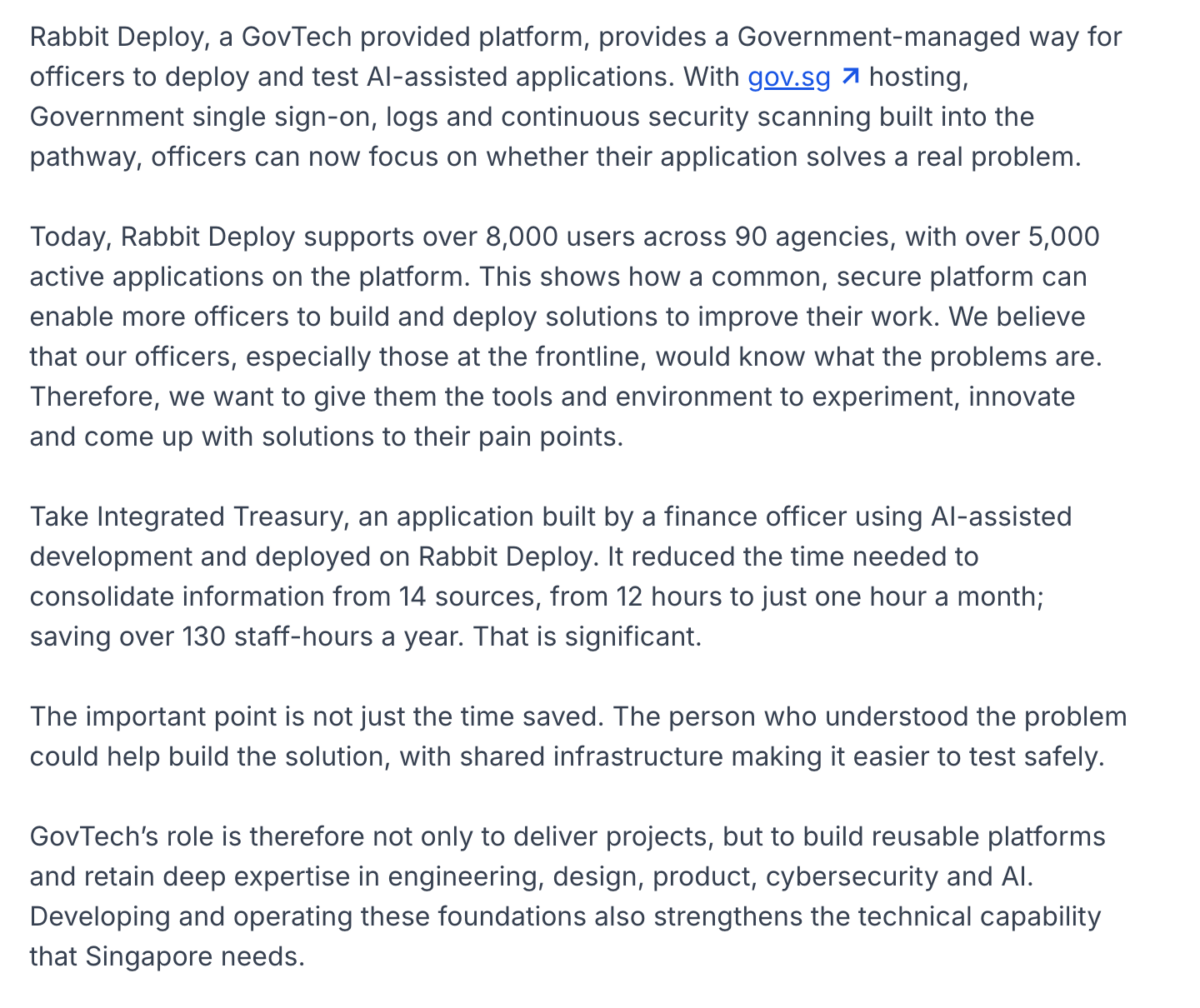
One of them is Integrated Treasury, built by a finance officer using AI-assisted development. It cut the time needed to consolidate information from 14 sources from 12 hours to one hour a month, saving over 130 staff-hours a year. Mr Tan’s point was that the person who understood the problem could help build the solution, because the shared platform made it safe to test.
Mr Tan then turned to people rather than platforms. Singapore can buy technology from around the world, but it needs people who can assess, secure and operate it, and if AI writes the routine code, junior engineers still have to learn to recognise poor architecture. The task should be automated, not the learning.
What day one covered
Senior Minister of State Jasmin Lau opened the conference on 4 November with GovTech’s tenth anniversary and examples of its work. The first is the Standard Data Platform, which gives agencies common pieces to bring data in, process it, store it and serve it, instead of each building its own pipelines. EnterpriseSG went from onboarding the platform to production in four months and now uses it for trade intelligence and forecasting, and for tools that let officers query enterprise-wide data in plain English.
The second is Chat.gov.sg, a chatbot that finds government information and services in one place and says so when it has no reliable answer. Before launch the team tested it on 50 citizen-facing topics, including in Singlish, then set automated red-teaming agents on it to break its rules and used whatever got through to tighten the guardrails. It can explain CPF Board policies but will not recommend a financial product.
This year’s conference also carried the first STACK Expo, which turns the event into an industry fair where GovTech and its partners demonstrate their solutions.
The conference by the numbers
STACK is GovTech’s biennial conference, billed as the largest government-led technology conference in Singapore. The 2026 edition ran on 4 and 5 November at Sands Expo and Convention Centre, with hands-on workshops on 3 November, and conference passes sold out. The usual pass price from 15 October 2026 was S$600 before GST, the early-bird price S$400 and the workshop add-on S$200, with the pass covering two days of keynotes, plenaries, panel discussions and lightning talks plus priority access to the Expo. The previous edition, STACK 2024, drew more than 1,900 in-person attendees.