Sheng Siong closed at S$2.19 on Wednesday, flat on the day, after touching a 52-week low of S$2.14 during the session. The supermarket chain has lost about 22% since its third-quarter results, and the shares now sit below the lowest published analyst target. The valuation is far less demanding than it was a month ago, but the brokers are still cutting and the FY2027 cost picture is unclear. We would hold, not buy.
The call
Sheng Siong Group Ltd (SGX: OV8), one of Singapore’s largest supermarket chains, is our pick today. We rate it a hold. This is our opinion, not a recommendation tailored to anyone’s circumstances.
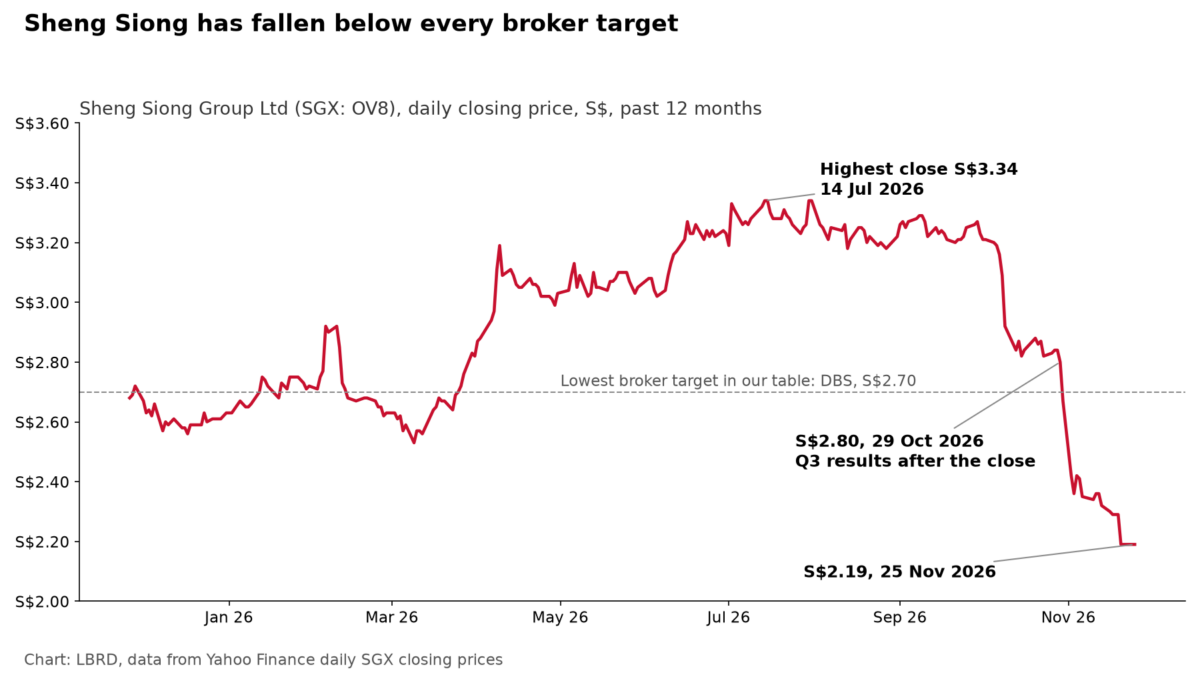
The shares closed at S$2.19 on Wednesday, 25 November 2026, unchanged from Tuesday’s close and level with the closing low of 20 November. The day’s range was S$2.14 to S$2.21, and about 3.4 million shares changed hands. The S$2.14 intraday low is also the bottom of the stock’s 52-week range, which runs up to S$3.46. Wednesday’s close is the latest price going into this morning’s SGX session, which opens at 9am.
At S$2.19, the stock is about 22% below its S$2.80 close on 29 October, the day the results came out after the market shut, and about 37% below its 52-week high.
How the shares got here
We covered the results themselves on 2 November (Sheng Siong Q3 revenue rises 6.2 per cent to S$441.5m), so this is about what the market has done since.
Sheng Siong reported its third-quarter numbers on 29 October 2026 (SGX announcement; company release). Net profit rose only 1.8%, to S$44.6 million. The shares fell 4.6% on 30 October and a further 9.4% to S$2.42 on 2 November, The Business Times reported. Five of the six brokers in our table cut their targets after the results, and Phillip Securities kept its own unchanged. The slide has since continued to Wednesday’s S$2.19.
The brokers’ reasoning after the results is plain enough. Revenue still grows, but costs are now growing faster.
Why the market is paying less
In the third quarter, revenue rose 6.2% while selling and distribution costs rose 11.4% and administrative costs 12.1%. Operating profit grew only 3.4%. The company points to more staff for new stores, higher variable bonuses, depreciation on new leases and merchant fees from digital payments and quick commerce.
Comparable same stores took 0.5 percentage points off third-quarter revenue growth, against a base lifted by SG60 vouchers in July 2025, though they still added 1.9 points over the nine months. New stores did the work, adding 9.1 points to third-quarter growth. DBS expects fourth-quarter revenue growth to slow to about 4% as CDC voucher support tapers, The Business Times reported.
Interest income is also shrinking. Finance income fell 21.9% in the third quarter and 38.5% over nine months, which matters for a company holding this much cash.
The numbers behind the call
These measures use Wednesday’s close of S$2.19. The calculations are ours and are illustrative.
| Measure | Value | Basis |
|---|---|---|
| Price to earnings | about 20 times | Maybank’s FY2026 core net profit forecast of S$164 million |
| Price to earnings at S$2.67 | 24.4 times | Maybank, 2 November 2026 |
| Fall from pre-results close | about 22% | S$2.80 on 29 October to S$2.19 |
| Fall from 52-week high | about 37% | S$3.46 to S$2.19 |
| Cash at 30 September 2026 | S$388.9 million | Company release |
The shares are much cheaper on earnings than before the results, and the balance sheet, which Maybank describes as net cash, gives some cushion. A lower multiple alone is not a reason to buy, though, when the earnings it is measured on are still being cut.
What the brokers say
All six brokers in the table published within days of the results, and every target was set before the fall to S$2.19. None is a reaction to this week’s trading. The change is measured from S$2.19 and is our calculation.
| Firm | Rating | Target | Report date | Change from S$2.19 |
|---|---|---|---|---|
| RHB | Buy | S$3.20, from S$3.59 | 3 November 2026 | about +46% |
| CGS International | Buy | S$3.10, from S$3.60 | 2 November 2026 | about +42% |
| UOB Kay Hian | Hold, downgraded | S$2.88, from S$3.71 | 2 November 2026 | about +32% |
| Maybank | Hold | S$2.85, from S$3.12 | 2 November 2026 | about +30% |
| Phillip Securities | Hold | S$2.75, unchanged | 2 November 2026 | about +26% |
| DBS | Hold | S$2.70, from S$3.00 | 2 November 2026 | about +23% |
The consensus of 10 analysts compiled by S&P Global, in data dated 2 November, is a hold, with an average target of S$2.86, a low of S$2.30 and a high of S$3.50. Even that lowest target is above Wednesday’s price.
The forecasts are moving the same way. Maybank expects core net profit of S$164 million for FY2026, S$174 million for FY2027 and S$177 million for FY2028. RHB cut its FY2026 to FY2028 forecasts by 8%, 11% and 11%, and DBS trimmed FY2027 by 2%, according to The Business Times.
The bull case
The store network is still growing. Sheng Siong opened seven new stores in the first nine months, three of them in the third quarter, taking its Singapore count to 92 from 84 a year earlier. Maybank notes four HDB tenders pending, with openings possibly in the first half of 2027.
Gross margin rose 0.7 percentage points to 32.2% on a better sales mix. Management expects grocery demand to stay resilient, with Singapore’s economy growing 5.4% year on year in the third quarter. And at about 20 times Maybank’s earnings forecast, with S$388.9 million of cash, the stock is priced well below where it traded a month ago.
The bear case
Electricity is the largest known risk for FY2027. Sheng Siong’s utilities contract has not yet been renewed, and DBS says prevailing rates are around twice the contracted rate. Maybank puts utilities at about 1.5% of sales, a cost that could double, with limited room to pass it on to shoppers.
Competition is getting harder. The Johor Bahru to Singapore RTS Link is expected to start passenger service in February 2027, which the company says may increase cross-border shopping and price competition. Maybank also flags grocery delivery from Shopee, Grab and Foodpanda, and says the Foodpanda partnership carries platform fees two to three times those of Deliveroo.
Momentum is poor. The shares have kept falling since the results, and none of the brokers in our table has updated its target since 3 November.
Why hold, not buy
The de-rating has done a lot of work. The stock has lost about 22% since the results and now trades below every published target. On that measure alone it looks like a buy.
We would not go that far yet. Those targets were set when the shares were at S$2.42 to S$2.67 and were already being cut, so the gap to S$2.19 says more about how stale they are than about hidden value. Earnings in FY2027 face a known rise in electricity costs, negative same-store sales and new cross-border competition. We would want to see the terms of the utilities renewal and the fourth-quarter same-store sales trend before turning positive.
For an existing holder, the cash pile and the store pipeline are reasons not to sell at a 52-week low. For a new buyer, there is no rush.
What to watch
Next come the terms of the utilities contract renewal, the openings from the four pending HDB tenders, the FY2026 results and final dividend, and the start of the RTS Link in February 2027. The company has not confirmed a date for the full-year results.
We would move to buy if same-store sales stabilise or if Sheng Siong shows it can absorb higher electricity costs. We would turn negative if costs keep outrunning revenue in the fourth quarter.
Research by Warren.
This is general information, not financial advice, and does not take into account your objectives or financial situation.