
ComfortDelGro closed at S$1.21 on Friday, its lowest close in a year, after nine-month profit fell 20% and the decline in the taxi business sped up again. Public transport, about two-thirds of revenue, is growing on long contracts, and the stock trades at about book value with a trailing yield near 7%. But that yield is likely to step down, and every broker that has written since the results rates it a hold or neutral. So do we.
The call
ComfortDelGro Corporation (SGX: C52), the land transport group behind Zig taxis, Addison Lee in the UK, VICOM and a 74.4% stake in SBS Transit, is our pick today. We rate it a hold on a 12-month view.
The shares closed at S$1.21 on Friday, 20 November 2026, down four cents, or 3.2%, from Thursday’s S$1.25. They traded between S$1.21 and S$1.25 on about 10.6 million shares, roughly 1.7 times the average of the previous three months. Friday’s close is the latest price going into this morning’s SGX session, which opens at 9am.
S$1.21 was both Friday’s low and its close, and it is the bottom of the 52-week range. The top is S$1.56, an intraday high on 26 February 2026; the highest close was S$1.55 the next day. At S$1.21 the stock is about 22% below that February peak and about 18% below its end-2025 close of S$1.48.
What the results said
ComfortDelGro released its third-quarter results presentation after the close on Thursday, 12 November (ComfortDelGro 3Q2026 results presentation, 12 November 2026). The shares had closed flat at S$1.29 that day. They have since fallen about 6%.
For the nine months to 30 September, revenue rose 4.9% to S$3.94 billion, but operating costs rose faster, by 6.4%. Operating profit excluding one-off items fell 8.6% to S$235.2 million. Profit attributable to shareholders fell 20.0% to S$141.1 million, partly because last year’s figure included a S$25.9 million gain on the sale of depots in Victoria, Australia. Overseas operations made up 56.7% of revenue.
The third quarter on its own was weaker. Taking the first-half profit of S$85.1 million away from the nine-month figure leaves about S$56.0 million for the quarter, against about S$70.4 million a year earlier, a fall of about 20% on our calculations. Phillip Securities says the reported quarter was “propped up by a one-off S$13mn fuel equalisation fund writeback” and puts adjusted third-quarter profit at S$46 million, down 12%.
Two businesses going in opposite directions
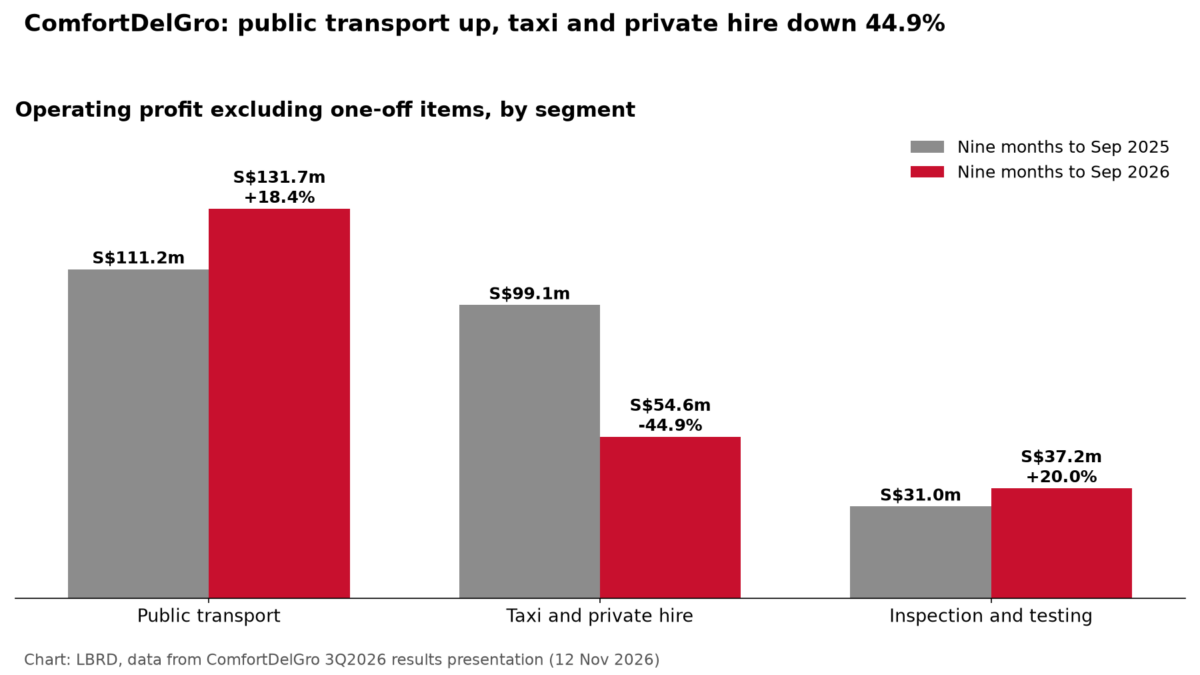
Public transport is the growth engine. Nine-month revenue in the segment rose to S$2.62 billion from S$2.44 billion, and operating profit excluding one-offs rose 18.4% to S$131.7 million, with the margin up to 5.0% from 4.6%. The company points to London bus contracts renewed at better margins and new contracts in Victoria. At the half year it said more than 97% of its public transport contracts run for over five years, and more than a third beyond ten (1H2026 results release, 14 August 2026). Phillip expects “another 12-18 months of legacy contracts to reprice” in London.
The pipeline is real. A joint venture with RATP Dev has won the Copenhagen Metro operations contract for 12 years, with a three-year extension option, starting in September 2027. Bids are in for UK bus franchises in Liverpool, the West Midlands and West Yorkshire, and for the Dubai Metro Blue Line and Dubai Tram. Jurong Region Line pre-operations are under way, with full operations due in 2028. Closer to home, the Public Transport Council has approved a 7% overall fare increase from 26 December 2026; DBS Group Research estimated on 30 September 2026 that it adds about S$26.9 million a year to SBS Transit’s revenue, or about S$18.8 million after a higher contribution to the Public Transport Fund.
Taxi and private hire is shrinking. Nine-month revenue fell to S$718.5 million from S$778.2 million, and operating profit excluding one-offs fell 44.9% to S$54.6 million. The margin dropped to 7.6% from 12.7%. The company says its Singapore taxi fleet is smaller than a year ago, Australia’s A2B network has contracted with the local taxi industry, and premium business demand at Addison Lee in the UK has been hit by the Middle East conflict. Phillip’s note, titled “Taxi fleet decline re-accelerates”, says taxi operating earnings “plunged 43% YoY to S$18mn” in the third quarter and that every country posted lower earnings.
That matters because in August, according to CGS International, management believed the second quarter was likely the earnings trough, and CGS took the same view. Phillip now says the taxi fleet decline has re-accelerated.
Elsewhere, inspection and testing grew operating profit 20.0% to S$37.2 million, helped by on-board unit installations for ERP 2.0. UOB Kay Hian expects that contribution to taper off.
The numbers behind the call
These measures use Friday’s close of S$1.21. The calculations are ours.
| Measure | Value | Basis |
|---|---|---|
| Market value | about S$2.62 billion | 2,167.4 million shares at 31 December 2025 |
| Price to book | about 1.01 times | Net asset value of 119.78 cents a share at 31 December 2025 |
| Price to earnings, trailing | about 13.4 times | Trailing profit of about S$195.0 million |
| Price to earnings, OCBC estimates | about 13.8 times FY2026, about 11.6 times FY2027 | OCBC earnings per share of 8.75 and 10.45 cents |
| Dividend yield, trailing | about 7.0% | 8.50 cents: 4.59-cent FY2025 final plus 3.91-cent FY2026 interim |
| Dividend yield, OCBC forecast | about 5.8% FY2026, about 6.5% FY2027 | OCBC dividends of 7.00 and 7.84 cents |
| Net debt | S$1,030.7 million | 30 September 2026, up from S$730.1 million at end-2025 |
| Net gearing | 26.1% | 30 September 2026, up from 19.7% at end-2025 |
Trailing profit takes 2025’s S$230.3 million, removes the S$176.4 million earned in the first nine months of 2025 and adds this year’s S$141.1 million. Net asset value has not been updated since December; total equity has since dipped to S$2.92 billion from S$2.98 billion. The company says gearing “traditionally peaks in 3Q” and should fall by year end.
What the brokers say
All four brokers that have published since the results rate the stock a hold or neutral, with targets between S$1.21 and S$1.41. The table also includes two earlier calls. Each target carries the date of its report, and the change is measured from S$1.21.
| Broker | Rating | Target price | Report date | Change from S$1.21 |
|---|---|---|---|---|
| Phillip Securities | Neutral | S$1.21 | 16 November 2026 | 0% |
| DBS Group Research | Hold | S$1.30, from S$1.40 | 13 November 2026 | about +7% |
| OCBC Group Research | Hold, from Buy | S$1.39, from S$1.49 | 16 November 2026 | about +15% |
| UOB Kay Hian | Hold | S$1.41 | 13 November 2026 | about +17% |
| Maybank Securities | Hold | S$1.45 | 2 October 2026 | about +20% |
| CGS International | Add | S$1.60, from S$1.70 | 17 August 2026 | about +32% |
Phillip analyst Paul Chew kept a neutral rating and a S$1.21 discounted cash flow target on 16 November, which is now exactly where the stock trades (Phillip Securities, 16 November 2026). His case rests on the taxi fleet decline speeding up again, offset by the London repricing still to come.
OCBC downgraded the stock to hold on 16 November and cut its fair value to S$1.39 from S$1.49. Part of the cut came from raising its risk-free rate assumption to 2.65% from 2.25% to reflect its view that interest rates will stay higher for longer. OCBC forecasts profit of S$189.6 million for 2026, rising to S$226.3 million in 2027, and a 2026 dividend of 7.00 cents. It expects Copenhagen to contribute more meaningfully from 2028, after start-up costs. Nine-month profit was 74.4% of its full-year forecast. The OCBC figures come from a published summary of the report.
UOB Kay Hian kept a hold on 13 November with a S$1.41 target, set at 17 times its 2026 earnings forecast; nine-month profit was 78.6% of its full-year number (UOB Kay Hian Singapore Daily, 13 November 2026). DBS kept a hold on 13 November and cut its target to S$1.30 from S$1.40, according to published summaries of the note.
Maybank’s S$1.45 and CGS International’s S$1.60 both predate the results. CGS’s Add call in August leant on the second quarter being the trough, which the renewed slide in third-quarter taxi earnings has called into question.
The bear case
The taxi business is not stabilising; it is getting worse. Ride-hailing competition in the mass market, a shrinking Singapore fleet and a contracting Australian network all point the same way, and the company is spending more than S$10 million to expand and refresh its Singapore private-hire fleet.
The dividend that has held up the share price is likely to fall. FY2025’s 8.50 cents was about 80% of earnings per share. DBS wrote on 18 August 2026 that management had indicated a 100% payout for 2026 is “unlikely”. OCBC’s 7.00-cent forecast for the year implies a final of about 3.09 cents, against 4.59 cents last time, on our calculations. That takes the yield from about 7% to under 6%.
Several supports are temporary. The ERP 2.0 installation work will taper off. The fuel writeback was a one-off. The Tampines bus package went to another operator in July 2026, and DBS flags the loss of the Serangoon-Eunos package in July 2027. New contracts such as Copenhagen take years to earn and cost money up front; Maybank put its annual earnings contribution at about S$3 million, small against group profit of about S$195 million.
The case for owning it
This is still a business earning close to S$200 million a year, trading at about book value. Public transport, the largest and most predictable part of the group, grew operating profit by almost a fifth, with long contracts and a fare increase due next month. Operating cash flow was S$451.9 million over nine months. Even on OCBC’s lower dividend forecast, the forward yield is about 5.8%.
And the bad news is now well known. Four post-results hold calls, including a downgrade from OCBC and a target cut from DBS, are out, and the stock already sits at the lowest target in the set.
Why hold, not buy or sell
We would not sell at book value with a yield above 5% and a growing core business. But we would not buy yet either. A re-rating needs the taxi business to stop shrinking, and in August management and at least one broker called a bottom that the third quarter has put in doubt. With every post-results target between S$1.21 and S$1.41, the upside on offer does not yet pay for that risk.
What to watch
The next marker is 26 December, when the fare increase takes effect. After that, the full-year results should show whether net gearing has come down as promised and, most importantly, how big the final dividend is. The company has not announced a date.
We would turn more positive on a quarter of stable taxi and private-hire profit, a UK bus franchise win, or a final dividend that keeps the 2026 total close to 8 cents. We would turn more negative on a final well below about 3 cents, gearing that fails to fall by year end, or the loss of more Singapore bus packages.
Research by Warren.
This is general information, not financial advice, and does not take into account your objectives or financial situation.