
AI skills in Singapore job postings are now asked for in 5.3% of ads, up from 3.6% in 2022, according to a new report from the Skills and Workforce Development Agency (SWDA). The share is still small, but it has moved from 4.0% in 2025 to 5.3% in the first quarter of 2026. SWDA released the “Human Capabilities in the Age of AI” report on 18 November 2026, and the findings reach well beyond tech jobs.
The agency is the new statutory board formed from SkillsFuture Singapore and Workforce Singapore, under the Ministry of Manpower. It drew on more than 300,000 local job postings a year covering over 1,600 roles, plus data on more than 1,300 roles across 35 sectors in the national Skills Frameworks.
AI skills in Singapore job postings: who is asking for them
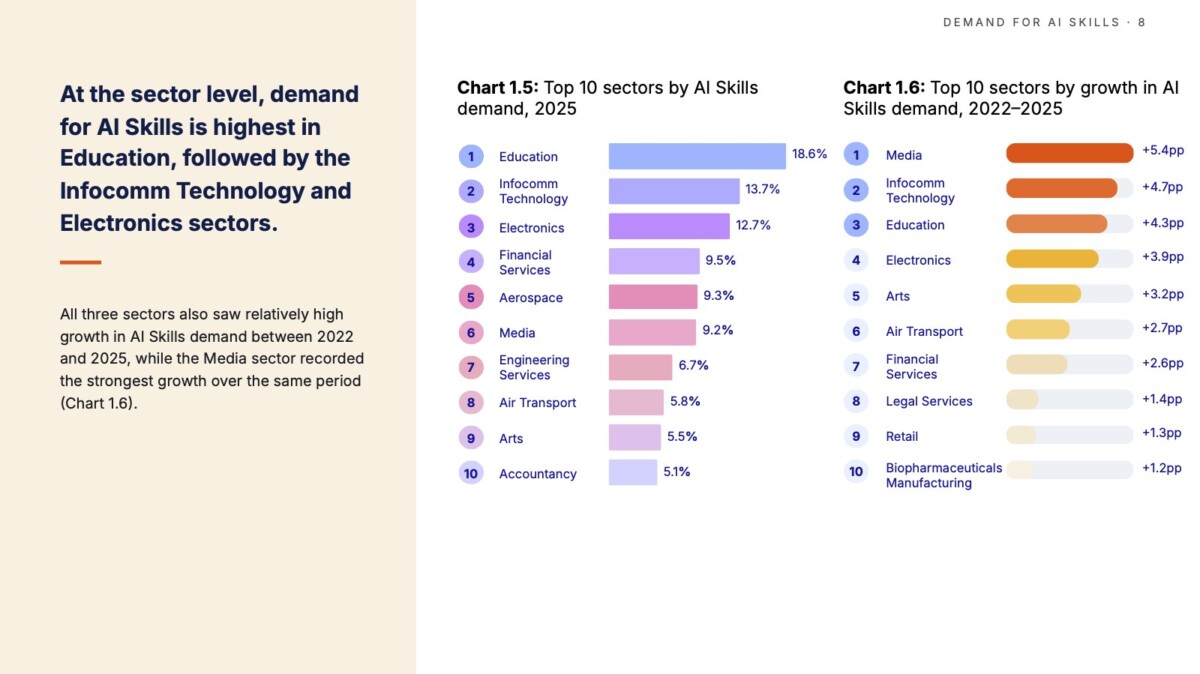
Education leads. In 2025, 18.6% of postings in the sector mentioned AI skills, ahead of Infocomm Technology at 13.7% and Electronics at 12.7%.
- Financial Services: 9.5%
- Aerospace: 9.3%
- Media: 9.2%
- Engineering Services: 6.7%
- Air Transport: 5.8%
- Arts: 5.5%
- Accountancy: 5.1%
Media saw the sharpest rise between 2022 and 2025, at 5.4 percentage points. Infocomm Technology followed at 4.7 points and Education at 4.3.
Not just for techies
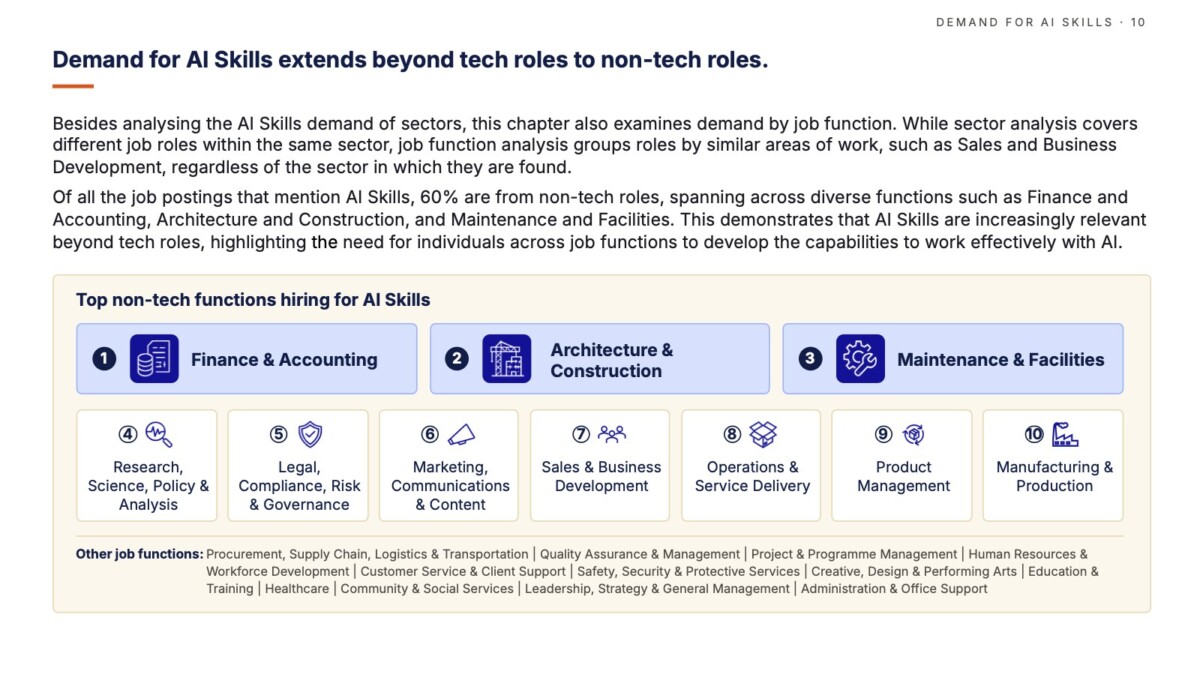
Among 2025 postings that mentioned AI skills, about 60% were for non-technology roles. SWDA says AI skills appeared in postings for three in five job roles that year, mostly tied to AI-related apps and tools.
The top three non-tech functions hiring for AI skills were Finance and Accounting, Architecture and Construction, and Maintenance and Facilities. Demand also tilts senior: for middle and senior roles, the share rose from 3.8% in 2022 to 4.4% in 2025, while junior roles stayed at about 3.4%.
Your career stage changes what you need to learn
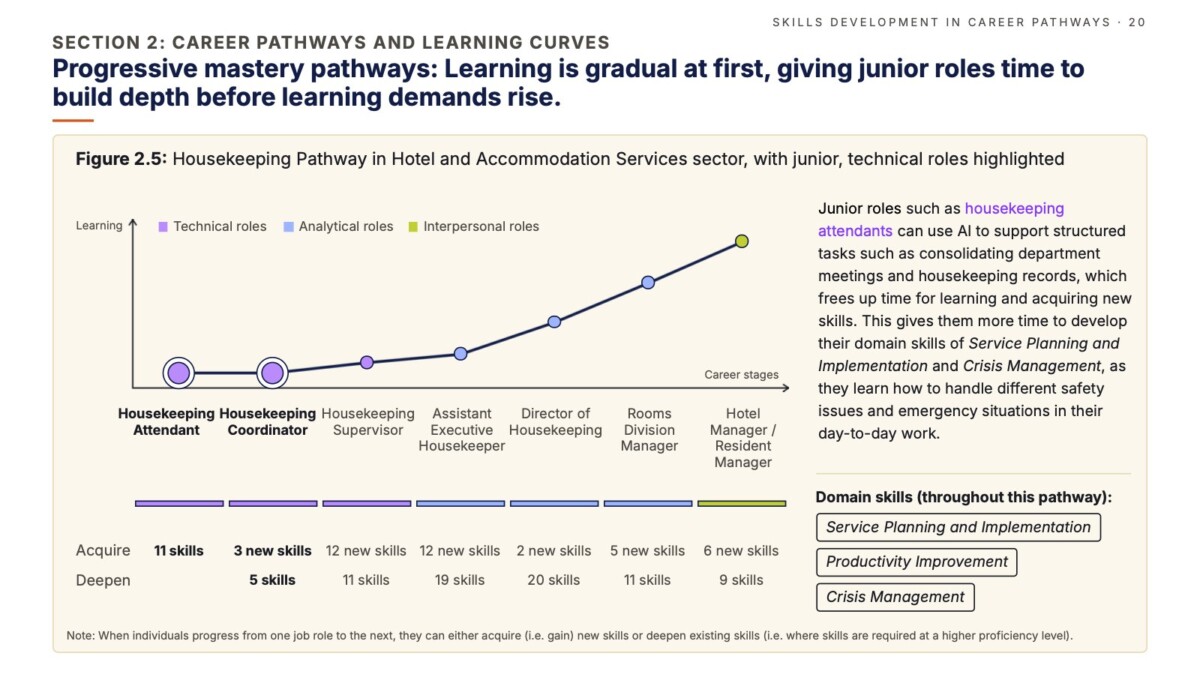
The report finds that most junior roles lean on technical skills, most middle and senior roles lean on analytical skills, and interpersonal skills become more common at senior levels. It also describes two learning patterns that together cover about 92% of career pathways in the Skills Framework.
- Front-loaded learning: a steep curve early on, with many new skills picked up in junior roles.
- Progressive mastery: skills deepen gradually, and the steepest learning comes between the middle and senior stages.
SWDA gives two examples. A junior aircraft maintenance apprentice can use AI for analytics and record-keeping, but should still review maintenance records personally to understand the aircraft’s components. In hotels, an assistant executive housekeeper using AI for budget forecasting should still work out how the analysis is built, since budgeting is a new skill at that stage.
Human-AI Agency: a proposed 17th core skill
The report proposes Human-AI Agency as a 17th Critical Core Skill, alongside the existing 16. It covers the ability to use judgement, autonomy and responsibility when AI is part of the work, such as deciding what to ask of AI and when to question its output.
SWDA developed the proposal with the Institute for Adult Learning. It is open for public feedback, and the agency says it will share more details in the first half of 2027.
What to do with this
The full report sits on the Jobs-Skills Portal, together with a new Careers Pathways dashboard and an AI Skills@Work series on how work has changed in different organisations. Both are free to browse, so you can check which skills your target role asks for before you pay for a course.
If you are planning a switch, our guides to the SkillsFuture Mid-Career Credit and the Mid-Career Training Allowance cover the money side. For hiring events, see our list of November career fairs and the Punggol Digital District Career Fair on 11 December.