
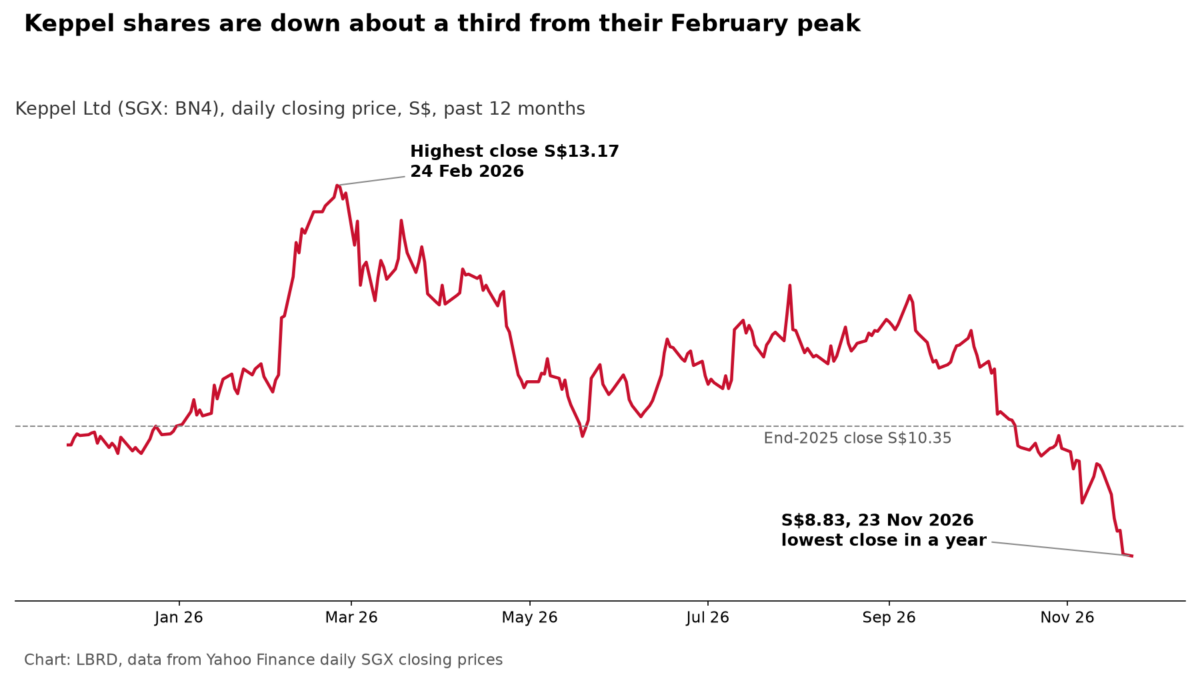
Keppel closed at S$8.83 on Monday, its lowest close in a year and about a third below its February peak, on the same day it finished selling its Ho Chi Minh City stake for S$343 million and ended an arbitration over land fees. The parts of the group it wants to keep are still growing, it has already beaten this year’s asset-sale target, and every broker target in our table sits about 35% or more above the price. We think the selling has gone further than the news.
The call
Keppel Ltd (SGX: BN4), the Singapore asset manager and operator in power, decarbonisation, data centres, subsea cables and real estate, is our pick today. We rate it a buy on a 12-month view. It is a patient buy, not a quick trade.
The shares closed at S$8.83 on Monday, 23 November 2026, down two cents, or 0.2%, from Friday’s S$8.85. They traded between S$8.62 and S$8.84 on about 4.0 million shares, roughly in line with the three-month average. Monday’s close is the latest price going into this morning’s SGX session, which opens at 9am.
The S$8.62 intraday low is the bottom of the 52-week range, and S$8.83 is the lowest close in a year. The top of the range is S$13.25, an intraday high on 25 February 2026; the highest close was S$13.17 the day before. At S$8.83 the stock is about 33% below that February close, about 15% below its end-2025 close of S$10.35, and about 12% lower than it was on 2 November.
Monday’s news
In a filing to SGX after the market closed on Monday, Keppel said its wholly owned subsidiary Corredance had completed the sale of its 40% stake in Empire City LLC, the Thu Thiem project in Ho Chi Minh City (Keppel SGX filing, 23 November 2026). With that, all claims over the additional land use fees imposed on the project, which Keppel put at about 6.877 trillion dong (about US$261 million) when it began the arbitration in April, are deemed settled, and the arbitration has been discontinued. Keppel announced the sale on 5 August 2026 at US$270 million (about S$343 million) in cash (Keppel, 5 August 2026).
The money is already counted in Keppel’s numbers. Phillip Securities says the Empire City sale drove the S$380 million rise in realised asset sales in the third quarter, to S$940 million. What Monday adds is that the sale is complete and a legal dispute is gone.
What the business update said
Keppel’s third-quarter update on 29 October split the group in two (Keppel 3Q and 9M 2026 business update, 29 October 2026).
The part Keppel is keeping is growing. It calls this the New Keppel. Its net profit rose close to 15% year on year in the third quarter and more than 20% over nine months, and recurring income rose more than 10%. Asset management profit was up 30%. Asset management fees reached S$354 million over nine months, up 18%, and Phillip says third-quarter fees alone rose 48% to S$154 million. Funds under management passed the S$100 billion end-2026 target in July, about S$19.5 billion of new money has been raised this year, and the deal pipeline is about S$23 billion. In the first half, New Keppel earned S$530 million, up 25%, with an annualised return on equity of 15.0% (Keppel 1H 2026 results, 30 July 2026).
Infrastructure brings long contracts. The decarbonisation and sustainable solutions business had S$8.1 billion of contracted revenue at the end of September, with 10 to 15 years of visibility and a tender pipeline of about S$15 billion. The 600MW Keppel Sakra Cogen plant started in late May, and 43% of contracted generation capacity is secured for three years or more.
The part it is selling is still losing money. Group net profit for the nine months was 40% lower, after the gross asset value of the non-core book fell 4% on impairments, depreciation and holding costs. In the first half, group profit fell 59% to S$154.7 million, with a S$375 million non-core loss that included legacy rig impairments and adjustments linked to M1.
And it is selling faster than planned. Keppel has announced about S$3.7 billion of asset sales this year, beating its S$2 billion to S$3 billion target, and about S$940 million has been received. It aims to complete the sale of its first six legacy rigs to Keppel Offshore Fund, worth about S$600 million, by the end of 2026. Chief executive Loh Chin Hua said: “Despite the volatile environment, we have exceeded our target of $2-3 billion in non-core asset monetisation announced for the year.”
Why the shares fell
Three things went wrong at once.
First, the core missed. UOB Kay Hian says recurring New Keppel profit growth of just over 10% trailed its 20% forecast for the year. Integrated power grew EBITDA only 7% over nine months, which UOB Kay Hian puts down to planned maintenance on a Keppel Merlimau Cogen unit and weaker spark spreads. UOB Kay Hian cut its core earnings forecasts by 4% to 6% (UOB Kay Hian, 30 October 2026), and on 3 November dropped Keppel from its Alpha Picks, saying slower core growth “limits near-term upside” (UOB Kay Hian Singapore Country Daily, 3 November 2026). Phillip called power EBITDA “disappointingly weaker”.
Second, M1 is back. The proposed sale of 83.9% of M1’s telco business for S$1,288 million did not go through and has been taken off the asset-sale list (Keppel 3Q 2026 presentation slides).
Third, the market turned on data centre stories. On 17 November Keppel was the biggest decliner in the Straits Times Index, down 2.9% to S$9.27, according to Lianhe Zaobao, as the index fell to a five-month low on proposed US licensing rules for advanced AI chips in data centres in Singapore and four other economies.
The numbers behind the call
These measures use Monday’s close of S$8.83. The calculations are ours, from company figures.
| Measure | Value | Basis |
|---|---|---|
| Market value | about S$15.9 billion | 1,800.6 million shares at 30 June 2026 |
| Price to book | about 1.58 times | Net asset value of S$5.60 a share at 30 June 2026 |
| Price to net tangible assets | about 1.81 times | S$4.87 a share at 30 June 2026 |
| Price to earnings, FY2025 New Keppel | about 14.5 times | 61 cents a share, excluding non-core and discontinued businesses |
| Price to earnings, FY2025 headline | about 20.1 times | 44 cents a share |
| Price to earnings, trailing headline | about 27.9 times | 31.7 cents: first-half 2026 plus second-half 2025 |
| Ordinary dividend yield | about 3.9% | FY2025 ordinary dividends of 34 cents |
| Total FY2025 yield | about 5.3% | About 47 cents including specials |
| Net gearing | 0.84 times | 30 June 2026, from 0.82 times at end-2025 |
The headline price-to-earnings ratio looks expensive only because of non-core losses. On the earnings Keppel says will set its ordinary dividend, the stock trades at about 14.5 times last year’s figure.
The specials could add more. Keppel aims to pay 10% to 15% of cash received from non-core sales as special dividends. On the S$940 million received so far, that works out at about 5.2 to 7.8 cents a share on our calculations. If the rig sale completes by year end, taking the total to about S$1.54 billion, it would be about 8.6 to 12.8 cents. Keppel has not said the FY2026 special will be based on these exact figures, so treat this as an illustration, not guidance.
What the brokers say
Every broker below rates Keppel a buy or add. The lowest dated, named target is about 35% above Monday’s close. None of these notes was written after the November slide. The change is measured from S$8.83.
| Broker | Rating | Target price | Report date | Change from S$8.83 |
|---|---|---|---|---|
| UOB Kay Hian | Buy | S$11.90, from S$13.26 | 30 October 2026 | about +35% |
| Phillip Securities | Buy | S$13.80 | 2 November 2026 | about +56% |
| CGS International | Add | S$13.52 (published summary) | 20 October 2026 | about +53% |
UOB Kay Hian analyst Roy Chen kept a buy after the update but cut his target to S$11.90, set at 17 times 2027 core earnings and adjusted for assets being sold and net debt. Phillip analyst Paul Chew kept a buy and his S$13.80 target on 2 November; he says electricity spreads have recovered, though maintenance will weigh on near-term earnings (Phillip Securities, 2 November 2026). Phillip also puts the next S$2.8 billion of sales, the six rigs and Keppel South Central, at 16 to 24 cents of special dividend.
CGS International’s add call predates the business update, and its details come from a published summary of the note. It values Keppel at 18 times FY2027 New Keppel profit plus the non-core book at book value, and it had named M1’s sale as the key catalyst, which has since fallen through. Lim & Tan Securities rated the stock accumulate on 29 October. Across 15 analysts polled by S&P Global, the average target is S$12.71.
The bear case
The headline numbers will stay messy for as long as the non-core book is being wound down, and another round of rig or property write-downs is possible. Sale prices can disappoint: CGS noted the Keppel South Central deal valued the building at S$1.23 billion, below its earlier expectation of about S$1.9 billion. The rigs still need work, with RigCo and Seatrium finishing four of them and the first two deliveries due in 2027 and 2028.
M1 is unresolved. Power earnings depend on spark spreads and plant uptime. Higher interest rates make fundraising harder for the asset management arm. And with net gearing at 0.84 times, buybacks and special dividends compete with paying down debt. Keppel did not give an updated gearing figure at the third quarter.
The case for owning it
The parts of Keppel that will be left once the selling is done are growing at double digits, with asset management fees accelerating and power and decarbonisation earnings backed by long contracts. Keppel has already beaten its asset-sale target for the year, and Monday’s completion closed the sale of a disputed Vietnam asset. At about 1.6 times book and about 14.5 times last year’s New Keppel earnings, the market is paying little for that growth. Keppel also has a S$500 million buyback programme, under which it had bought back 34.2 million shares for S$356 million by the time of its first-half results.
The power miss is real, but UOB Kay Hian ties it partly to planned maintenance on a Merlimau unit, which should not happen every year.
Why buy, not hold
At S$8.83 the market is pricing in more write-downs and slower growth, but not the cash already coming in from asset sales or the special dividends tied to it. You are paid about 3.9% from ordinary dividends while you wait. The risk is time: this could take several quarters to play out, and the stock may stay weak while data centre sentiment is poor.
What to watch
The next marker is the six-rig sale, which Keppel aims to complete by the end of 2026. Then come the FY2026 results, which will show the final ordinary dividend, the size of the special and, for the first time, the change in the value of the non-core book. Keppel has not announced a results date.
We would turn more negative if the rig sale slips past year end, if the FY2026 ordinary dividend comes in below the 34 cents paid for FY2025, if there is another large non-core write-down, or if Keppel cuts its funds-under-management growth guidance. We would grow more confident on a new solution for M1 and a full year of Sakra Cogen in 2027.
Research by Warren.
This is general information, not financial advice, and does not take into account your objectives or financial situation.