
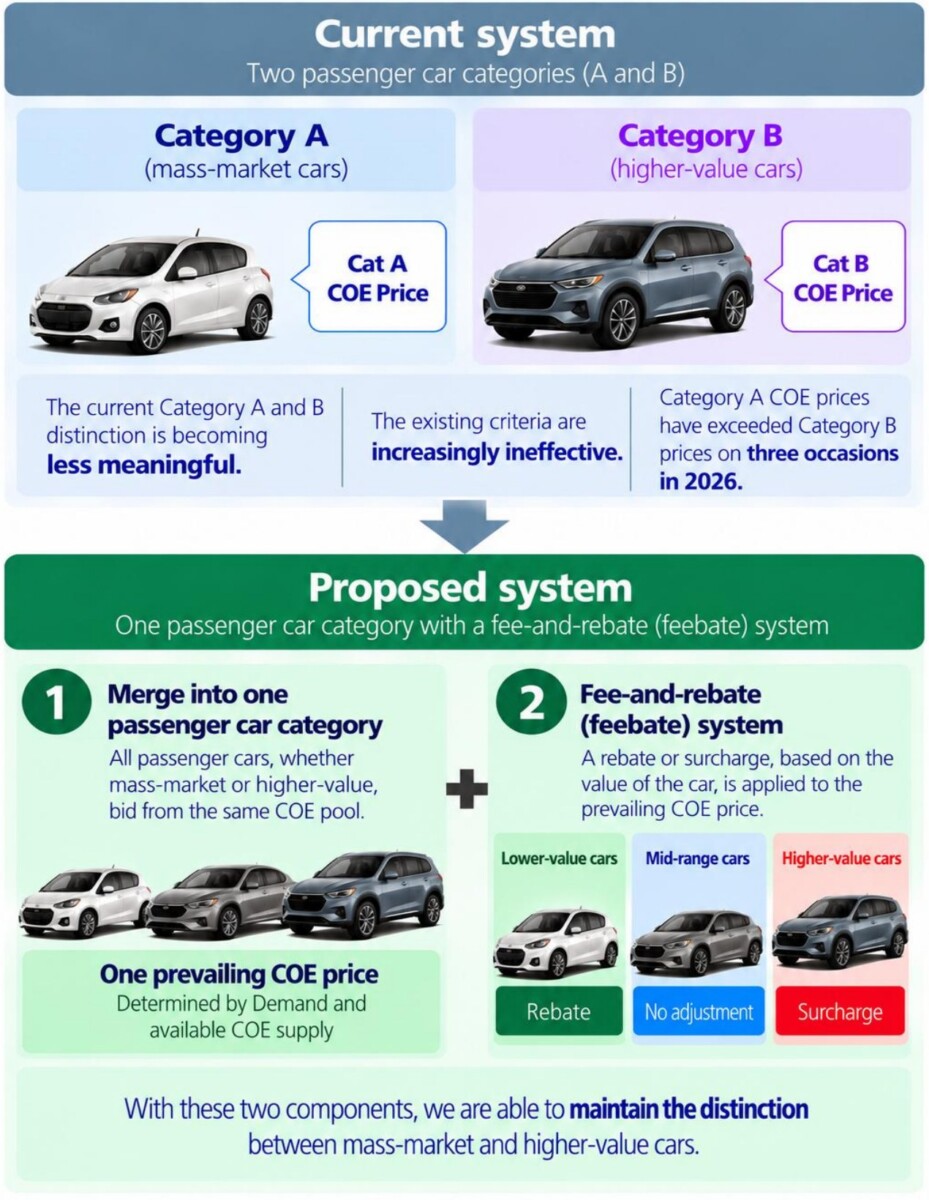
Car buyers in Singapore would bid in one COE category for all passenger cars, and then get a rebate or pay a surcharge of up to S$15,000 depending on the car’s value, under a proposal now open for public comment. The Land Transport Authority opened a public consultation on Thursday, 8 October, on merging Categories A and B and adding a fee-and-rebate, or feebate, system. Feedback closes on 2 November at 11.59pm.
The proposal is not yet policy. The review is due to finish by the end of 2026, with findings and recommendations in the first half of 2027.
Why LTA wants to change the categories
Category A is meant for mass-market cars and Category B for higher-value ones. Since 2014, the line between them has been drawn by engine capacity and engine power. That line no longer works well, because electric cars are software-driven and makers can tune a model’s power rating to fit under the Category A limit. The same Tesla Model Y can land in either category depending on its power rating.
The result is that more buyers chase Category A COEs, and the gap between the two premiums has narrowed. From February to June 2026, the Category A premium was higher than Category B’s on three occasions. At the 7 October exercise, Category A closed at S$130,001 and Category B at S$130,100, a gap of S$99.
How the feebate would work
Under the proposal, all passenger cars bid in one pool and there is one COE price, still set by demand and the supply of COEs. A rebate or surcharge is then applied to that prevailing price. Buyers of lower-value cars get a rebate, mid-range cars see no adjustment and higher-value cars pay a surcharge.
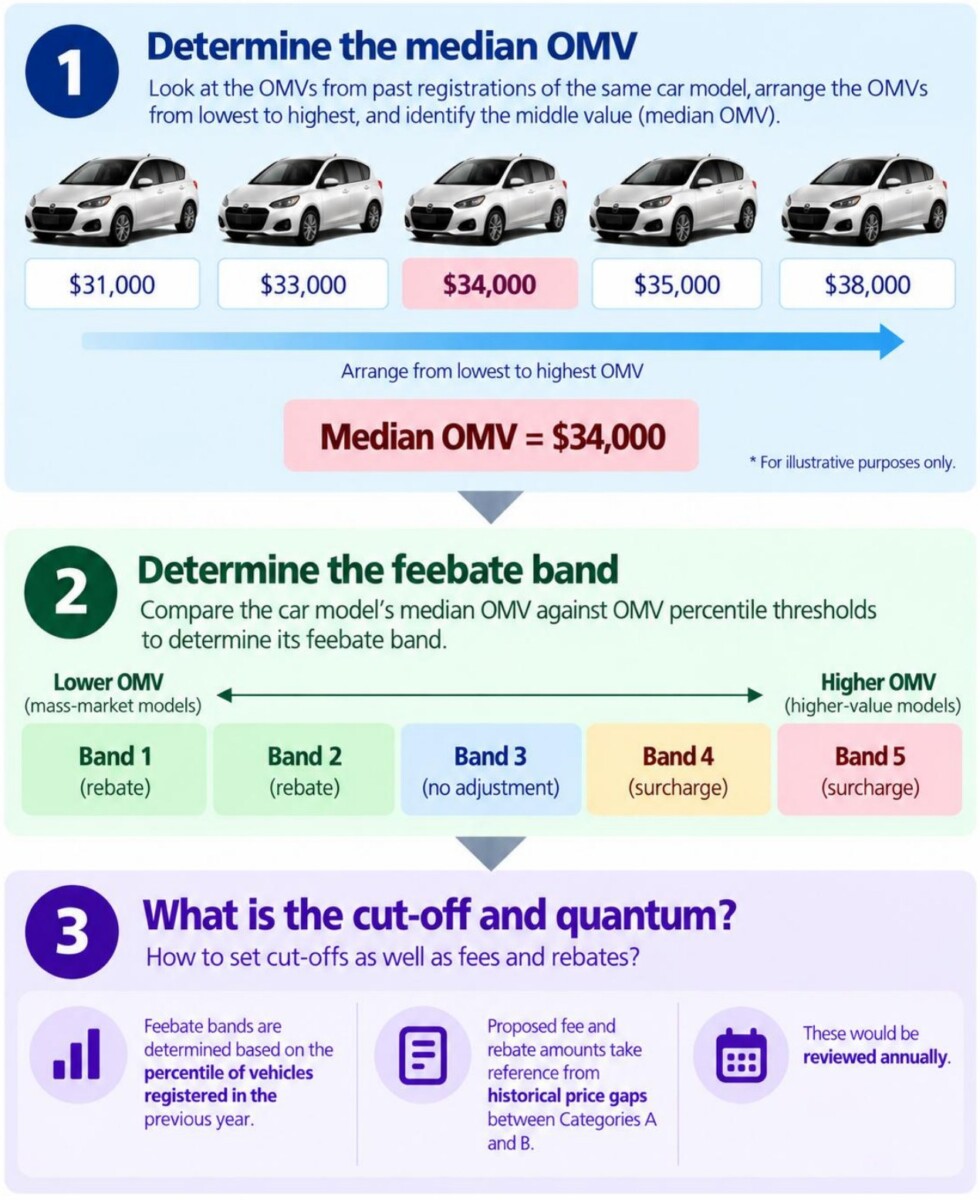
LTA proposes to sort cars by the median Open Market Value of each model, which is the middle OMV across that model’s past registrations. OMV is the import value already used to work out the Additional Registration Fee. A model’s band would be published once a year, so buyers would know the rebate or surcharge before choosing a car, and car retailers could appeal a band.
LTA has put two structures out for views:
- Three bands: cars in the bottom 35 per cent by OMV get a S$15,000 rebate, cars from the 35th to 50th percentile see no change, and cars above the 50th percentile pay a S$15,000 surcharge.
- Five bands: a S$15,000 rebate up to the 10th percentile, a S$7,500 rebate from the 10th to 35th, no change from the 35th to 50th, a S$7,500 surcharge from the 50th to 75th, and a S$15,000 surcharge above the 75th.
In both options, the gap between the cheapest and the priciest band is S$30,000 on any given COE premium. The amounts take reference from the historical price gap between Categories A and B.
Which cars would land where
LTA’s paper gives indicative bands based on cars registered in 2025, and these would be reviewed every year. In the three-band option, the Honda Jazz, Mazda 3, Nissan Note, Suzuki Swift, Toyota Sienta, Toyota Noah, BYD Atto 3 and Volvo EX30 110kW sit in the rebate band. The Audi A3, Honda Civic 1.5 Turbo, Nissan Serena, Toyota Corolla Altis and BYD Sealion 7 Dynamic sit in the middle with no adjustment. The Mercedes-Benz A180 and GLC, Tesla Model 3 RWD and Model Y RWD, Honda Odyssey and Toyota Alphard pay the surcharge.
The five-band option splits those groups further. The Honda Freed, Toyota Sienta and BYD Atto 3 move to the S$7,500 rebate band, while the Jazz, Mazda 3 and Swift keep the full S$15,000 rebate. At the top, the Honda Odyssey and Tesla Model 3 would pay S$7,500, and the Tesla Model Y RWD, Mercedes-Benz GLC and Toyota Alphard would pay S$15,000.
Renewals and Category E
Owners who renew a COE now pay the Prevailing Quota Premium for their category, which is the moving average of COE prices over the last three months. A merger would leave one PQP. There may be no need to apply the feebate to renewals because Category A and B prices have already converged. LTA is seeking views on this and on transitional arrangements for existing owners, such as those with mass-market cars.
Category E, the open category, is also under review. It is now used mostly for Category B cars. One option is to remove it. The other is to keep it for cars only, so buyers who need a car urgently still have a route without eating into Category C supply for commercial vehicles.
Other ideas LTA has weighed
The paper also answers other suggestions LTA received. The consultation sets aside other options: allocating COEs by family needs would be hard to administer fairly, pay-as-you-bid is unlikely to change prices much, a separate private hire car category would take quota from Categories A and B, and a surcharge on multiple-car ownership is unlikely to have a significant effect on prices. LTA is looking at making it easier for individuals to bid for COEs directly, while keeping dealer-assisted bidding.
The merger is not meant to move overall COE prices, which stay set by demand and supply. Views can be sent through the consultation form at go.gov.sg/coe-pcd-feedback until 2 November, 11.59pm.