
4,000 households with housing loans from banks and other financial institutions could run short of cash if mortgage rates rose sharply and incomes fell at the same time, in the latest stress test by the Monetary Authority of Singapore (MAS), set out in a written parliamentary reply on Wednesday, 7 October.
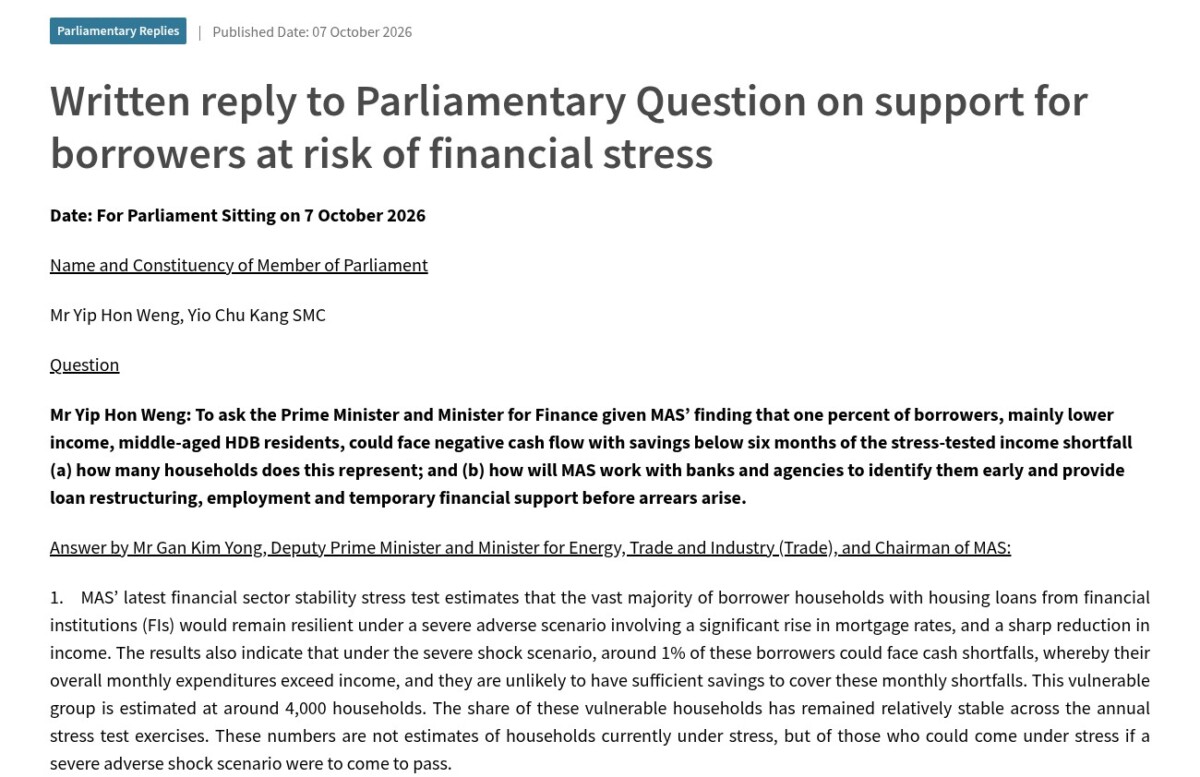
That is 1 per cent of borrowers with such loans. Deputy Prime Minister Gan Kim Yong, who chairs MAS, gave the figure in answer to Yio Chu Kang MP Yip Hon Weng, who had asked how many households sat behind MAS’s finding that 1 per cent of borrowers could face negative cash flow.
What the 4,000 figure measures
The number comes from MAS’s latest financial stability stress test, which runs a severe adverse scenario of a significant rise in mortgage rates and a sharp fall in income. Under that scenario, MAS counts a household as vulnerable when its monthly spending exceeds its income and it is unlikely to have enough savings to cover the gap.
The figure is not an estimate of households under stress now, but of those that could come under stress if the severe scenario happened. The share has stayed relatively stable across the annual stress tests, and the vast majority of borrower households would remain resilient under the scenario.
The count covers loans from financial institutions, not HDB concessionary loans. 60 per cent of HDB households with outstanding loans hold HDB concessionary loans. Those loans are pegged to the CPF Ordinary Account interest rate rather than to market rates.
Where rates stand now
Three-month compounded SORA, a key benchmark for domestic loans, stands at 1.2 per cent. Its 10-year average is 1.5 per cent.
The 10-year Singapore Government Securities yield stood at 2.5 per cent, against a 10-year average of 2.2 per cent. Its discount to the 10-year US Treasury yield widened from 170 basis points in January 2025 to 250 basis points in September 2026.
The buffers built into every loan
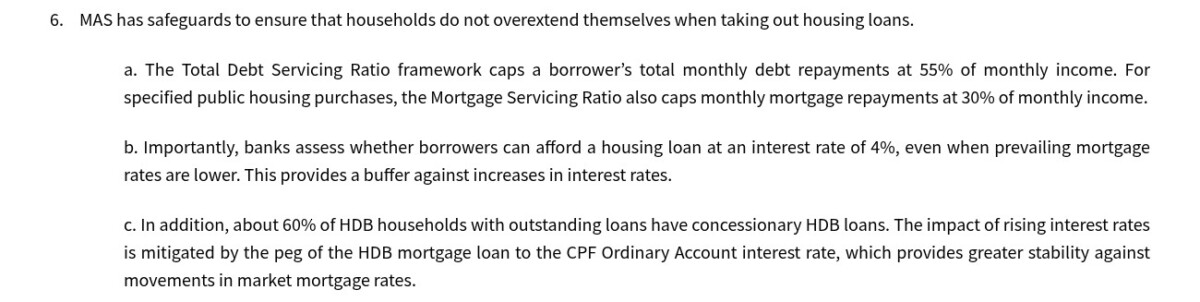
Three safeguards sit behind every loan. The Total Debt Servicing Ratio caps a borrower’s total monthly debt repayments at 55 per cent of monthly income. For specified public housing purchases, the Mortgage Servicing Ratio caps the monthly mortgage repayment at 30 per cent of income. And banks assess whether a borrower can afford the loan at an interest rate of 4 per cent, even when actual mortgage rates are lower.
On a S$500,000 bank loan for an HDB flat over 25 years, the monthly instalment at the 4 per cent assessment rate is S$2,639. Under the 30 per cent Mortgage Servicing Ratio, that needs a monthly household income of at least S$8,797.
The 4 per cent test is a buffer against rate increases. A borrower approved today has been assessed at a rate more than three times the current 1.2 per cent SORA benchmark.
Where borrowers can go
Financial institutions monitor repayments and engage borrowers who show signs of stress early. HDB homeowners who fall behind can ask HDB, if they took an HDB loan, or their bank, if they took a bank loan, to discuss restructuring, and HDB can refer them to social service agencies. Borrowers already in debt difficulty can approach Credit Counselling Singapore.
The macroeconomic outlook remains highly uncertain, including for global and domestic interest rates. MAS’s advice to households is to exercise prudence in taking on debt, borrow within their means, keep adequate savings and liquidity buffers, and factor in the possibility of higher interest rates.