
Primary 1 registration changes that add places for children with no ties to a school will start with the 2027 exercise as planned, with no deferral and no transition period. The Ministry of Education reply in Parliament on 7 October answered questions from nine MPs, two of whom had asked for a one-year delay or a three-year transition.
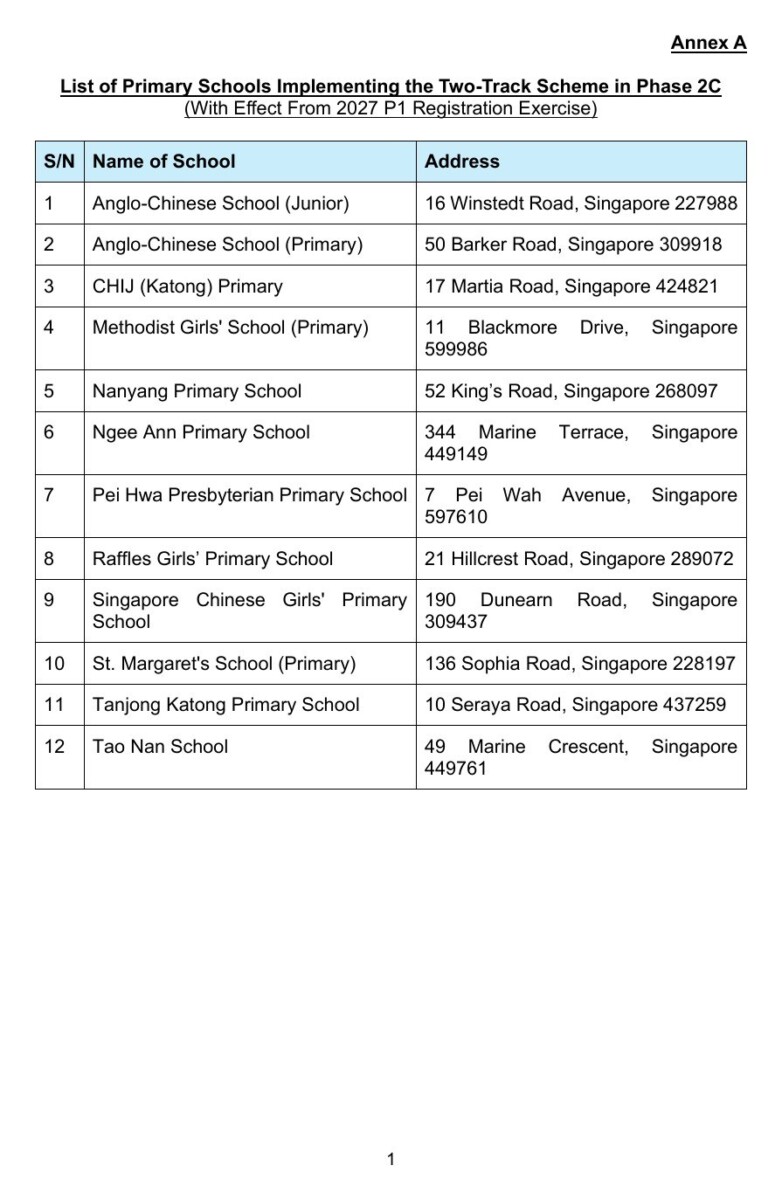
The two changes were announced on 10 September. Phase 2C, which is open to all children regardless of prior connection to a school, will have 60 reserved places instead of 40. Twelve schools will also split their Phase 2C places into two tracks by home-school distance.
Why will the changes not be delayed?
MOE recognised that some families had made housing arrangements based on the existing framework. More families would benefit the sooner the changes took effect, and some parents had asked why the changes were not made in time for the 2026 exercise.
So the revised framework applies to children registering for Primary 1 in 2027. Small-intake schools with fewer than 180 Primary 1 places keep 40 reserved places in Phase 2C.
What stays the same?
Phases 1, 2A and 2B do not change. MOE decided to focus on Phase 2C and not make structural changes to Phases 2A and 2B for now, so alumni, school partners and community volunteers keep their existing priority.
The Parent Volunteer Scheme in Phase 2B is unchanged, and schools still decide whether and how to run it. Children in an MOE Kindergarten inside a primary school keep their Phase 2A priority. Those who do not get a place in Phase 2A can still apply in later phases, including Phase 2C. Most MOE Kindergarten children have secured a place in their preferred school.
Phase 2C Supplementary and Phase 3, for international students, are also unchanged. Balloting still applies in any phase from 2A to 2C Supplementary when applicants outnumber places.
How were the 12 two-track schools chosen?
The Two-Track Scheme applies to schools where public housing makes up less than 40 per cent of dwelling units within 2km. At these schools, Phase 2C places are split equally between children living within 2km and children living beyond 2km. Permanent resident children are considered only after all Singapore Citizen children in both tracks are admitted.
The share of public housing was chosen because it is simple, easier to run and gives parents more certainty, since the housing make-up of an area does not change often. The 2km line keeps access for children near the school while opening places to families further away. The aim is to widen access rather than reserve places for particular groups, so there is no priority for children in rental flats.
The 12 schools are:
- Anglo-Chinese School (Junior)
- Anglo-Chinese School (Primary)
- CHIJ (Katong) Primary
- Methodist Girls’ School (Primary)
- Nanyang Primary School
- Ngee Ann Primary School
- Pei Hwa Presbyterian Primary School
- Raffles Girls’ Primary School
- Singapore Chinese Girls’ Primary School
- St. Margaret’s School (Primary)
- Tanjong Katong Primary School
- Tao Nan School
The same 40 per cent test was applied to CHIJ (Katong) Primary and Ngee Ann Primary, which are on the list although there are HDB estates within 1km.
How will children living further away get to school?
Many of the 12 schools are reachable by MRT or major bus routes, and school bus operators will set routes and pick-up points based on demand. Singapore Citizen students in need can get financial help from MOE, including subsidies for public transport and school bus fares.
The two changes will not on their own produce a more diverse mix of pupils, because parents’ preferences and school choices matter too. MOE will monitor how the changes work and keep the framework under review.