
Start every workout with 5 to 10 minutes of warm-up exercises, such as dynamic stretching or jogging on the spot, and end with 5 to 10 minutes of cool-down stretches. That is the advice in HealthHub’s 20-minute home workout guide. If you are unsure whether your body is ready, the guide says, check with a health professional first.
What a warm-up does
HealthHub’s Healthy Ageing Hub, from the Health Promotion Board and aimed at adults aged 50 and older, says a warm-up gradually raises body temperature, heart rate and blood circulation through the muscles, tendons and ligaments. A SingHealth guide by Changi General Hospital’s Department of Sport and Exercise Medicine adds that a proper warm-up improves flexibility and reduces the risk of sudden muscle strains or joint sprains, which often happen with cold muscles and joints.
HealthHub’s simplest version is to do your activity at a slower speed or lower intensity, such as a brisk walk before a jog. The SingHealth guide adds dynamic movements such as leg swings, side steps, gentle lunges and arm circles.
A simple march on the spot
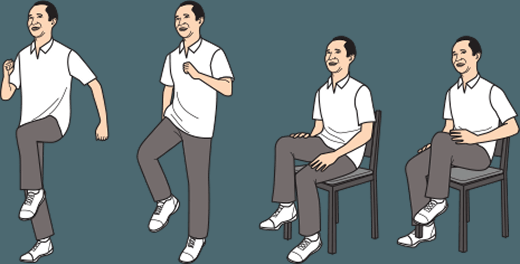
The Healthy Ageing Hub’s warm-up is a stationary march. Stand tall, march slowly on the spot at your own pace, lift your knees slightly higher and swing your arms for one minute. Do three sets. That is about three minutes, so treat it as a start within the 5 to 10 minute window, not a replacement for it.
How to cool down
After exercise, HealthHub says to cool down with gentle stretches and to drink water before, during and after your workout. Changi Sports Medicine Centre at Changi General Hospital says to take a few minutes so your heart rate can return to its resting rate, and that a light jog or walk after a run helps prevent soreness and muscle injuries. The SingHealth guide suggests stretching the calves, thighs, hips, shoulders and back, holding each stretch for 15 to 30 seconds.
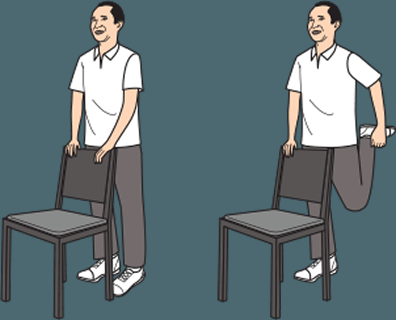
The Hub’s cool-down is a standing thigh stretch. Stand tall with one hand on a sturdy chair, hold the other leg just above the ankle and gently pull it towards your buttocks, keeping the knee pointing to the floor. Hold for 30 seconds while breathing normally, then switch legs, and do two sets. Avoid bouncing as you stretch. If you cannot reach your ankle, loop a towel just above it and hold the ends.
When to stop, and when to see a doctor
Muscle soreness is normal when you start a new routine, HealthHub says, but stop if you feel pain, because it could be a sign of injury. If you have a condition such as heart disease, high blood pressure, diabetes or asthma, check with your doctor or a fitness professional on the type, intensity and duration of activity to start with. If you feel unwell, do not exercise until you have fully recovered.
The Healthy Ageing Hub says to stop exercising immediately and seek help if you:
- feel pain or pressure in your chest, neck, shoulders or arms
- have sharp or severe joint pain
- feel dizzy or sick
- break out in a cold sweat
Dr Benedict Tan, Chief and Senior Consultant at Changi Sports Medicine Centre, Changi General Hospital, advises seeing a doctor immediately if everyday activities become difficult or an injured limb is swollen, using RICE (rest, ice, compress, elevate) while you wait. For less severe injuries, his rule of thumb is to watch the condition for two weeks and see a doctor if the symptoms persist.
This is general information, not individual medical advice. If you are unsure whether a routine suits you, ask your doctor.