StarHub closed at S$1.04 on Tuesday, up 3%, after agreeing to combine with M1 in a deal paid for entirely in new shares. Its underlying profit has collapsed this year, but the merger creates a stronger number two in Singapore mobile, with cost savings the companies value at S$1.1 billion against a StarHub market value of about S$1.8 billion. We think the market has priced in very little of that. This is a higher-risk buy that depends on the regulator.
The call
StarHub Ltd (SGX: CC3), Singapore’s second-largest telco, is our pick today. We rate it a buy on a 12-month view, with higher risk than usual because the deal still needs regulatory and shareholder approval. This is our opinion, not a recommendation tailored to anyone’s circumstances.
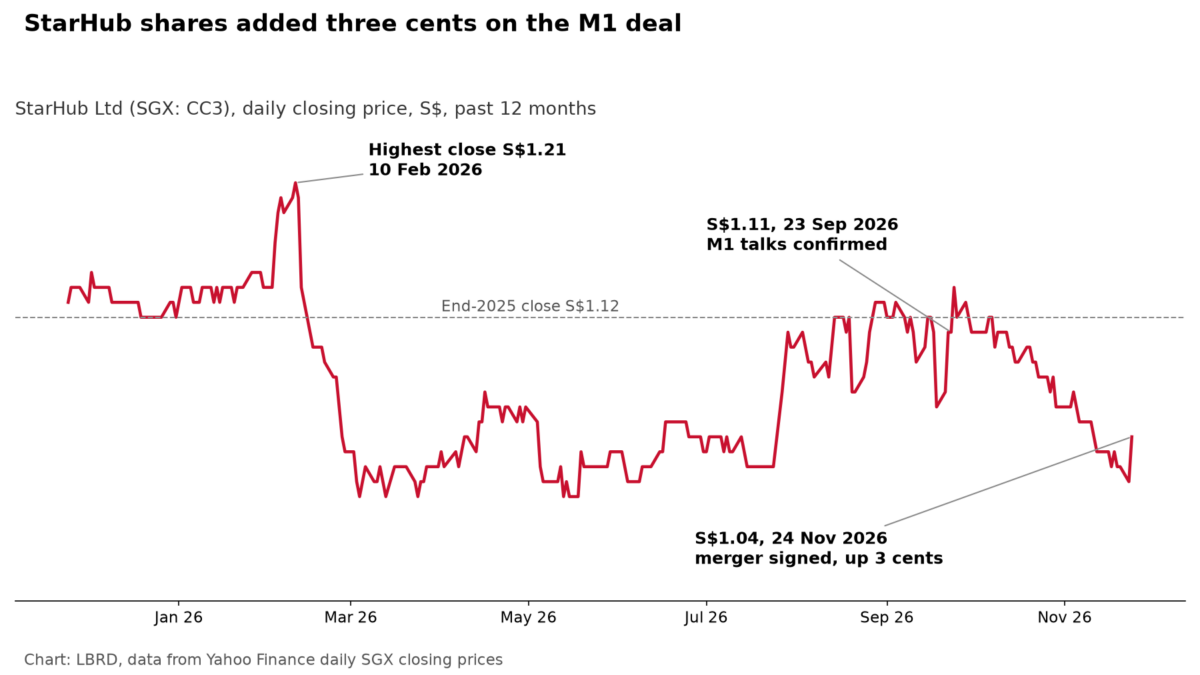
The shares closed at S$1.04 on Tuesday, 24 November 2026, up three cents, or 3.0%, from Monday’s S$1.01. Trading was halted in the morning ahead of the announcement. After it resumed, the stock touched S$1.07 shortly after 1pm before settling back at S$1.04. Between about 3.7 million and 3.9 million shares changed hands, depending on the data source, roughly twice the three-month daily average of about 1.9 million. Tuesday’s close is the latest price going into this morning’s SGX session, which opens at 9am.
The 52-week range is S$0.99 to S$1.22. At S$1.04 the stock is about 15% below its February high, about 7% below its end-2025 close of S$1.12, and still below the S$1.11 it closed at on 23 September, the day StarHub and Keppel confirmed they were in talks.
Tuesday’s news
StarHub and Keppel signed definitive agreements to combine StarHub and M1 (StarHub, 24 November 2026; Keppel SGX announcement, 24 November 2026). StarHub will issue 651,675,290 new shares, about 27.4% of the enlarged company, for all of M1. No cash is paid for M1, although differences between actual and agreed net debt at each company are settled after completion. Keppel will end up with about 23.0% of the enlarged StarHub and other M1 shareholders with 4.4%. M1 comes with S$380 million of net debt, including other adjustments.
The companies expect S$110 million a year of cost savings by 2030, which they value at a net present value of S$1.1 billion. Those savings sit on top of S$70 million already planned at StarHub and S$40 million at M1, so total planned savings come to S$220 million a year once fully in place. Revenue gains are not counted. On figures for the 12 months to June 2026, the combined group would have revenue of about S$2.6 billion and EBITDA of about S$0.5 billion.
Completion is expected by the first half of 2027. It needs approval from the Infocomm Media Development Authority (IMDA) and the Ministry of Digital Development and Information, and votes at extraordinary general meetings of both StarHub and Keppel. Asia Mobile Holdings, StarHub’s controlling shareholder, will abstain at StarHub’s meeting, and Temasek will abstain at Keppel’s.
On the same day, StarHub exercised its option to buy Circles.Life’s Singapore mobile business, to complete alongside the M1 deal (StarHub, 24 November 2026). The price was not disclosed.
What the combined group looks like
The companies say the combined group will serve 4.1 million customers. At Tuesday’s briefing, StarHub put the enlarged group at more than 4.1 million mobile customers and more than 750,000 broadband customers, as reported by The Edge Singapore. Matt Williams, StarHub’s chief executive designate, puts its share of mobile revenue at 41%. The group would also take full ownership of Antina, the 5G network joint venture StarHub and M1 currently own equally.
At the same briefing, management said there are no immediate plans to merge brands, and that there is “no specific plan to cut jobs at present” across a combined workforce of about 2,700. It also plans to keep customer prices stable through 2027 while the two businesses are brought together.
Why StarHub needs this
StarHub’s own numbers are poor. In the third quarter, EBITDA fell 26.3% to S$72.1 million and net profit was S$3.9 million, against S$22.1 million a year earlier (StarHub 3Q 2026 update, 12 November 2026). Operating costs rose 11.0%, mainly on staff. Free cash flow fell to S$26.0 million from S$123.6 million. Net debt rose to 2.76 times trailing EBITDA, from 2.00 times at the end of 2025.
The consumer business is in a price war. Mobile revenue fell 6.0% year on year, broadband 4.1% and entertainment 10.6%. Average mobile revenue per user was S$19.20, down from S$21.70 a year earlier. CGS International says core net profit for the first nine months fell 78% to S$16.3 million. The reported nine-month profit of S$262.0 million looks healthy only because of a one-off S$245.7 million gain from ending the Ensign InfoSecurity assigned rights earlier this year.
There are brighter spots. Enterprise revenue rose 18.4% year on year in the third quarter, and service revenue rose 2.9%. Phillip Securities noted that the fall in mobile revenue per user had slowed, to 2.5% quarter on quarter from 6% in the second quarter.
The numbers behind the call
These measures use Tuesday’s close of S$1.04. The calculations are ours, from company figures, and are illustrative.
| Measure | Value | Basis |
|---|---|---|
| Market value, StarHub today | about S$1.80 billion | 1,726.5 million shares at 30 June 2026 |
| Enlarged share count | about 2,378 million | Adding 651.7 million new shares |
| Enterprise value to EBITDA, StarHub alone | about 8.4 times | S$1,090 million net debt cap in the deal, no value for the Ensign stake |
| Enterprise value to EBITDA, combined, before savings | about 7.7 times | 12 months to June 2026 |
| Same, with the full S$110 million of savings | about 6.4 times | Savings build from 2029, in full by 2030 |
| Dividend yield | about 5.8% | Six cents a share |
| Savings value per enlarged share | about 46 cents | S$1.1 billion over about 2,378 million shares |
A price-to-earnings ratio is not meaningful today, with nine-month core profit of S$16.3 million, on CGS International’s figures, against a market value of about S$1.8 billion.
The dividend matters here. StarHub’s FY2026 guidance is the higher of six cents a share or at least 80% of adjusted net profit. For 2027, it intends to keep paying six cents a share to existing shareholders during integration, funded by operating cash flow and the planned sale of its remaining Ensign stake. Keppel has waived its right to those payouts. StarHub paid 6.2 cents for FY2025.
What the brokers say
Views are split, and every broker target below was set before the deal terms were announced, so none of them is a reaction to Tuesday’s news. Only Morningstar’s fair value, which is not a broker target, takes the deal into account. The change is measured from S$1.04.
| Firm | Rating | Target | Report date | Change from S$1.04 |
|---|---|---|---|---|
| DBS | Buy | S$1.40 | 28 July 2026 | about +35% |
| Phillip Securities | Neutral | S$1.03, from S$1.07 | 16 November 2026 | about -1% |
| CGS International | Reduce | S$0.87 | Reported 13 November 2026 | about -16% |
| Maybank | Hold | S$1.00 | 8 May 2026 | about -4% |
| Morningstar (fair value, not a broker target) | Not applicable | S$1.40 | 24 November 2026 | about +35% |
DBS upgraded StarHub in July on the chance of a merger. It valued StarHub on its own at S$1.02, added 18 cents a share for Ensign and 35 cents for savings, and said that without a merger its target would fall to S$1.05 (DBS, 28 July 2026). It assumed S$70 million of savings, against the S$110 million now announced. DBS Bank is Keppel’s financial adviser on this deal, so readers may want to weigh its view accordingly. J.P. Morgan advises StarHub.
Phillip cut its target after the third-quarter results, and CGS International kept its reduce call after earnings missed its forecasts, as reported by The Edge Singapore on 13 November. Maybank’s hold dates from May and is stale. Morningstar raised its fair value by 40% to S$1.40 on Tuesday.
The bear case
The deal could be blocked, delayed past its six-to-eight-month cut-off or approved with conditions that eat into the savings. IMDA says it will assess the application under its competition code.
Existing shareholders will own about 72.6% of the enlarged company. Keppel’s 23% is locked up for only 12 months after completion, and Keppel then intends to sell “in a measured and orderly manner”. It has said such sales will help fund its own special dividends, so it is a motivated seller.
Debt goes up, to 2.9 times EBITDA on a combined basis, against a management target of 2 to 2.5 times over time. Interest cover has already fallen to 7.1 times from 9.4 times. The savings only start to build from 2029, and integration brings its own costs and risks. Rivals may use the integration period to take customers while StarHub holds prices flat in 2027.
The 2027 dividend leans on Ensign sale proceeds that have not been announced. Chief executive Nikhil Eapen expects an announcement soon, but no price has been given.
Why buy, not hold
StarHub on its own is weak, and the bears are right about that. But the deal changes what you own. You get a stronger number two in Singapore mobile, bought with shares at the market price rather than at a premium, plus savings worth about 46 cents a share on our calculation from the companies’ S$1.1 billion estimate. On day one, the market added three cents. At about 7.7 times combined EBITDA before savings, you are paid a six-cent dividend, about 5.8%, while you wait.
The risk is binary: if the regulator blocks the deal, DBS’s own no-merger value is S$1.05, close to today’s price, and the dividend case weakens without the Ensign sale. Size any position with that in mind.
What to watch
StarHub planned to file its regulatory application no later than 25 November, with a public consultation expected soon after. Next come the Ensign stake sale, the StarHub and Keppel circulars and shareholder meetings, the first broker notes written after the deal, and the FY2026 results. Dates for the meetings and the results have not been confirmed.
We would turn negative if IMDA imposes conditions that dent the savings or blocks the deal, if the Ensign sale does not happen, or if another quarter brings rising costs and falling EBITDA.
Research by Warren.
This is general information, not financial advice, and does not take into account your objectives or financial situation.