
The NPHS 2025 mental health chapter has some numbers worth reading slowly. About 15.9 per cent of Singapore residents aged 18 to 74 showed signs of poor mental health, and the figure climbs to 25.8 per cent for those aged 18 to 29. At the same time, 87.5 per cent say they would seek help if they could not cope with stress.
The National Population Health Survey is run by the Ministry of Health and the Health Promotion Board, and the 2025 report came out on 3 October 2026. Household interviews took place from August 2024 to July 2025. Here is the mental health chapter in plain language.
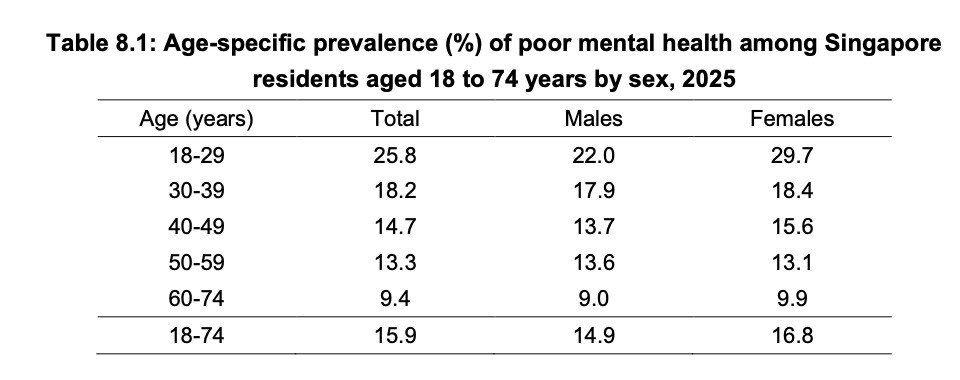
What the NPHS 2025 mental health score measures
Interviewers used the 12-item General Health Questionnaire (GHQ-12). A score of 3 or more counts as poor mental health. MOH is clear that this signals recent psychological distress, not necessarily a mental disorder.
So the 15.9 per cent is a snapshot of how many people were struggling around the time they were asked. It is not a count of diagnoses.
Who is most affected
- Age 18 to 29: 25.8 per cent, the highest of any group.
- Age 30 to 39: 18.2 per cent.
- Age 40 to 49: 14.7 per cent, then 13.3 per cent for 50 to 59.
- Age 60 to 74: 9.4 per cent, the lowest.
- Females 16.8 per cent against males 14.9 per cent, and young women aged 18 to 29 at 29.7 per cent.
By ethnic group, Indians (17.7 per cent) and Malays (17.4 per cent) had slightly higher rates than Chinese (15.2 per cent). By education, post-secondary residents were at 16.6 per cent, secondary 15.3 per cent and primary 12.1 per cent.
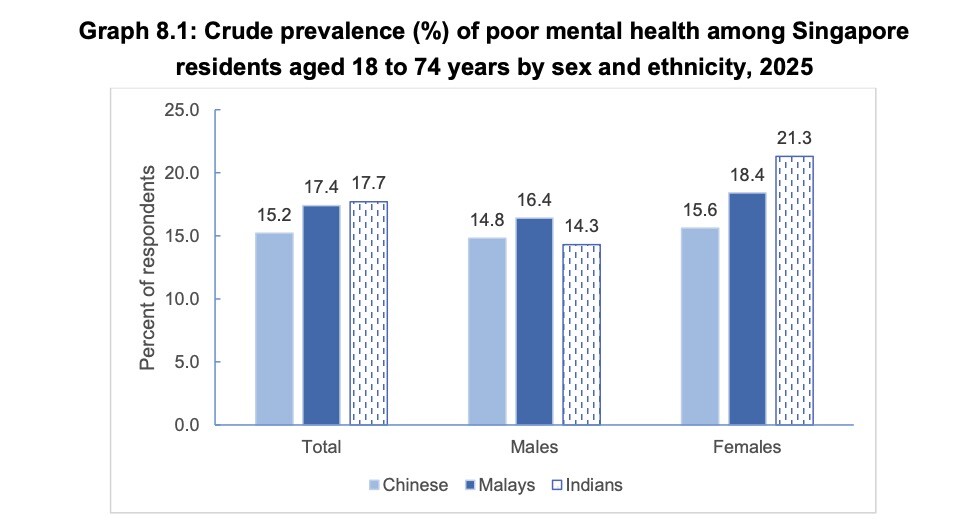
Is it getting worse?
The crude rate was 13.4 per cent in 2020 and 15.9 per cent in 2025. The report says the upward trend between those years is not statistically significant. The 2024 figure was 15.4 per cent, so the latest year is only a small step from the last.
If you are in your twenties and this sounds familiar, the numbers are a reminder that you are not the odd one out. Our guides to free helplines on PSLE results day and what happens when you call national mindline 1771 cover where to turn.
Who would you turn to for help?
The survey asked what people would do if they were constantly unable to cope with stress. Overall, 87.5 per cent said they would seek help from healthcare professionals, informal networks such as family and friends, or both. That compares with 82.3 per cent in 2019.
- Informal support networks such as family and friends: 80.9 per cent, up from 74.5 per cent in 2019.
- Healthcare professionals such as counsellors, doctors, psychologists or psychiatrists: 53.6 per cent, up from 47.8 per cent in 2019.
- Females were more willing than males to go to either: 90.4 per cent against 84.6 per cent.
- Adults aged 60 to 74 were least willing to see a healthcare professional, at 45.5 per cent. Those aged 40 to 49 were most willing, at 60.1 per cent.
- Willingness to lean on informal networks fell with age, from 86.9 per cent for 18 to 29 down to 72.2 per cent for 60 to 74.
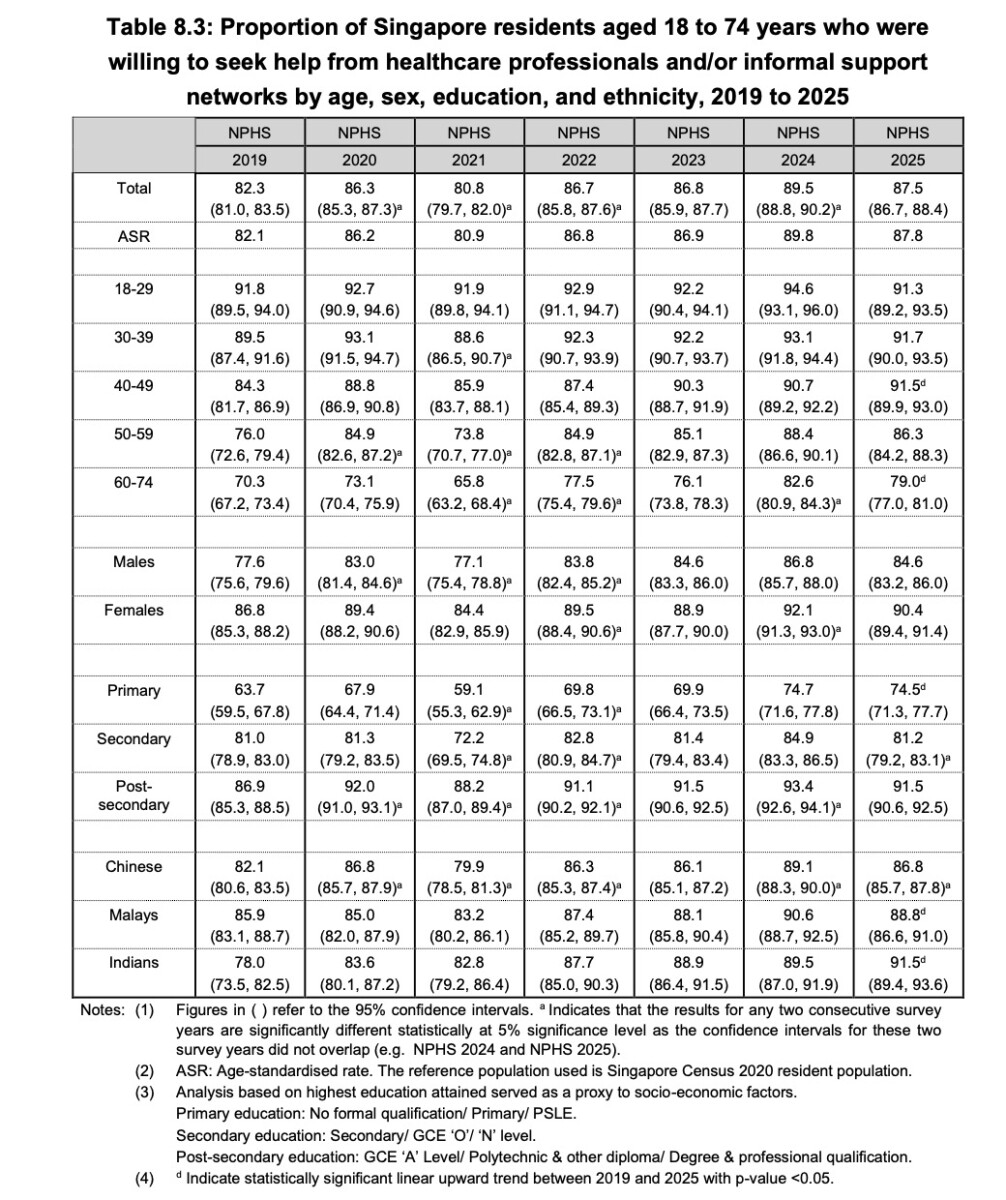
Notice the gap. Nearly nine in ten say they would reach out, yet only about half name a professional. Friends and family carry most of the load, which is good, but they are not trained to treat anxiety or depression.
What to do with this
If your mood has stayed low for a couple of weeks, a GP visit is a reasonable first step. If you or someone you know is in crisis, the Samaritans of Singapore hotline is 1767 (24 hours), and national mindline 1771 is open 24/7.
The full chapter is in the NPHS 2025 report on the MOH website, in case you want to check the age and education tables yourself. We also covered the survey’s fitness numbers in our piece on strength training and activity levels.