
PSLE results day stress tends to hit the whole household, not just the 12-year-old holding the results slip. MOE says the 2026 results come out at 11am on Tuesday 24 November or Wednesday 25 November (the exact day is still tentative), and the seven-day window for Secondary 1 school choices opens the same afternoon. That gives families about two weeks from today, 09 November 2026, to plan how they will handle the moment, whatever the score.
Below is what the official guidance from HealthHub and MOE actually suggests, plus the free helplines worth saving in your phone now, with their real opening hours.
PSLE results day stress: the dates that drive it
Part of the tension comes from how compressed the timeline is. According to MOE’s S1 posting page:
- Results are released at 11am on 24 or 25 November 2026 (tentative).
- Online school choice submission opens at 11.30am on results day and runs for seven calendar days, closing at 4.30pm on the last day.
- Parents submit six school choices, and the S1 Portal stays open 24 hours a day during that period.
- Secondary 1 posting results are expected on Friday 18 December 2026 (tentative).
- If a parent cannot go, a nominated adult can collect the results with a proxy form.
We covered the mechanics in our PSLE results and S1 choices guide. This piece is about the emotional side, which is the bit most of us improvise.
What to say, and what not to say
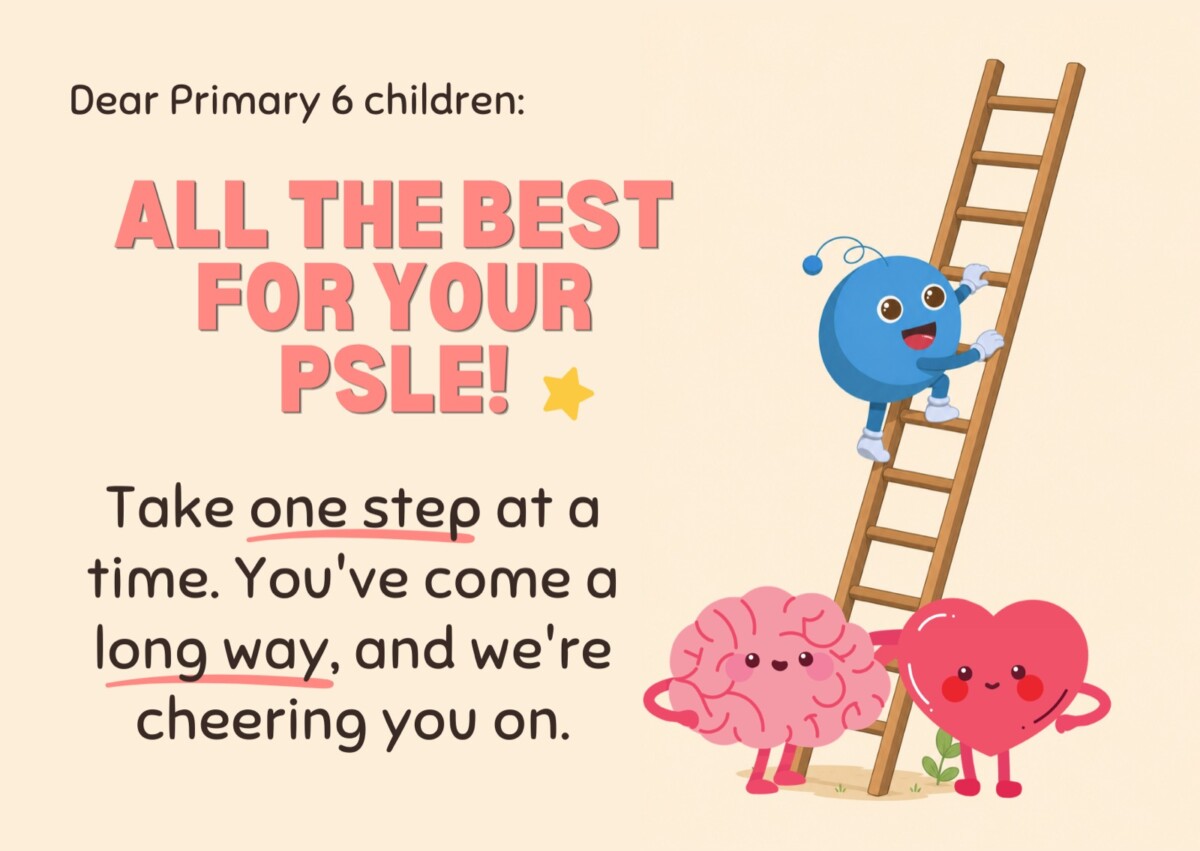
HealthHub’s exam guidance is refreshingly simple. Let your child talk about how they did, and steer them away from dwelling on mistakes or comparing scores with classmates. If the result is disappointing, remind them that other opportunities exist and talk through what to do differently next time.
The single line HealthHub suggests parents actually say out loud is that you are proud of them, and that your love stays the same regardless of the outcome. It sounds obvious, but in the kiasu rush of comparing notes on the class WhatsApp group, it is easy to skip.
Starters that open a conversation
HealthHub’s MindSG pages suggest starting casually rather than with a debrief. Something like “It seems like you are looking a little stressed, how was your day?” works better than “So what did you get for Maths?”. The advice is to listen without lecturing and resist the urge to fix things on the spot.
Things that tend to backfire
- Comparing your child’s score with siblings, cousins or friends.
- Toxic positivity, which HealthHub describes as brushing aside sadness or anger instead of acknowledging it.
- Booking the next round of tuition or enrichment that same evening.
- Making the school choice discussion the first thing you talk about after the results.
MOE has made a similar point in Parliament, describing the PSLE as a learning checkpoint and asking parents to model a focus on learning and self-improvement rather than grades and outperforming others. Its reply on PSLE pressure also points parents to the Parenting for Wellness resources.
Practical ways to lower the temperature at home
The HealthHub MindSG guide on children’s stress lists a handful of concrete habits that help in the days around results:
- Protect sleep. HealthHub recommends 9 to 11 hours a night for children, which matters more than another late-night discussion of cut-off points.
- Build in breaks, such as a short walk, a nap or reading for fun.
- Move together, even a 10-minute walk or dancing along to a video.
- Try deep breathing, progressive muscle relaxation or guided imagery, which mindline.sg also offers as free self-help tools.
- Help your child name what they feel, using HealthHub’s emotions explorer and feelings tracker.
- Show how you manage your own stress, since children pick up on it quickly.
Our honest take: plan something low-key and fun for results evening that does not depend on the score. A simple dinner out or a lepak session at the park signals that the day is about more than a number.
Free helplines to save before results day
These are all free, and the hours below are taken from each organisation’s own website. It is worth checking them again closer to the date.
For your child: Tinkle Friend
Run by the Singapore Children’s Society, Tinkle Friend supports primary school children aged 13 and below. The helpline at 1800-2744-788 is open Monday to Friday, 2.30pm to 5pm. Online chat runs Monday to Thursday from 2.30pm to 7pm, and Fridays from 2.30pm to 5pm. It is closed on weekends and public holidays, including today’s Deepavali holiday, so note those gaps.
For parents and older children: mindline 1771 and SOS
- National mindline 1771: call 1771 at any hour, or WhatsApp a counsellor at 6669 1771. The mindline.sg site also has a free self-assessment and an anonymous peer support space called let’s talk.
- Samaritans of Singapore (SOS): the 24-hour hotline is 1767, and its CareText service on WhatsApp is 9151 1767, also 24 hours.
- School counsellors: HealthHub encourages older children to approach their school counsellor, and to see that seeking help is not a sign of weakness.
- In an emergency or if someone is in immediate danger, call 995 or 999.
If you want to know what a call to 1771 sounds like before you need it, our earlier piece on what happens when you dial mindline 1771 walks through it.
Look after yourself too
HealthHub is blunt that parents who skip their own self-care find it harder to support their child. With Singapore families now spending far more on tuition than a decade ago, as an IPS study on tuition spending found, a lot of parental stress is tied up in the result too. If you notice you are the one losing sleep, mindline 1771 is there for you as well.
Save the numbers today, agree on a plan with your partner or co-parent, and keep the evening of 24 or 25 November free for your child rather than for spreadsheets of cut-off points.