Selling or advertising a non-compliant e-scooter or power-assisted bicycle online will become an offence, and so will fitting a battery that was not tested with the device, under the Land Transport and Related Matters (No. 2) Bill that went through its second reading in Parliament on Wednesday, 7 October. The same Bill raises the maximum fine for illegal ride-hail drivers from S$3,000 to S$10,000, the Ministry of Transport (MOT) said.
Minister of State for Transport Baey Yam Keng said the online sales, advertising and battery rules are due to start in the second quarter of 2027.
Online listings get the shop rules
The Active Mobility Act’s rules for retailers were written mainly for physical shops. The Bill extends them to online sales and advertising. Selling or advertising a non-compliant active mobility device online becomes an offence, and sellers must put warning notices on device listings that set out the device and usage rules.
The rules cover listings and adverts that originate in Singapore, or that are made by a Singapore-connected person and can be seen here. Mr Baey said they cannot reach foreign-based sellers with no Singapore presence, and that import controls remain the main safeguard against those.
LTA will be able to direct sellers to amend or remove offending listings. In his round-up speech, Mr Baey said the Bill lets LTA require platforms to hand over information on sellers, but does not give it a general power to order platforms to take listings down. Platforms do not have to pre-screen listings, but must not knowingly take part in publishing unlawful adverts.
The Bill also makes it an offence to misrepresent a device or battery, such as passing off a non-compliant device as compliant, and bans adverts for illegal modification services.
The battery catch
The battery rule reaches people who already own a device. Fitting or using a non-compatible battery in a power-assisted bicycle, motorised personal mobility device or mobility vehicle will be banned.
Compatibility is not whatever the seller says. For PMDs and power-assisted bicycles, Mr Baey said a compatible battery is one fitted into and tested with that device model to the prescribed safety standards, or another battery of the same brand and model. Third-party batteries can qualify only if they are tested together with the device model. For mobility scooters and motorised wheelchairs, the manufacturer must install or endorse the battery.
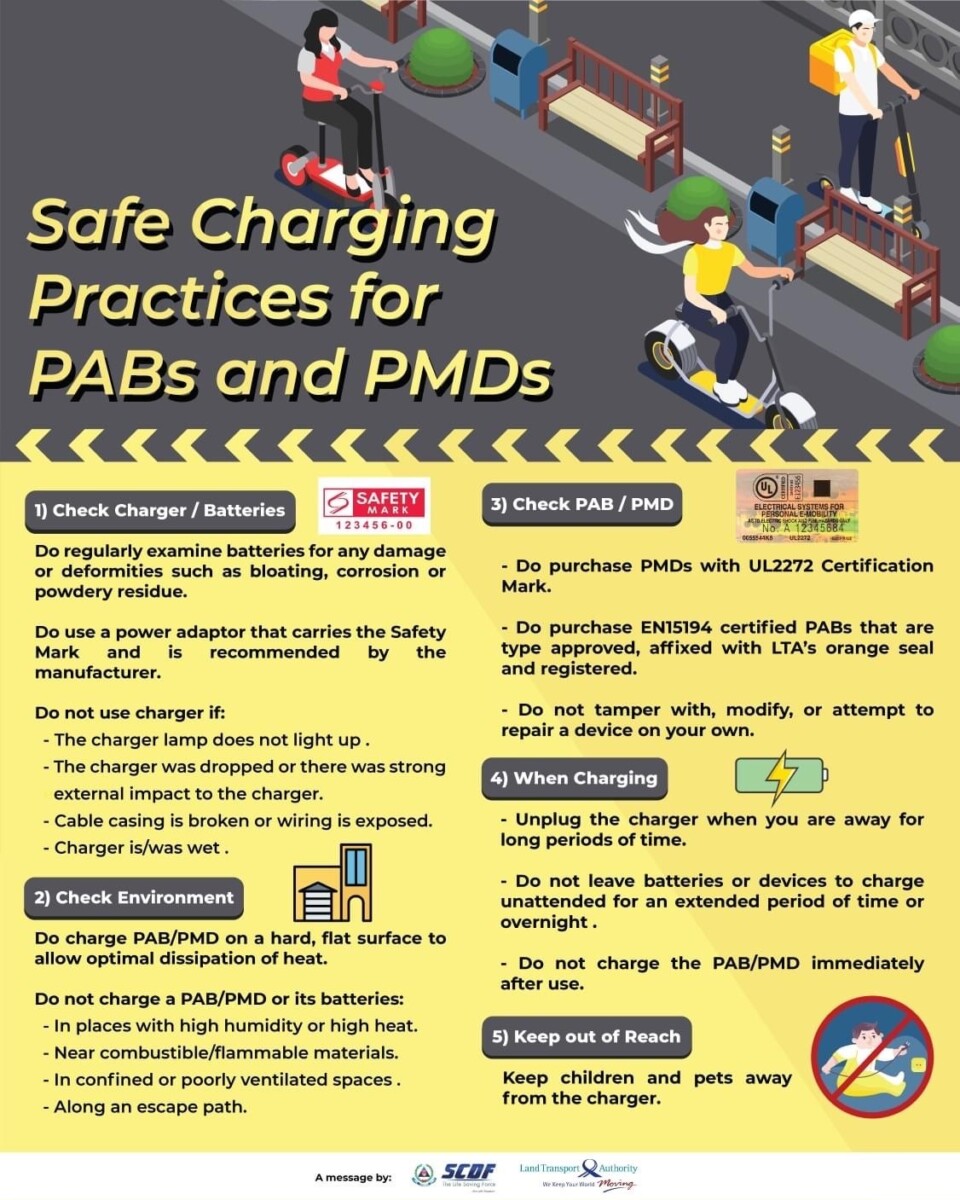
Sellers will have to display the battery’s compatibility, voltage and capacity, and may not sell a battery knowing it will go into a non-compatible device. LTA already publishes a list of compatible batteries for approved power-assisted bicycle models and plans similar lists for whitelisted e-scooter and mobility scooter models before the rules start.
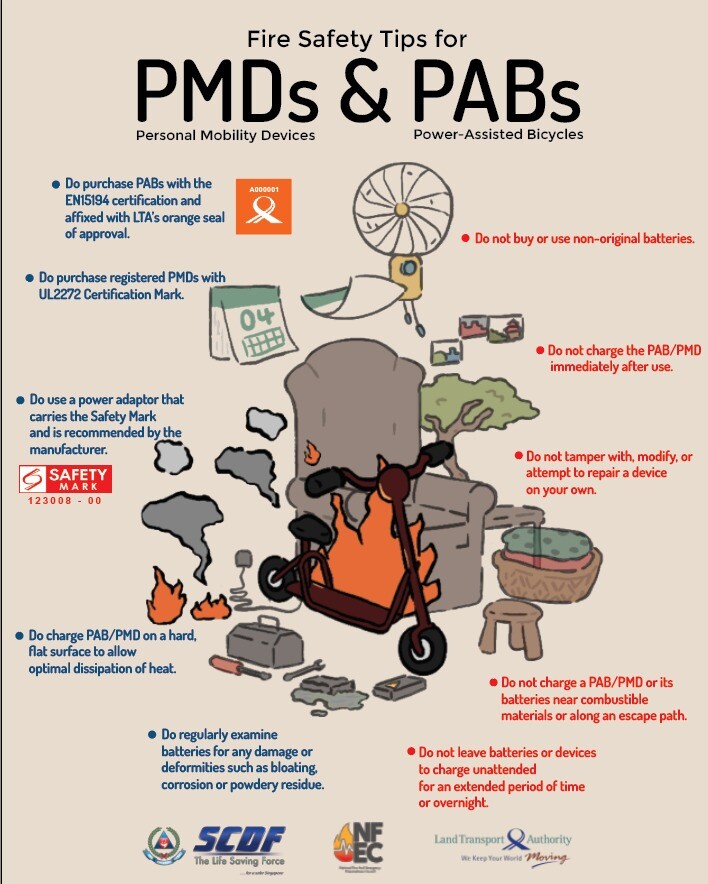
Mr Baey cited 55 active mobility device fires in 2023, 67 in 2024 and 49 in 2025. A non-compatible battery already voids a device’s safety certification today, and Mr Baey said the Government does not plan to subsidise replacements or offer trade-ins.
Older e-bikes and illegal imports
From 1 January 2028, Blue Seal power-assisted bicycles, approved before the EN15194 standard became mandatory in 2016, can no longer be kept or used. Those bicycles are now at least 10 years old.
The maximum penalty for an individual who illegally imports a power-assisted bicycle or motorised PMD doubles, from a S$5,000 fine, six months’ jail or both, to S$10,000, 12 months or both. For companies, the maximum fine rises from S$10,000 to S$40,000. MOT said this starts later this year.
Illegal ride-hail, and who it hits
Beyond the higher fine for drivers, publishing adverts for illegal point-to-point rides becomes an offence, including forwarding and sharing them on messaging apps. Mr Baey said someone forwarding such an advert commits an offence if they knew the service was unlawful, or went ahead despite signs that it might be.
LTA will be able to order advertisers to take adverts down and require platforms to identify them. It has impounded around 240 vehicles since July 2025, and the period before a seized vehicle must be released without prosecution goes from one month to three, because investigations take three to four months.
There is no specific penalty for passengers for now. Mr Baey said the Government may introduce one in future.