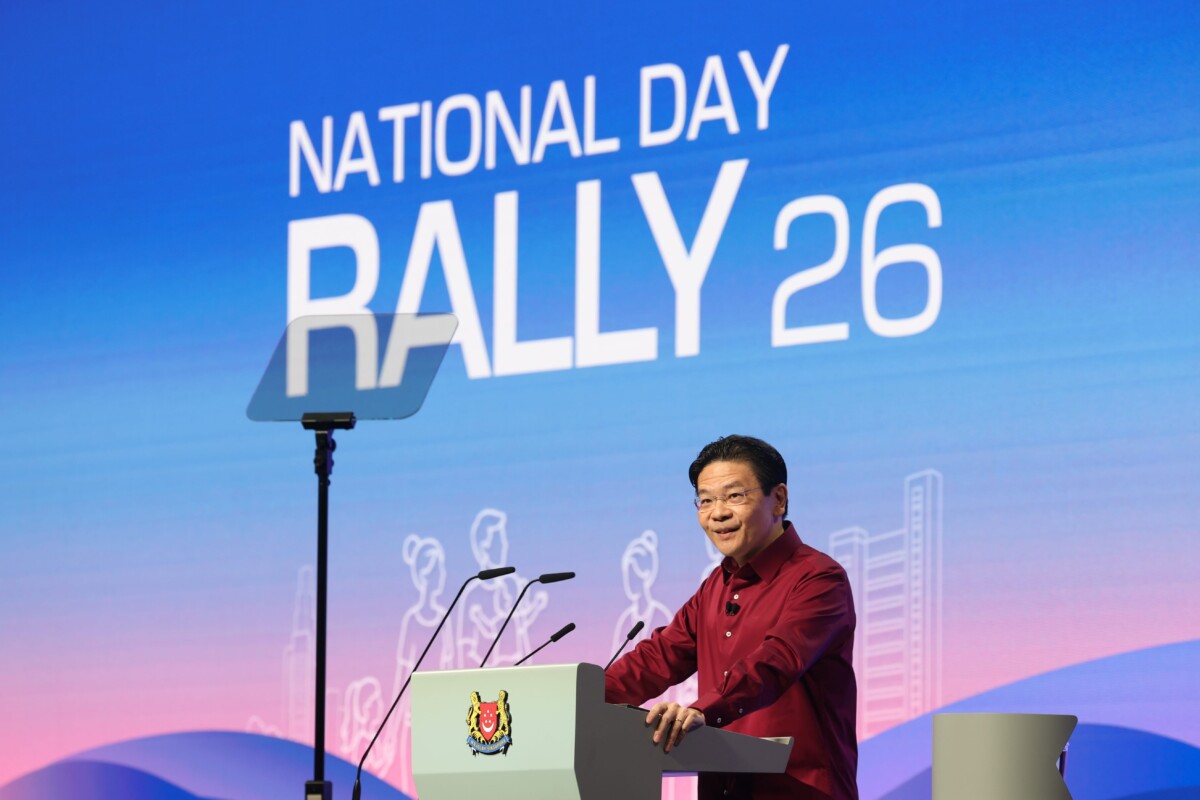
The most telling line about autonomous vehicles Singapore has produced so far came from a Punggol resident, not an engineer. PM Lawrence Wong played the clip at the National Day Rally on 23 August 2026. Residents were not asking whether the driverless shuttles were safe. They were asking for more routes, more pick-up points, and 24-hour service so they could go eat prata.
That is a nice problem to have. It is also the reason LTA changed the plan last month.
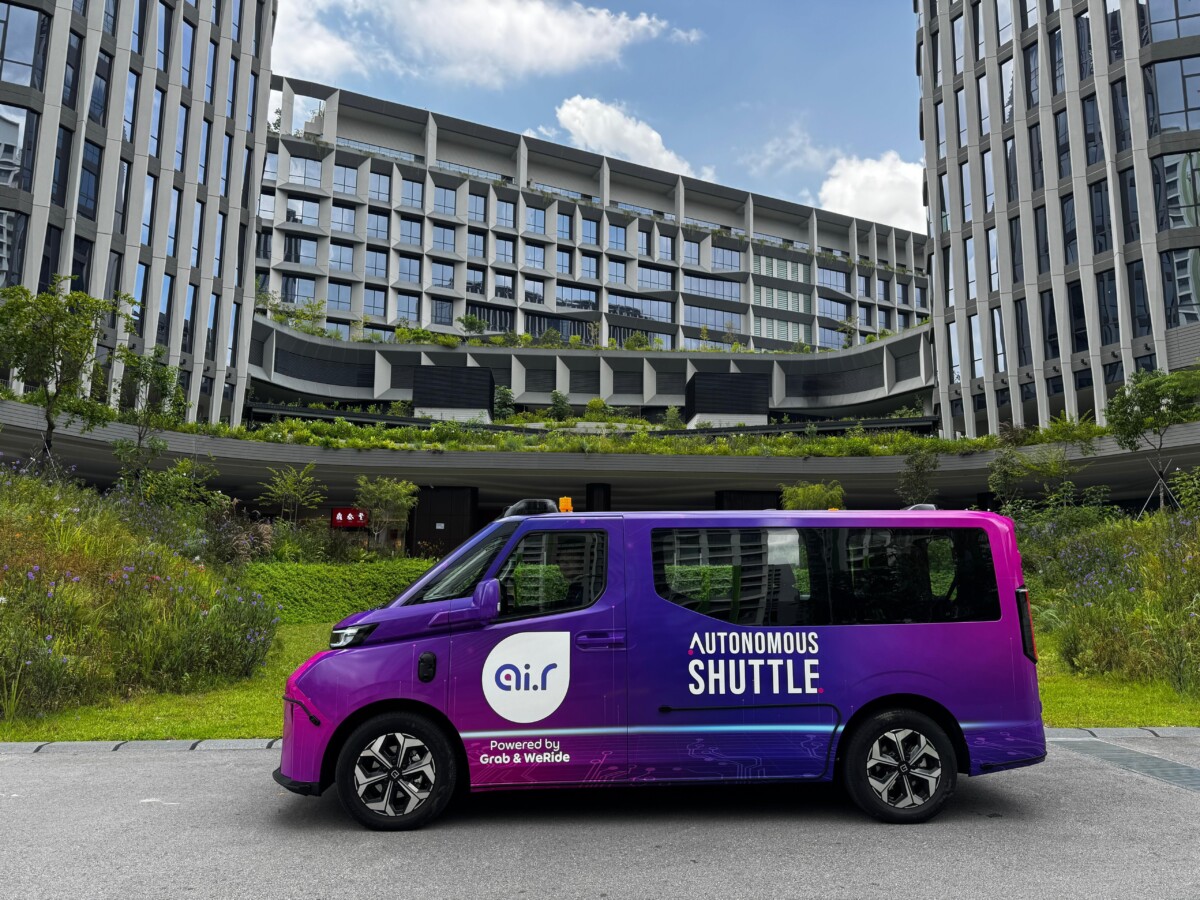
What is actually running in Punggol right now
Sixteen fixed-route autonomous shuttles, purple, five to eight seats each, with an amber beacon on the roof and the words Autonomous Shuttle on the side. They went on the road in September 2025 for mapping, opened to invited residents in January 2026, and opened to anyone who registered from 1 April 2026.
- Route 1: Grab on the WeRide platform, 10km round trip. Matilda Court and Punggol Clover to Oasis Terraces polyclinic and Punggol Plaza market. About 35 minutes, saving up to 10.
- Route 2: ComfortDelGro on Pony.ai, 12km. Punggol Northshore and Waterway Sunrise to Oasis Terraces, Punggol Plaza, One Punggol and Punggol Coast MRT. About 55 minutes, saving up to 15.
- Route 3: Grab on WeRide, 12km round trip. Matilda Court and Punggol Clover up to northern Punggol, Punggol Coast MRT and the One Punggol hawker centre.
Rides are still free. A flat $4 fare was announced for mid-2026 revenue service, but as of LTA’s 29 July 2026 update that had not started. There is a safety operator on board at all times, and there will be through the trial and into commercial operation.
Uptake has been quick. Over 11,500 unique riders as at 12 July 2026, up from around 740 in early March. Of roughly 900 people surveyed after a ride in July, 99 per cent said they felt safe and would recommend it.
Fixed routes are being replaced with on-demand
LTA said the quiet part out loud on 29 July. The fixed-route model “cannot fully meet residents’ diverse travel needs”. Around 60 per cent of Punggol respondents wanted to choose their own boarding and alighting points, and about 40 per cent wanted more direct routes.
So Grab will pilot an on-demand, direct-routing service between any existing Route 1 or Route 3 pick-up and drop-off point. LTA expects it to start “in the next few months”. Revenue service now begins only when that on-demand service opens to the public, which is a sensible sequencing decision.
Driverless public buses are next
LTA awarded a roughly $8.14 million, three-year contract in October 2025 to a consortium of MKX Technologies, Zhidao Network Technology and BYD Singapore. Six electric autonomous buses with 16 passenger seats each, with an option for up to 14 more.
- Service 400 around Marina Bay, and Service 191 at one-north
- Operated by SBS Transit, running alongside manned buses as a hybrid fleet
- Normal public bus fares, no premium
- Safety operator on board first, then a remote operator in a control centre with a customer service officer on the bus instead
Timing has softened. The original line was second half of 2026. MOT’s own page as at 31 July said “piloted by end 2026”. LTA has been consistently upfront that AV bus technology is less mature than AV cars, that current models carry fewer passengers than a standard bus, and that accessibility for elderly passengers, prams and wheelchair users still has to be worked through.
Beyond Punggol, the towns and areas under consideration are Tengah, Sentosa, Tuas and Mandai. Nothing is confirmed, and no target date or vehicle count for island-wide deployment has been published. As Acting Minister Jeffrey Siow put it, there are fewer than 7,000 such AVs in the world today.
What has to happen before an AV touches a public road
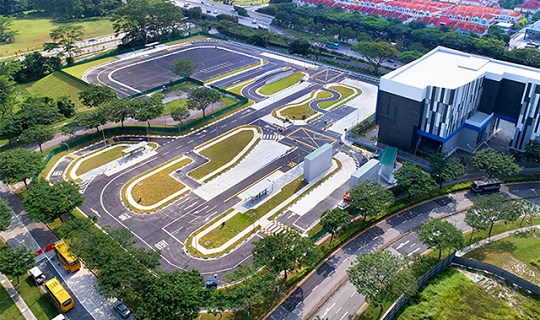
Every AV must pass safety assessments at CETRAN, the two-hectare test centre at NTU that opened in November 2017 and replicates Singapore road conditions. LTA and CETRAN developed those assessments with input from Traffic Police.
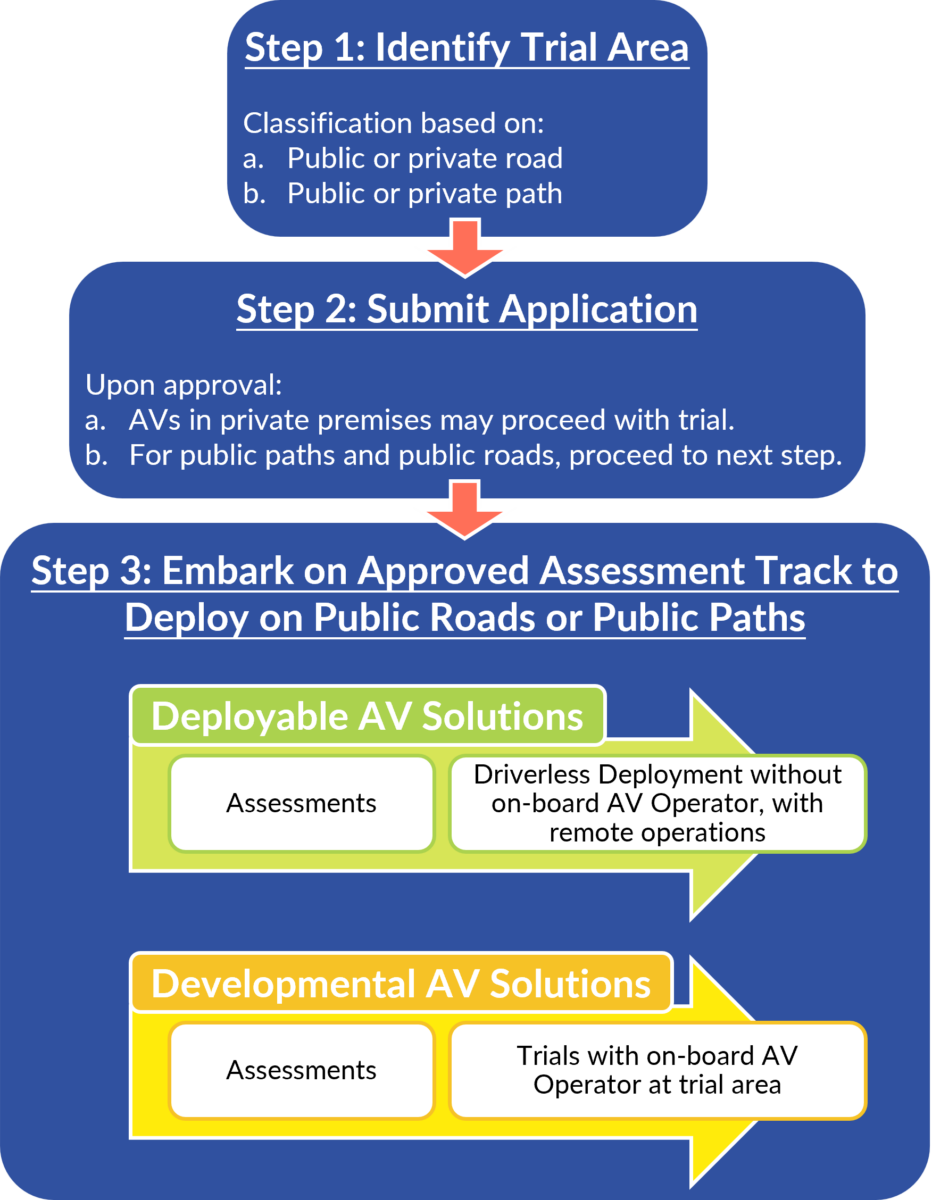
The framework splits into two tracks. Track 2 is developmental, where an AV operator stays on board. Track 1 is for deployable solutions and needs a viable use case plus at least a year of multi-AV track record, followed by a closed-circuit test, a stakeholder demonstration, a remote operations assessment and a deployment readiness assessment.
Non-negotiables include comprehensive third-party liability insurance, a black-box data recorder, the blinking amber beacon whenever the vehicle is in autonomous mode, and an AV on trial decal.
A dedicated AV Act is being drafted, together with an AV cybersecurity framework covering technical approval, remote operations, software controls, monitoring and incident management. Senior Minister of State Sun Xueling set that out at the ITS Summit on 28 July 2026. It has not been tabled yet.
The one incident, and what it revealed
On 17 January 2026 a ComfortDelGro AV under road test clipped a road divider at Edgedale Plains in Punggol. No passengers were on board.
LTA’s review found the vehicle behaved correctly. It detected an object off the road and moved into the adjacent lane as a precaution. Simulation showed it would likely have completed the manoeuvre safely had the safety officer not taken manual control partway through, which exited autonomous mode. LTA imposed a safety timeout, reviewed the intervention procedures jointly, and familiarisation resumed on 30 January.
Awkward finding, published anyway. That is the part that should build confidence.
What happens to the drivers
This is the part PM Wong spent the most time on. Two-thirds of Singapore’s taxi drivers are already 60 or above, and bus captains are getting hard to recruit. For every local bus captain hired, two leave. The local share of bus captains fell from 54 per cent in 2021 to 41 per cent in 2025.
MOT announced a Manpower Transition Package on 7 July 2026 with MOM, NTUC, Grab and ComfortDelGro:
- A new Career Conversion Programme for AV specialists, covering safety operators, remote operators and fleet management, with up to 90 per cent salary support to employers. GrabAcademy is a registered training provider. Launching in the third quarter of 2026.
- A customised pathway under the Career Conversion Programme for Public Transport Professionals, turning drivers into bus captains.
- A training incentive from January 2027, running three years: $20 an hour, capped at 80 hours, so up to $1,600 per driver, across roughly 2,000 short courses. It is designed to offset vehicle rental and lost income while training.
Separately, from 1 January 2027 starting salaries for new local bus captains rise by $450 a month, with $2,000 more in first-year sign-on bonuses. Most new local bus captains should earn around $600 more per month in year one, with average monthly pay above $4,000.
The resource page is at go.gov.sg/av-transition-package. For a sense of what else is on offer, our guide to SkillsFuture in 2026 covers the credits and allowances these programmes sit alongside.
Where this actually lands
Singapore recorded 149 road deaths in 2025, a 10-year high. Sun Xueling framed AVs partly as a road safety play, since a computer does not speed, run a red light or drive after drinking.
MOT expects a human in the loop for a long time yet. Nobody in government is promising an empty driver’s seat by a particular year. If you live in Punggol, the near-term change is that you will soon be able to pick your own stop instead of waiting at a fixed one. Everywhere else, it is still a waiting game.
If you are curious enough to try it, the shuttles pass One Punggol, and our write-up of the cafe inside the library there makes a decent excuse for the trip.