Business Adaptation Grant Singapore is worth a closer look if it affects your plans this month. Here is the practical Singapore angle, with the official details, location notes and decision points pulled into one reader-friendly guide.
Who The Grant Is For
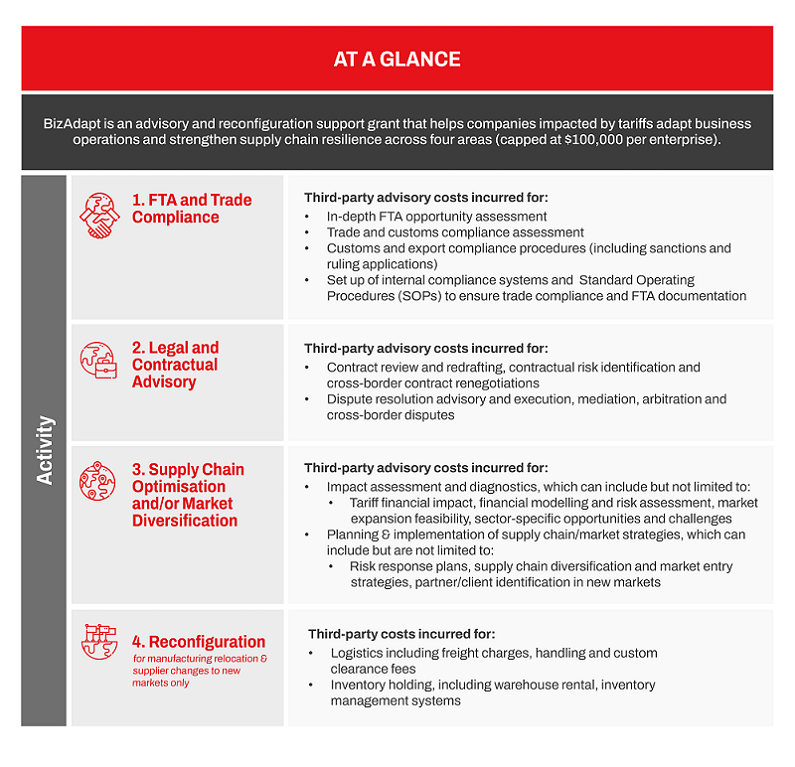
The Business Adaptation Grant Singapore companies are now looking at is aimed at firms dealing with the impact of higher US tariffs and related trade disruption. Enterprise Singapore describes the scheme as support for businesses that need to adjust markets, supply chains, operations or documentation because the external trading environment has changed.
For an SME, the important starting point is whether the business has a real exposure to the affected trade flow. A company that exports directly to the United States, supplies a customer whose orders are being rerouted, or depends on imported inputs that have become more expensive should read the scheme differently from a company that is simply worried about headlines.
The grant is most useful when there is a specific adjustment to make: finding alternative markets, reviewing supply-chain routes, getting professional advice, changing compliance documentation, or testing a new sales channel. A vague wish to become more resilient is not enough by itself. The application should be tied to a clear business problem and a practical project.
Costs And Timing To Clarify

Before applying, SMEs should separate urgent costs from strategic costs. Urgent costs might include advisory work to understand contract exposure or tariff classification. Strategic costs might involve overseas market development or reworking supplier arrangements. Mixing everything into one broad project can make the application harder to assess and harder to manage.
Enterprise Singapore’s official page should be the final reference for support levels, qualifying costs and application mechanics. The more useful internal exercise is to prepare a one-page note before speaking to an adviser: what changed, how revenue or costs are affected, what action the company wants to take, and what outcome would count as success.
If the issue is skills rather than trade exposure, the better starting point may be training support such as the programmes covered in our SkillsFuture Roadshow At Bukit Panjang Plaza. Grants work best when the scheme matches the problem rather than when a business tries to reshape the problem around a scheme.
How To Make The Application Less Painful

Keep the project narrow enough to explain in plain language. If a director cannot describe the grant project in two minutes, the scope is probably too loose. A good version might be: a local manufacturer needs advice and market validation to shift part of its customer base from one exposed route to another, with a defined budget and timeline.
Documents matter because grant teams need evidence. Prepare recent financials where relevant, contracts or sales data that show the exposure, quotations from service providers, and a clear project plan. Do not wait until the portal asks for details before working out the story.
The grant should also be treated as partial support, not as a reason to spend money the company would otherwise avoid. If the project still makes commercial sense without support, the grant can help. If it only makes sense because someone else is paying part of the bill, the business case needs a harder look.
What SMEs Should Do This Week
Start with the Enterprise Singapore page, then speak to the company’s accountant, trade adviser or business-development lead. If the exposure is material, put numbers around it: affected revenue, changed costs, delayed shipments, customers at risk, and the estimated budget for adaptation.
For smaller firms, the best first move is often not a full application. It is a short eligibility check and a list of missing documents. That prevents a rushed submission and gives the team time to decide whether the project is grant-worthy, urgent, and operationally realistic.
The Business Adaptation Grant is a timely tool, but it is not a substitute for business judgement. Use it to support a concrete adjustment, not to postpone a decision the company already knows it has to make.
Application Checks To Do First
Business Adaptation Grant Singapore should be treated as a business project before it is treated as a form. Write down the affected product line, customer segment or supply-chain route, then attach numbers where the team has them. That gives the application a sharper commercial reason and helps the company avoid asking for support on a problem it has not properly scoped.
The strongest applications usually show that management has already compared options. For example, a company can explain why it is testing a new market instead of absorbing the cost, why it needs external advice instead of handling the issue internally, or why a documentation change has become urgent. Those are business decisions, not administrative afterthoughts.
SMEs should also decide who owns the project after approval. A grant-funded project can still fail if responsibility is split vaguely between finance, sales and operations. Name the internal lead, set a reporting rhythm, and keep quotations, invoices and project evidence in one place from the start.
Reader Notes For Business Adaptation Grant Singapore
The best way to use this information is to match it against a real plan you already have. If Business Adaptation Grant Singapore affects a purchase, booking, application, class, event visit or investment review, write down the exact decision before opening another tab. That keeps the official details grounded in your own schedule, budget and risk tolerance instead of turning the topic into casual browsing.
Singapore readers also need to account for timing. Event capacities, booking windows, promotion redemptions, registration pages and venue arrangements can change quickly, especially around public events and card-linked offers. Check the named official page on the day you act, then keep a copy of the confirmed timing, address, payment term or booking reference if money or travel plans are involved.
For the latest timings, admission details or application rules, use the official page before making a firm plan.