The call
Yangzijiang Shipbuilding (SGX: BS6), the STI constituent that builds commercial ships at yards in Jiangsu, is our pick today. The call is buy, on a 12-month horizon.
The shares closed at S$4.32 on Tuesday, 17 November 2026, down 2.5% from S$4.43 on Monday, on about 13.4 million shares. That is the latest price going into this morning’s session. The stock traded between S$4.31 and S$4.42 on the day. It closed at S$4.59 on 10 November, the day the third-quarter update came out after the bell, so the shares have fallen about 6% since.
The 52-week range is S$3.16, set on 6 February 2026, to S$5.41, an intraday high on 23 September. The highest close was S$5.26 on 22 September. At S$4.32 the stock is about 18% below that close but still about 24% up this year, from S$3.48 at the end of 2025. Market value is about S$17.0 billion on 3,935.6 million shares.
What the update said
Yangzijiang released its third-quarter business update after the market closed on 10 November (SGX: 3Q2026 Business Update, 10 November 2026). It was an operating update, with no income statement.
New orders for the ten months to 31 October came to US$6.98 billion for 87 vessels: 53 containerships, 18 oil tankers, 13 bulk carriers and three gas carriers. The target for the whole of 2026 was US$4.5 billion. At the end of July the year’s wins stood at US$1.96 billion (SGX: 1H2026 results announcement, 6 August 2026), so more than US$5 billion was signed in August, September and October alone. For comparison, the group won US$2.46 billion across 60 vessels in all of 2025.
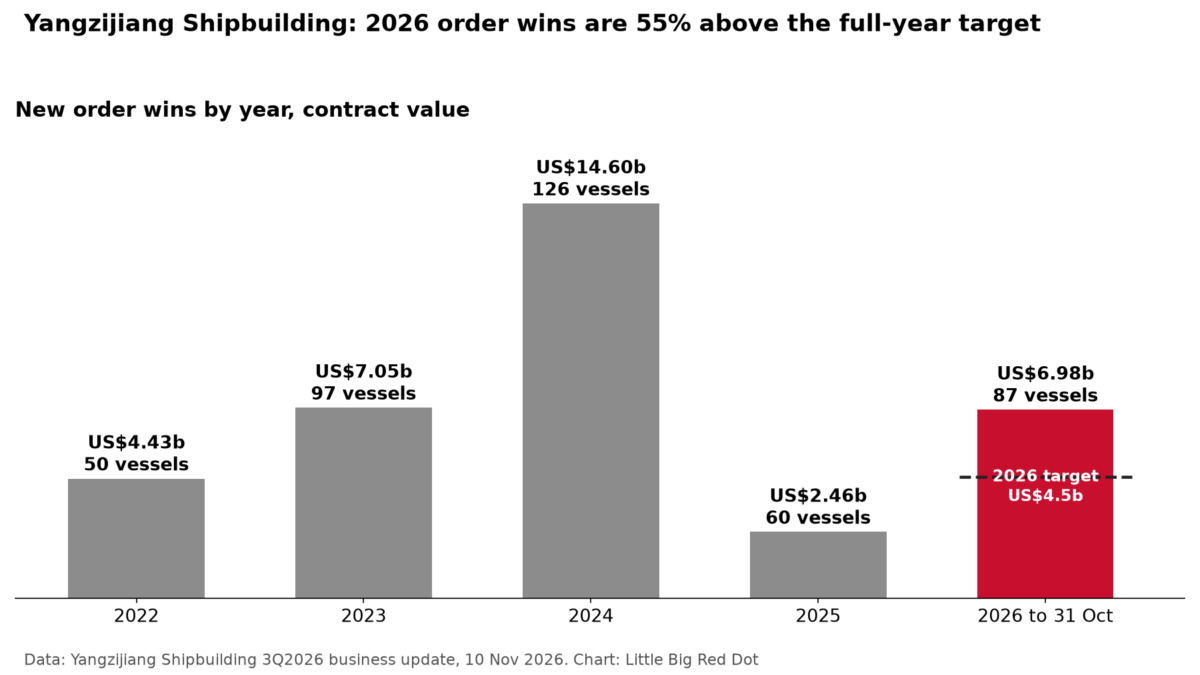
The mix improved too. The quarter brought twelve 24,000-TEU LNG dual-fuel containerships and ten 210,000-DWT bulk carriers, which DBS Group Research called the group’s “first ultra-large vessel wins since end-2024” (DBS Group Research, 11 November 2026). UOB Kay Hian says ultra-large dual-fuel containerships “typically offer YZJ the highest margins among vessel types” (UOB Kay Hian, 12 November 2026). OCBC puts the average contract value this year at about US$80 million a vessel, against US$41 million in 2025.
The orderbook reached a record US$26.3 billion for 285 vessels at 31 October, with deliveries running from 2026 to 2031. It was US$22.4 billion at 30 June. Containerships account for 173 vessels and US$19.4 billion, about 74% of the total. Oil tankers make up US$2.4 billion, bulk carriers US$2.3 billion and gas carriers and others US$2.2 billion. About 67% by value is green, dual-fuel or alternative-fuel tonnage. UOB Kay Hian reports that most 2030 slots for large vessels are taken and that the group is now opening 2031 slots.
Deliveries are on track. By 31 October, 47 of the 58 vessels targeted for 2026 had been handed over. Executive chairman and chief executive Ren Letian said: “Newbuild demand remains firm, supported by fleet renewal, the transition towards dual-fuel vessels and ongoing trade route disruptions that continue to absorb shipping capacity.”
The earnings base
The last full set of numbers is the first half. Revenue rose 36.2% to RMB17,533.8 million, gross profit rose 42.8% to RMB6,349.9 million and net profit attributable to shareholders rose 28.4% to RMB5,368.0 million (SGX: 1H2026 press release, 6 August 2026). The gross margin was 36.2%, and the shipbuilding margin a record 37.1%. OCBC says management expects that margin “to be sustained”.
The balance sheet is in net cash. At 30 June the company reported “a net cash position of RMB12.5 billion”, which is about S$2.4 billion, or roughly 14% of the market value. That was after paying RMB4,218 million in dividends and spending RMB5,629 million on a 10% stake in Poseidon Corp, the parent of Seaspan, one of the group’s main containership customers. Mr Ren now sits on Poseidon’s board, and UOB Kay Hian says talks with Seaspan on six larger containerships are continuing.
Capacity growth is already paid for. The Hongyuan yard, which adds about 20% to capacity, has started operating and should be fully running in early 2027, DBS says. An RMB2 billion LNG terminal is due in the first half of 2027.
The numbers behind the call
These measures use Tuesday’s close of S$4.32, with the yuan at about 0.1928 Singapore dollars and the US dollar at about S$1.2882 early this morning. The calculations are ours unless stated.
| Measure | Value | Basis |
|---|---|---|
| Market value | about S$17.0 billion | 3,935.6 million shares at 30 June 2026 |
| Price to earnings, trailing | about 9.0 times | Trailing net profit of about RMB9,824 million |
| Price to earnings, trailing, excluding net cash | about 7.7 times | Market value less about S$2.4 billion of net cash |
| Price to book | about 2.65 times | Net asset value of 844.04 RMB cents a share at 30 June 2026 |
| Dividend yield, trailing | about 4.6% | 20.0-cent final dividend for 2025 |
| Dividend yield, OCBC 2026 forecast | about 5.9% | 25.50 cents, a forecast rather than a declaration |
| Orderbook to market value | about 2.0 times | US$26.3 billion, about S$33.9 billion |
Trailing profit takes the 2025 net profit of RMB8,637 million, reported with the full-year results on 24 February 2026, removes the first half of 2025 and adds the first half of 2026. The 2025 final dividend of 20 cents, up from 12 cents, was a 50% payout and was paid on 14 May.
Maybank Research made the valuation point in August, when it upgraded the stock. It said the group traded “at just ~8x forward P/E despite ~25% ROE, a sizeable discount to major Asian shipbuilding peers” (Maybank Research, 11 August 2026). In the same note, at August prices, HD Hyundai Heavy Industries traded on 16.7 times earnings against 8.7 times for Yangzijiang. UOB Kay Hian forecasts earnings growth of 21% in 2027 and 17% in 2028. Even if growth comes in at half that pace, nine times earnings is a low price for a business earning around 30% on equity with net cash.
What the brokers say
Every broker we could date rates the stock a buy. Each target carries the date of the broker’s report, and the change is measured from S$4.32.
| Broker | Rating | Target price | Report date | Change from S$4.32 |
|---|---|---|---|---|
| DBS Group Research | Buy | S$6.60 | 11 November 2026 | about +53% |
| OCBC Group Research | Buy | S$6.10 fair value | 11 November 2026 | about +41% |
| Citi | Buy | S$5.40, raised | 12 November 2026 | about +25% |
| UOB Kay Hian | Buy | S$5.30, from S$5.90 | 12 November 2026 | about +23% |
| Maybank Research | Buy | S$5.00, from S$4.15 | 11 August 2026 | about +16% |
DBS has held S$6.60 since 15 October and bases it on three times book or 12 times earnings. It says “recent share-price weakness offers a buying opportunity”. OCBC values the stock at 10.7 times its average earnings forecast for 2027 and 2028. UOB Kay Hian’s S$5.30 is based on nine times 2028 earnings, and it did not change its earnings forecasts when it cut the target. The OCBC and Citi calls come from published summaries of their reports; Citi’s previous target was not disclosed. The Maybank target dates from before the third-quarter update, and we found no newer Maybank note. The simple average of the five targets is about S$5.68, about 31% above the price.
The bear case
UOB Kay Hian sets out the main worry. It says “visibility on the 2027 order win outlook appears more limited at this juncture, given the lack of earlier delivery slots before 2030, and continued uncertainties related to the unresolved US-China port charge measures”. In plain terms, the yards are close to full, so any new order now fills a slot four or more years away.
The US policy risk now has a deadline. The US Trade Representative’s Section 301 fees on Chinese-built and Chinese-operated ships were suspended for a year from 10 November 2025. On 9 November 2026 the suspension was extended by only two months, to 11.59pm US Eastern time on 9 January 2027 (Federal Register, 10 November 2026). Law firm Holland & Knight called the move “Short-Term Relief, Not a Resolution” (Holland & Knight, 9 November 2026). If the fees return, owners whose ships call at US ports may think twice before ordering Chinese hulls. Yangzijiang has not quantified its exposure.
The cycle is mature. With about 74% of the orderbook in containerships, OCBC flags “containership overcapacity risk, as strong orders, no global scrapping, and yard capacity expansion could pressure post-2031 slots”. The company itself said in August that “newbuild prices have generally softened from their peak” for containerships, gas carriers and bulk carriers.
Cash conversion was weak in the first half. Operating cash flow was RMB1,871.8 million against a profit of RMB5,363.1 million, about 35%, as customer advances fell from RMB13,140 million to RMB11,331 million. Interest income fell 53% to RMB227.8 million, which the company put down to lower average bank balances and a shift towards lower-yielding yuan deposits, and the net margin slipped to 30.6% from 32.5%.
Currency matters too. Ships are priced in US dollars while costs are in yuan, and DBS warns that “CNY appreciation remains a headwind”.
Risks
On the downside: reinstated US port fees or wider US measures against Chinese shipbuilding, a slowdown in orders or newbuild prices, containership oversupply after 2030, a stronger yuan, higher steel costs on fixed-price contracts, delays at Hongyuan or on deliveries, and further large investments outside shipbuilding that compete with the dividend. On the upside: more contracts signed, a longer US suspension or a deal, a higher dividend payout and a strong 2027 order target.
What to watch
The US decision before 10 January 2027 comes first. After that, the full-year results, which last year came on 24 February, should bring the final dividend and the order target for 2027. No date has been announced. UOB Kay Hian says several contracts are “under active negotiation that could be signed later this year or early next year”, including the six Seaspan ships. Watch also for the last 11 deliveries of the 2026 target and the Hongyuan ramp-up.
The verdict
Yangzijiang has had an exceptional year for orders, has filled its yards to 2030, is lifting margins with larger and greener ships, and holds net cash. The market is pricing all of that at about nine times trailing earnings, as if this were the top of the cycle rather than a backlog worth twice the company’s value. Every dated broker target sits above the price, and even UOB Kay Hian’s reduced S$5.30 implies about 23% upside.
The worries are real but mostly about timing. A thin 2027 order book reflects full yards, not weak demand, and the cash dip in the first half came from the timing of customer advances and a one-off strategic stake. Expect a bumpy ride: the shares have moved 4.5% to 6.5% in a day three times in the past two weeks, and the January deadline will keep that going.
We would move to hold if the US reinstates the port fees on 10 January 2027 without a carve-out, if the 2027 order target comes in well below US$4.5 billion, or if the shipbuilding margin falls materially from 37.1% in the full-year results. We would also reassess above about S$5.50 if the price runs ahead of new orders or earnings upgrades.
Research by Warren.
This is general information, not financial advice, and does not take into account your objectives or financial situation.