
The call
Genting Singapore (SGX: G13), which runs Resorts World Sentosa (RWS), is our pick today. The call is hold, on a 12-month horizon.
The shares closed at S$0.560 on Monday, 16 November 2026, down 2.6% on the day after touching S$0.55 intraday. That is the latest price going into this morning’s session. Friday, the first session after the third-quarter update, saw a 5.7% fall to S$0.575 on about 88.2 million shares, so the stock has lost about 8% in two sessions from S$0.61.
The 52-week range is S$0.55 to S$0.81, with the low set on Monday, so the stock is about 31% below its high. Lianhe Zaobao put the fall this year at about 25% and noted the shares last traded this low in October 2020, when they touched S$0.54. At S$0.56, the market value is about S$6.76 billion on 12,063.6 million shares.
What went wrong
The quarter was weak almost everywhere that matters. In its business overview for the three months to 30 September, released after the market closed on 12 November, Genting Singapore reported revenue down 13% to S$566.1 million, adjusted EBITDA down 27% to S$161.8 million and net profit down 42% to S$54.7 million (SGX: Quarterly Business Overview 3Q2026, 12 November 2026). The figures are unaudited management accounts.
Gaming did the damage. Gaming revenue fell 22% to S$315.0 million. UOB Kay Hian estimates that VIP rolling-chip volume fell 32% and VIP gross gaming revenue 40%, with mass gaming revenue down about 5% (UOB Kay Hian, 13 November 2026).
The VIP slide is not just bad luck. In May, DBS Group Research said RWS’s VIP market share had dropped to a record low of 20% and called for “a comprehensive rethink of its operational strategy” (DBS Group Research, 13 May 2026). The wider market is soft too: Marina Bay Sands’ gaming revenue fell 10.3% in the third quarter, and DBS has linked weaker VIP volumes there to China’s tax crackdown on high-end patrons.
The renovation will hurt for longer. The company now says renewal works “will temporarily constrain operating capacity through 2027”. UOB Kay Hian expects available rooms to fall to between 950 and 1,000, from about 1,300, which “may temporarily result in a reduction of overall gaming volume and non-gaming revenue”. Maybank Research, in a 13 November note, said it expected the disruption to last until early 2028, and cut its earnings forecasts for 2026 to 2028 by 14% to 18%.
Profit for the year so far is down about 36%. Adding the first half’s S$156.1 million to the third quarter gives nine-month net profit of about S$210.8 million, against about S$329.3 million a year earlier (SGX: 1H2026 results announcement, 13 August 2026).
What held up
Some of the miss was luck. The company says that on a normalised hold basis, adjusted EBITDA “would have increased by approximately $36 million”. That would have put the quarter at about S$198 million, still down about 11% on a year earlier. UOB Kay Hian puts the VIP win rate at 2.74%, against 3.1% a year earlier.
Non-gaming revenue rose 1% to S$250.9 million “despite reduced hotel room inventory”. UOB Kay Hian says daily available rooms fell to about 1,070 from about 1,189, but the average room rate rose to S$518 from S$484, with occupancy at about 90%.
The balance sheet is strong. Cash stood at S$2,948.9 million at 30 June, and, excluding lease liabilities of about S$1.5 million, the group has no borrowings. That is about 24.4 cents a share, or about 44% of the share price. Net asset value was 67.2 cents a share. The company did not disclose a balance sheet with the third-quarter update, so the September cash figure is not known.
The dividend has been held. The interim payout for 2026 was 2.0 cents, matching the 2.0-cent final for 2025. The board called it “consistent with Management’s commitment to stable and sustainable shareholder returns during the RWS 2.0 redevelopment phase” (SGX: 1H2026 press release, 13 August 2026). DBS wrote in May that management had “reiterated commitment to defend 4Scts dividend, which could serve as a floor to share price”. If 4 cents is paid for 2026, the yield at S$0.56 is about 7.1%.
The longer-term case is the refit itself. DBS argues the works will help RWS narrow the gap with Marina Bay Sands over the medium term, and UOB Kay Hian calls the full launch of RWS 1.5 “an important re-rating catalyst”.
The problem with the dividend
This is the heart of the call. Trailing 12-month net profit is about S$272 million. A 4-cent dividend on 12,063.6 million shares costs about S$483 million, or roughly 177% of that profit. The difference is coming out of cash.
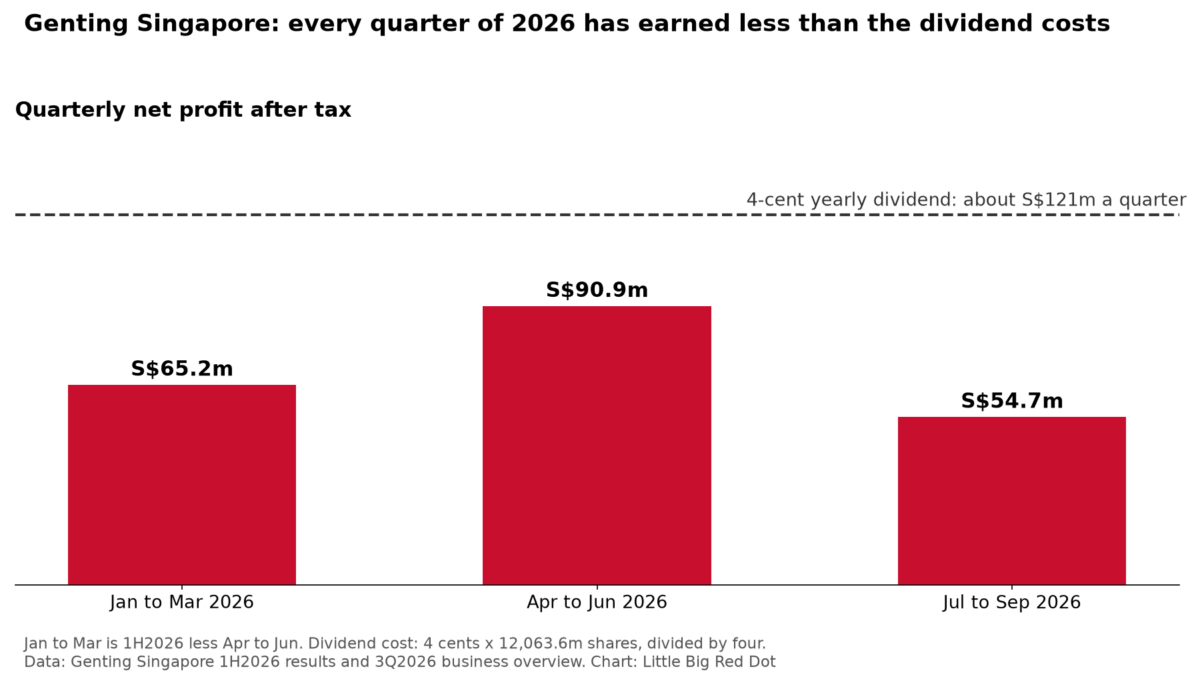
The cash is also spoken for. At 30 June, the group had contracted but not yet provided for S$2,949.2 million of capital spending, almost exactly the size of its cash pile. In the first half, operating cash flow of S$331.4 million, less S$310.3 million spent on property, plant and equipment and S$12.2 million on intangibles, left about S$8.9 million. Dividends paid in the same period were S$241.8 million.
UOB Kay Hian models capital spending of S$700 million this year and S$900 million in each of 2027 and 2028, with cash falling from S$3.2 billion at the end of 2025 to about S$2.2 billion by the end of 2027. It sees “upside for capital management limited by sizeable RWS 2.0-related capex in 2026-28”.
Forecasts may still be too high. Even after its cut, UOB Kay Hian’s 2026 net profit forecast of S$365.8 million, set against its own nine-month core profit estimate of S$221.4 million, implies about S$144 million in the fourth quarter. That is well above any quarter so far this year, and it would have to come with fewer rooms open.
The numbers behind the call
These measures use Monday’s close of S$0.56. The calculations are ours unless stated.
| Measure | Value | Basis |
|---|---|---|
| Market value | about S$6.76 billion | 12,063.6 million shares |
| Cash, 30 June 2026 | S$2.95 billion | About 24.4 cents a share, about 44% of market value |
| Price to book | about 0.83 times | Net asset value of 67.2 cents at 30 June 2026 |
| Price to earnings, trailing | about 24.9 times | Trailing net profit of about S$272 million |
| Price to earnings, trailing, excluding cash | about 14 times | Market value less June cash, over trailing profit |
| Price to earnings, 2026 / 2027 forecasts | about 18.5 / 17.5 times | UOB Kay Hian net profit forecasts of S$365.8 million and S$386.4 million |
| Market value less cash to trailing adjusted EBITDA | about 5.3 times | About S$721 million of adjusted EBITDA over four quarters |
| Dividend yield | about 7.1% | 4.0 cents, if the 2026 final matches the interim |
The brokers use higher multiples on their own definitions. UOB Kay Hian’s target “implies 7x 2027F EV/EBITDA (-1SD below mean)”, and CGS International uses 7 times 2027 EV/EBITDA. The cheapness on our simple measure flatters the stock because so much of the cash is committed to the renovation. At about 0.83 times book, the market is assuming that cash gets spent rather than returned, and that the earnings trough runs into 2027.
What the brokers say
Each rating carries the date of the broker’s report. Every post-results call is a hold.
| Broker | Rating | Target price | Report date | Change from S$0.56 |
|---|---|---|---|---|
| UOB Kay Hian | Hold | S$0.65, from S$0.70 | 13 November 2026 | about +16% |
| DBS Group Research | Hold | S$0.67 | 13 November 2026 | about +20% |
| Maybank Research | Hold | S$0.59, from S$0.65 | 13 November 2026 | about +5% |
| CGS International | Hold | S$0.63, from S$0.67 | 22 October 2026 | about +13% |
DBS first set its S$0.67 target in May, on 7.3 times forward EV/EBITDA, in line with the company’s five-year average. The DBS and Maybank post-results calls come from published summaries of their reports, and the CGS International call was made before the results. Morningstar cut its fair value estimate by 13% after the update (Morningstar, 13 November 2026). Across 15 analysts polled by S&P Global, the consensus rating is hold.
Risks
On the downside: a cut to the 4-cent dividend, more earnings downgrades, cost overruns on RWS 2.0, further VIP share losses to Marina Bay Sands, China’s clampdown on high-end gamblers, and bad debts from casino customers. Gross trade receivables were S$614.7 million at 30 June against an impairment allowance of S$438.6 million, and the first-half impairment charge was S$64.6 million. On the upside: better luck at the VIP tables, rooms reopening sooner than expected, a special dividend or a bigger buyback, and a pick-up in tourism.
What to watch
The full-year results are the real test, because that is when the final dividend is normally declared. No date has been announced. A 2.0-cent final would show management is willing to keep paying 4 cents out of cash through the refit. Watch also for a reopening timetable for Hotel Michael and the repositioned rooms, any buybacks below book value (the company bought back S$18.5 million of shares in the first half), and Marina Bay Sands’ fourth-quarter numbers, usually out in late January.
The verdict
On assets, Genting Singapore is about as cheap as it has been in years: below book, nearly half its value in cash, no borrowings and a 7% yield. That is why we would not sell at S$0.56, below every post-results target.
We would not buy yet either. The dividend is a management choice funded from capital, not something earnings cover, and the cash is already committed to a renovation that will hold back capacity until 2027 at least. Management has given no sign of where the trough is, forecasts are still falling, and the brokers see only 5% to 20% upside.
We would move to buy on a confirmed 2.0-cent final dividend alongside steadier VIP volumes or market share, on a larger buyback below book value, or on a price near S$0.50, which would be an 8% yield on 4 cents and about 0.74 times book. We would move to sell on a dividend cut without a credible capital plan, or if fourth-quarter adjusted EBITDA came in below the third quarter’s S$161.8 million on normal luck.
Research by Warren.
This is general information, not financial advice, and does not take into account your objectives or financial situation.