
If you want to ask for less salt at your next kopitiam meal, HPB has a plan that ends on 30 November 2026. Its “Ask for or choose less salt, your way” campaign runs from 22 September to 30 November, with a 3-week guide to help your taste buds adjust. The reason is blunt: the average Singapore resident takes in about 4,000mg of sodium a day, twice the 2,000mg limit.
That 2,000mg is roughly one teaspoon of salt. According to HPB’s National Nutrition Survey 2025, 95% of residents go over it, up from 88% in 2019. Sodium levels in popular dine-out dishes have also crept up by about 20% from 2010 to 2023, and by a further 10% between 2023 and 2025.
Why you should ask for less salt when eating out
Most of us eat out about nine times a week, and seven in ten residents eat out once a day. Here is the bit that surprises people: HPB says about 60% of our sodium comes from salt, sauces and seasonings added during cooking, such as stir-fries, gravies and soupy dishes. Another 15% comes from processed foods like instant noodles and sausages.
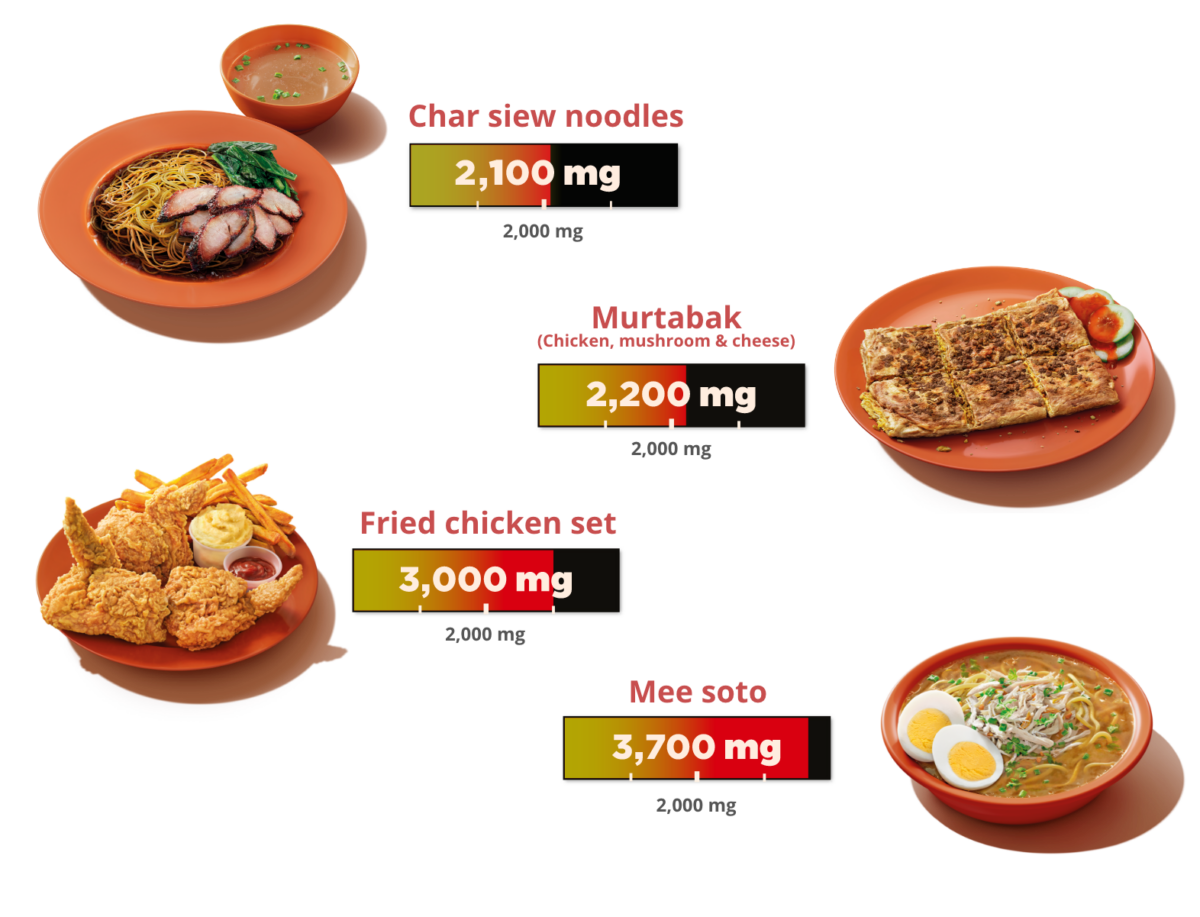
HPB’s own dine-out figures show how quickly one meal can blow the daily limit:
- Char siew noodles: 2,100mg
- Chicken, mushroom and cheese murtabak: 2,200mg
- Fried chicken set: 3,000mg
- Mee soto: 3,700mg
- Duck rice: 1,446mg
Those numbers come from HPB’s HealthHub page, so treat them as illustrative portions rather than every stall’s version. Still, a single bowl of mee soto sitting at nearly double the daily limit makes the point.
What “ask for less salt” looks like at the stall
You do not have to give up your favourite hawker dishes. HPB suggests a few small habits that cost nothing:
- Ask for less sauce or gravy, or have it on the side and pour sparingly.
- Skip drinking all the soup in soup-based dishes.
- Taste your food first before adding chilli sauce, ketchup or soya sauce.
- Look out for the red “Lower-sodium options available here” sign at HPB’s Healthier Dining partner outlets.
One myth worth dropping: drinking lots of water after a salty meal does not flush out the sodium. HPB says your kidneys regulate sodium levels, and water only eases the thirst. If you tend to feel puffy and parched after a heavy lunch, that is the salt talking, not a sign you need to chug more kopi-o.
The health stakes are real too. HealthHub notes that one in three residents aged 18 to 74 has high blood pressure, and that too much sodium is a major risk factor for heart disease and stroke. Pair this with the movement habits we covered in HPB’s free MOVE IT classes at The Kallang and you are covering both sides of the heart-health equation.
The 3-week plan to retrain your taste buds
HPB’s reasoning is that taste receptor cells are replaced roughly every 10 to 14 days. So in three weeks, there is likely at least one full turnover, which gives you time to adapt to less sodium. The results vary from person to person, but the idea is that food starts tasting “just right” with less salt.
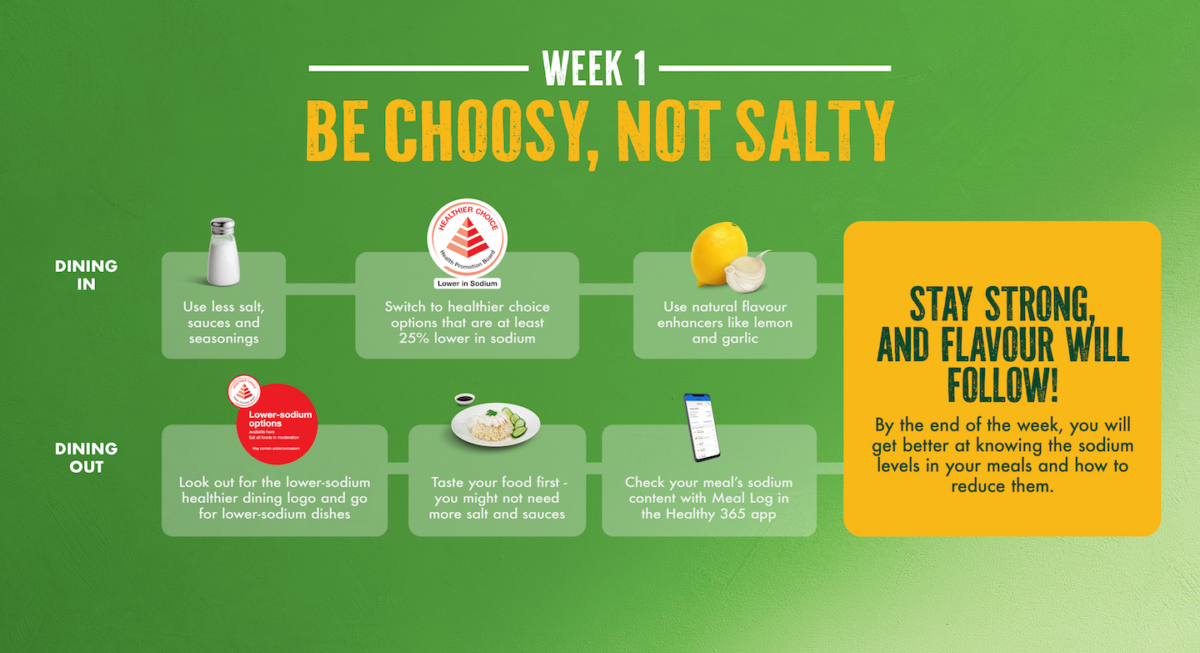
Week 1 is called “Be choosy, not salty”. At home, it means using less salt, sauces and seasonings, switching to Healthier Choice products that are at least 25% lower in sodium, and using lemon and garlic for flavour. When eating out, it means looking for the lower-sodium sign, tasting before adding sauces, and checking your meal’s sodium content with the Meal Log in the Healthy 365 app. You can download the full 3-week guide from HPB’s page on HealthHub.
Cooking at home with less sodium
If you cook, HPB has a few swaps. Sea salt and Himalayan pink salt are not lower in sodium than table salt, so check the Nutrition Information Panel and consider lower-sodium salt instead. Products with the “Lower in Sodium” Healthier Choice Symbol have at least 25% less sodium than similar products, and HPB says they can be used 1-for-1 in place of the regular versions.
Herbs, spices and aromatics such as ginger, garlic, chilli, spring onions and pepper add flavour without more salt. So does umami from dried mushrooms and seaweed. HPB also publishes lower-sodium recipes for local favourites, including Singapore fish head curry, laksa fried rice, char kway teow, sayur lodeh and chicken briyani.
Want a refresher on fuelling properly around exercise? Our guide to what to eat before and after a workout covers HealthHub’s timings. And if you are tracking meals on your phone, the enhanced HealthHub app is changing how health apps are organised from early 2027.
The campaign window is short, with only a couple of weeks left. But the 3-week guide and the recipes stay useful long after 30 November, so it costs you nothing to start this week.