
This Mozzie Wipeout checklist for HDB homes takes about ten minutes, and the National Environment Agency (NEA) wants it done at least once a week. The reason is small. Clean, stagnant water the size of a 20-cent coin is enough for Aedes mosquitoes to breed.
The year-end holidays are when many of us leave the flat for a week or hand the keys to a relative. A forgotten flowerpot plate or a pail left upright is exactly the sort of thing that turns into a breeding site while you are away. So here is the routine, plus what happens if NEA officers do find larvae.
Your Mozzie Wipeout checklist for HDB homes, room by room
NEA’s Stop Dengue Now campaign boils the weekly check down to five actions. Each one targets a spot that holds water in a typical HDB flat.
- Break up hardened soil in your potted plants, so water cannot sit in the compacted top layer.
- Lift and empty flowerpot plates, on the balcony, along the corridor and at the service yard.
- Overturn pails and wipe their rims, because eggs can cling to the wet edge.
- Change the water in vases (and any bowls of water for plant cuttings).
- Keep roof gutters clear and place BTI insecticide, which matters more for landed homes and ground-floor units with gutters.
Walk the flat with this list in hand, starting with the plants on the balcony and the buckets near the washing machine. If a container is not in use, turn it over or store it indoors.
Why the weekly rhythm matters
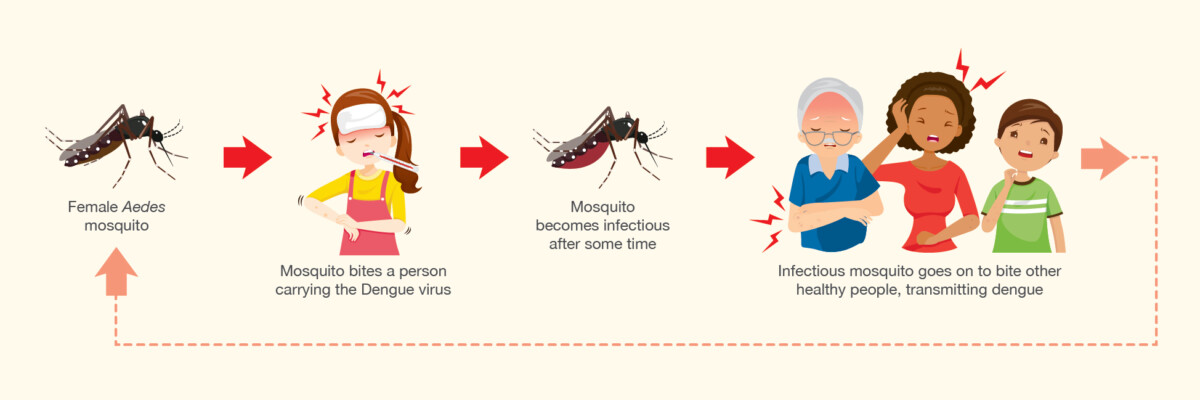
NEA’s explanation is a simple loop. A female Aedes mosquito bites someone with the dengue virus, becomes infectious after some time, then bites other healthy people. Removing the water breaks the loop at the very start.
The Aedes aegypti, the most efficient carrier in Singapore, has adapted to life close to people. It breeds in things like flowerpot plates and trays, so residential areas, including parks and playgrounds, carry a higher risk than forests. NEA also notes that Aedes bites mainly in daylight, with peaks soon after sunrise and just before sunset, although it can bite at night under artificial light.
Do not count on gadgets to do the job for you. NEA says homemade mosquito traps are not foolproof, especially when your flat has other standing water and a more attractive human around. The wipeout is the fix, and the rest is backup. If you want the bigger picture on how the programme works across estates, see our piece on Project Wolbachia reaching 53 per cent of Singapore homes.
If you live in a dengue cluster
NEA’s myENV app sends notifications on dengue clusters and areas with a higher Aedes aegypti population, so it is worth switching on. In a cluster, NEA asks residents to follow three protective actions: Spray, Apply, Wear (S-A-W). In practice that means spraying insecticide in dark corners, applying repellent and wearing long, light-coloured clothing.
For repellent, NEA says products with DEET, picaridin or IR3535 work best.
Those with less than 10 per cent DEET are safe for infants from 2 months of age. Plant-based options like citronella are less effective and need more frequent reapplication. Mosquito screens on windows and doors, and a net if someone naps in the day, add another layer. Our guide to dengue cluster colours and what households should do explains what each cluster alert means.
Know the symptoms too. NEA lists six: a sudden fever lasting 2 to 7 days, headache with pain behind the eyes, joint and muscle pain, skin rashes, nausea or vomiting, and mild bleeding such as nosebleeds or bleeding gums. See a doctor if several show up together. If someone at home is already sick, this household guide to protecting the patient is a useful read.
What a dengue inspection looks like, and the fine
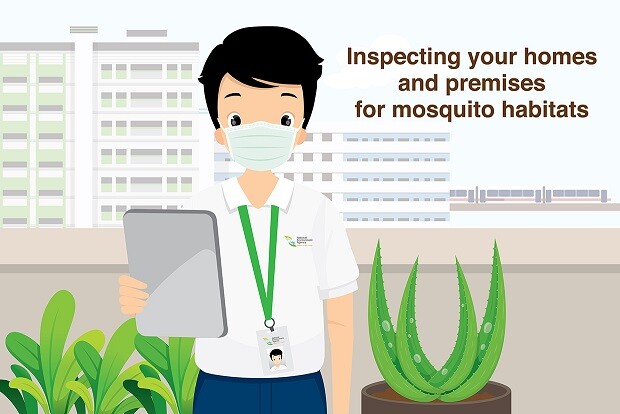
NEA officers do visit homes. They show their NEA Authority Card, explain why they are there, and enter only with your consent and while you accompany them. You can check an officer’s identity at nea.gov.sg/validate-officer or by calling 6225 5632.
If they find a breeding habitat, they will show it to you and ask you not to pour the water away. They collect a sample of the larvae or pupae in a vial, sealed in front of you and sent to the laboratory. NEA says it will not ask for any payment of fines on the spot.
If the sample is confirmed as mosquitoes or other vectors, a fine follows later. Under the Control of Vectors and Pesticides Act, breeding at your premises can mean a fine of up to S$5,000, imprisonment of up to 3 months, or both. For homes, enforcement usually comes through a Notice to Attend Court sent by mail. Compared with a ten-minute weekly routine, that is a steep price for one forgotten pail.
Your Sunday ten-minute plan
- Pick one fixed time each week, such as Sunday morning after breakfast.
- Check every plant pot, plate, vase and pail in the flat, including the corridor.
- Break up soil, lift plates, overturn pails, change vase water.
- Before travelling, do a full sweep and ask a neighbour or relative to repeat it if you are away longer than a week.
- Download myENV and switch on cluster alerts for your postal code.