
Sport Singapore would rather you spend two minutes on a form before you start training harder. The Get Active Questionnaire is a short yes-or-no check that tells you whether to go ahead on your own or speak to a doctor or exercise professional before you push harder.
It is free, it is on posters and banners at ActiveSG sport centres, and SportSG publishes it online in English, Chinese, Malay and Tamil. The questions are the Canadian Society for Exercise Physiology’s, from a 2017 form.
The questions
The rule printed on the form is simple: if you are unsure, answer yes.
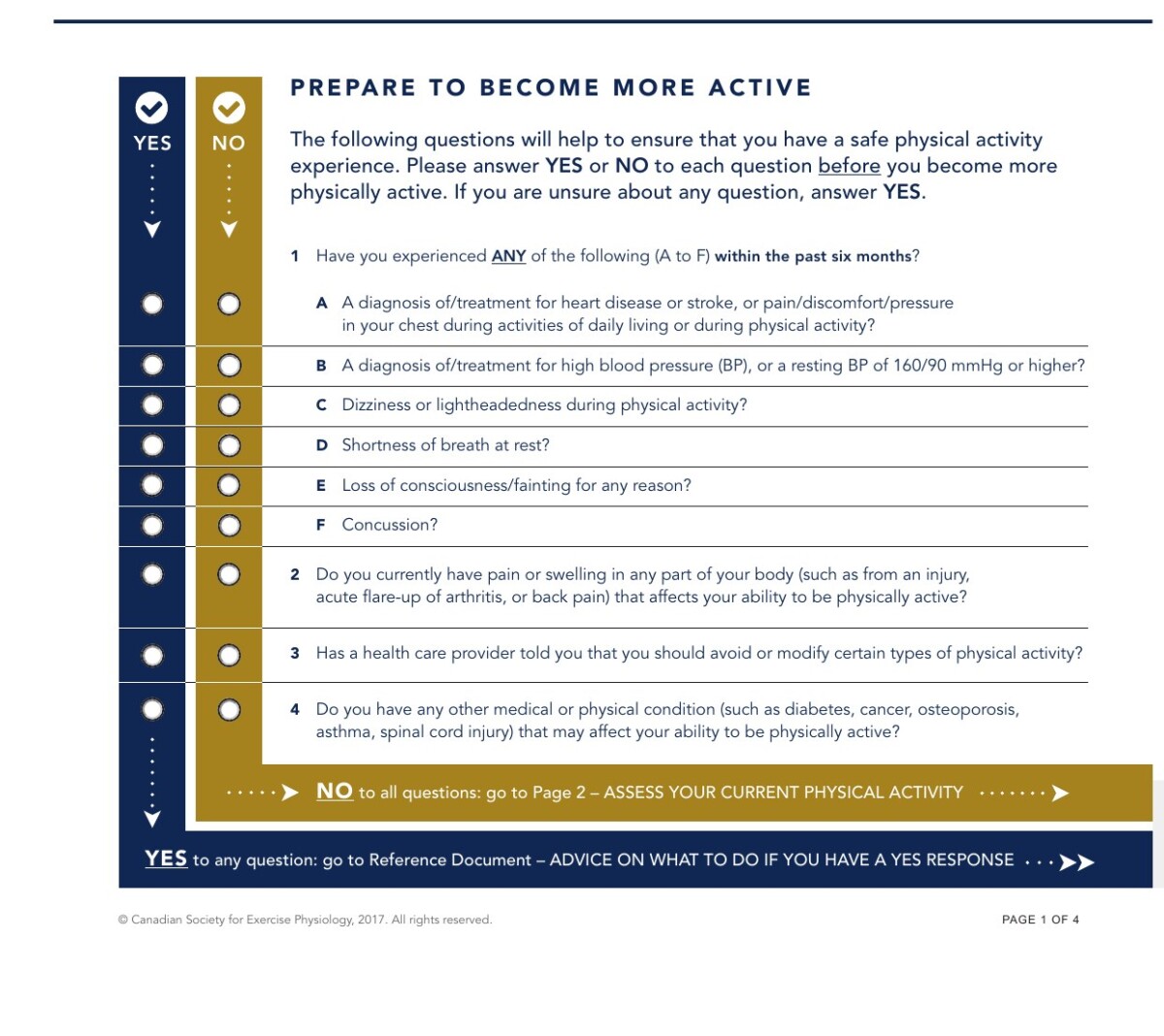
Question 1 covers the past six months. Have you had any of these?
- A diagnosis of, or treatment for, heart disease or stroke, or pain, discomfort or pressure in your chest during daily activities or exercise
- A diagnosis of, or treatment for, high blood pressure, or a resting blood pressure of 160/90 mmHg or higher
- Dizziness or light-headedness during physical activity
- Shortness of breath at rest
- Loss of consciousness or fainting for any reason
- Concussion
Three more follow. Do you have pain or swelling, such as an injury, an arthritis flare-up or back pain, that affects your ability to be active? Has a health care provider told you to avoid or modify certain activities? Do you have another condition, such as diabetes, cancer, osteoporosis, asthma or a spinal cord injury, that may affect it?
What a yes means
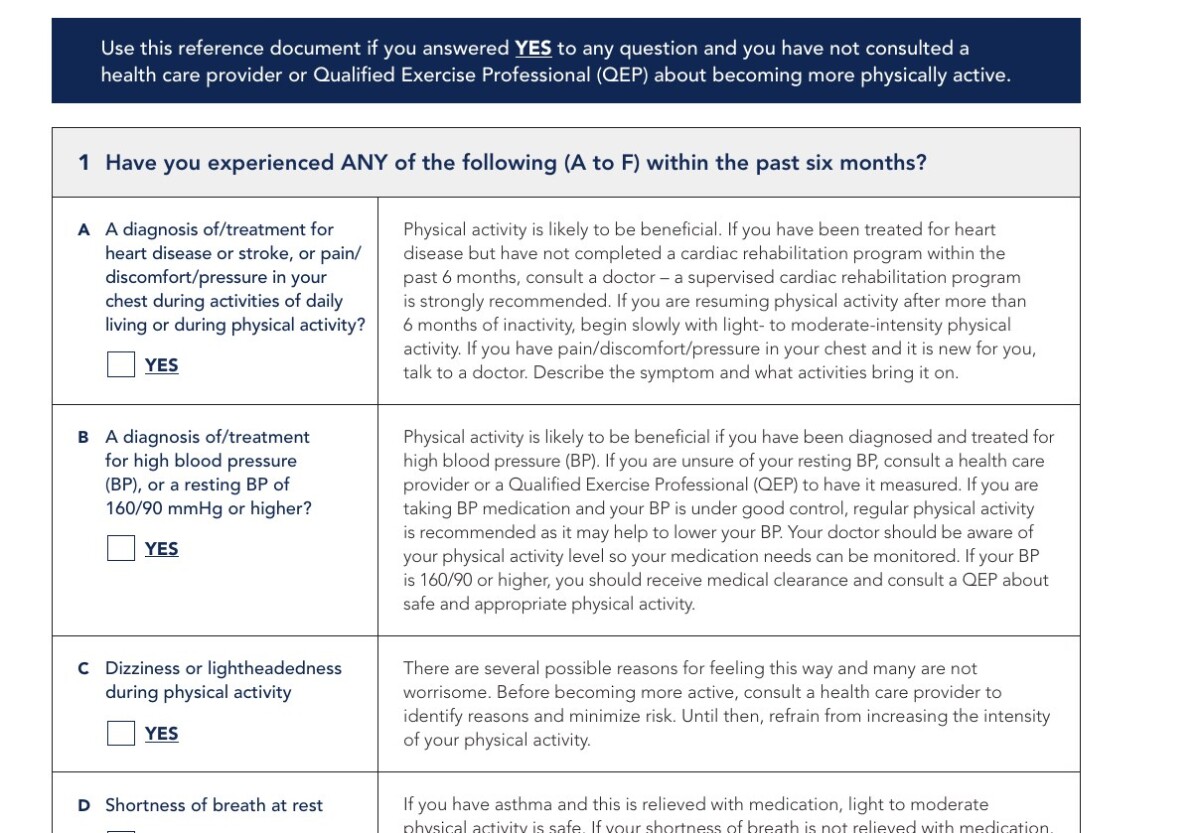
A yes does not mean you cannot exercise. It sends you to advice written for that answer.
New chest pain means seeing a doctor. If you do not know your resting blood pressure, get it measured, and a reading of 160/90 or higher calls for medical clearance before you step up. Dizziness during exercise means talking to a health care provider and holding your intensity where it is until you have. Fainting for any reason is also a reason to check with a health care provider before you step up.
Concussion gets a blunt warning: being more active while you still have symptoms may make them worse, drag out your recovery and raise your risk of another concussion. A health care provider should clear your return.
For new pain or swelling, see a provider. Otherwise, the form suggests gentle range-of-motion work and low-impact options such as swimming or cycling.
If you answer no to everything, page two asks how many days a week and how many minutes a day you are active, and points out when to delay. A temporary illness such as a cold is a reason to wait until you feel better, and any change in your health is a reason to fill the form in again. For how much activity to aim for, see our guide to Singapore’s physical activity guidelines.
SportSG’s safety basics for the session itself
Once you are cleared, SportSG’s fluid targets are 500ml of water 30 minutes before exercise, 250ml to 500ml every half-hour during it, and 1000ml afterwards. Isotonic or sports drinks are recommended for anything longer than an hour. Clear or light-coloured urine is a sign you are drinking enough, and strong coffee or alcohol can dehydrate you.
Warm up before and cool down after every session. Check the forecast, and cancel or postpone outdoor activity at any sign of lightning.
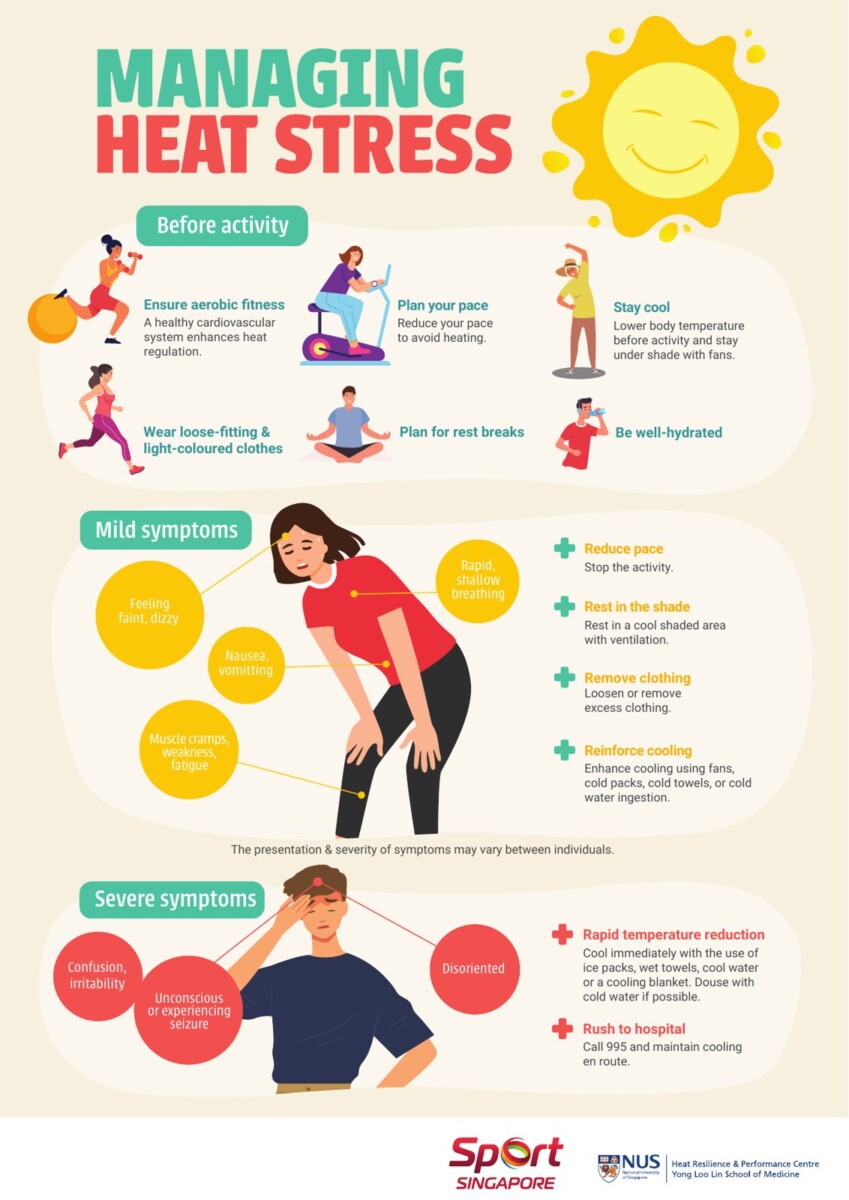
Feeling faint or dizzy, nausea, rapid shallow breathing, cramps, weakness or fatigue are mild symptoms: stop, rest in a cool shaded spot, loosen clothing and cool down with fans, cold packs or cold water. Confusion, disorientation, a seizure or loss of consciousness are severe. Cool the person immediately with ice packs, wet towels or cold water, call 995 and keep cooling on the way to hospital.