If you run a small or medium-sized enterprise in Singapore, chances are you have at least heard of the Enterprise Development Grant (EDG), the Productivity Solutions Grant (PSG) or the Market Readiness Assistance (MRA) Grant. These three schemes have been the workhorses of Singapore’s SME support ecosystem for years — helping bosses automate their operations, upgrade capabilities, and venture into overseas markets.
In 2H 2026, all that changes. Enterprise Singapore is merging EDG, PSG and MRA into a single unified scheme called EDGE — short for Enterprise Development and Growth for Enterprises. It is the most significant shake-up to Singapore’s SME grant architecture in more than a decade, and if you run a business or are planning to, it pays to understand what is actually changing.
Here is the plain-English guide to EDGE: what it is, why it is happening, and what SMEs need to do between now and the launch.
What exactly is EDGE?
EDGE is a new, single enterprise support scheme that will replace three of Singapore’s flagship SME grants:
- Enterprise Development Grant (EDG) — supports custom, bespoke projects to upgrade, innovate, grow or internationalise a business.
- Productivity Solutions Grant (PSG) — supports the adoption of pre-approved, off-the-shelf productivity solutions (POS systems, accounting software, HR tools, etc.) at up to 50% of eligible costs and capped at S$30,000 per application.
- Market Readiness Assistance (MRA) Grant — supports SMEs with the cost of entering new overseas markets, including business matching, market set-up, and overseas promotion.
Under EDGE, these three schemes will be consolidated into one application pathway on the Business Grants Portal (BGP). Instead of applying separately — and sometimes to the wrong scheme — SMEs will have a single entry point for capability-building, digitalisation and internationalisation support.
Deputy Prime Minister Gan Kim Yong announced the consolidation as part of a broader Business Refresh package aimed at making government support easier to access. The scheme will be administered by Enterprise Singapore and is scheduled to launch in the second half of 2026.
Why is Singapore doing this now?
If you have ever tried to apply for an SME grant, you will know the main problem EDGE is trying to solve: it is confusing. Business owners have historically had to figure out on their own which grant applies to which project, navigate different application forms, and sometimes discover — often too late — that they applied to the wrong scheme and had to start over.
Three of the most common pain points SMEs flagged with the old system:
- Overlap between schemes. A digitalisation project might fit under PSG (off-the-shelf tool), EDG (custom software) or even MRA (if it is for an overseas venture). Picking the right scheme was half the battle.
- Duplicated paperwork. If a company’s transformation journey spanned multiple pillars, it often had to file parallel applications across schemes — each with its own proposal, supporting documents, and claims process.
- Mixed timelines. PSG was relatively fast — 6-week approvals were common. EDG typically took 8–12 weeks. MRA had its own cycle. Coordinating a capability-building programme across all three was clunky.
EDGE is designed to collapse these three workflows into one — a single portal, a single application, and a more consistent service standard across project types.

What happens to EDG, PSG and MRA between now and the launch?
Here is the key message for SMEs: nothing disappears overnight. Enterprise Singapore has been clear that all three existing grants remain accessible right up until EDGE goes live in 2H 2026.
That means:
- You can still apply for PSG on the Business Grants Portal for any pre-approved solution on the approved list. PSG covers up to 50% of eligible costs, capped at S$30,000 per application.
- You can still apply for EDG for custom, bespoke projects under the three pillars of Core Capabilities, Innovation & Productivity, and Market Access. SMEs can receive up to 50% support, with sustainability-related projects supported at up to 70% (ending 31 March 2026).
- You can still apply for MRA for overseas market development, pitching, business matching and set-up costs.
Existing letters of offer and ongoing projects will continue to be administered under the terms of the original scheme — so if your EDG project is already in flight, you do not need to panic or re-apply.
What stays the same under EDGE?
While the branding and application process will change, several core principles look likely to carry over:
- Eligibility. The basic SME eligibility criteria — a business entity registered and operating in Singapore, with at least 30% local shareholding held directly or indirectly by Singaporeans or PRs, and that is financially ready to start and complete the project — are unlikely to change.
- Reimbursement basis. EDG has always been a reimbursement grant rather than upfront funding. Businesses pay for the project first and then claim once deliverables are met. Expect the same discipline under EDGE.
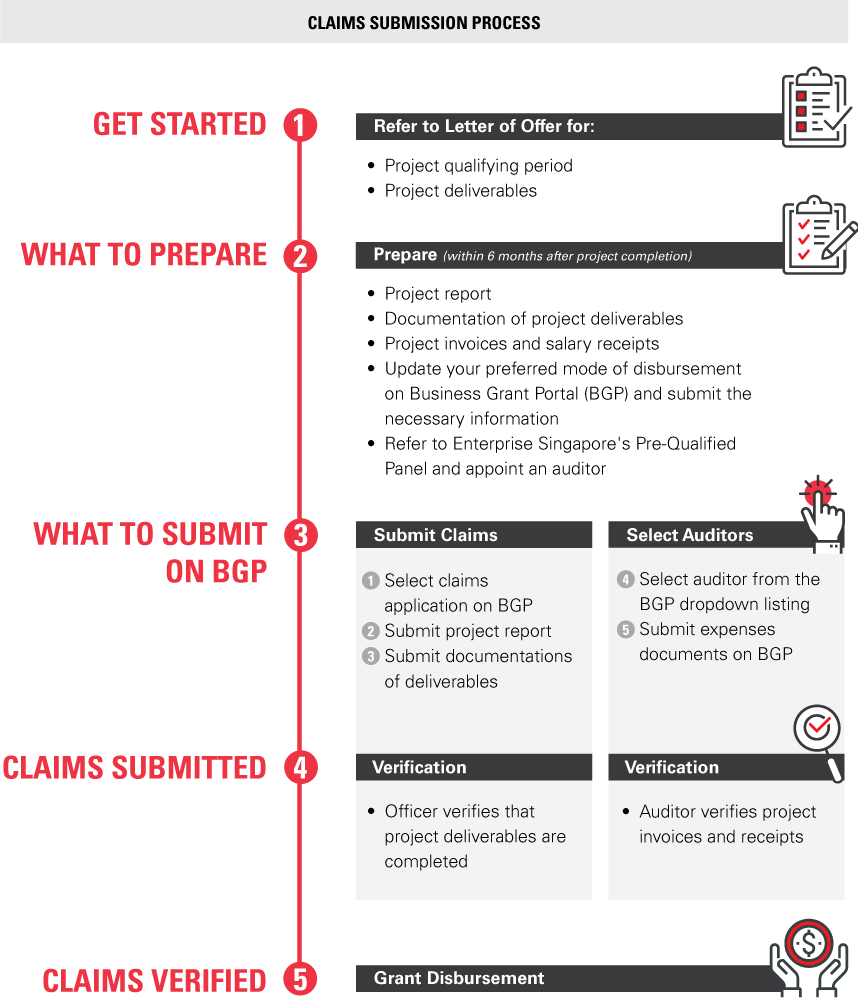
- Business Grants Portal (BGP). The portal itself is staying put. SMEs sign in via Corppass, submit applications, upload documents, track status and file claims — all on the same BGP, just with a single EDGE form instead of three separate ones.
- Pre-approved vendors for off-the-shelf tools. The pre-approved vendor list for PSG-style solutions is expected to continue. This is how the government keeps fraud low and approval turnaround fast.

What is NOT changing
It is just as important to understand what EDGE is not.
- The Enterprise Financing Scheme (EFS) — which covers working capital loans, trade loans, project loans, SME fixed asset loans, venture debt and mergers & acquisitions — is separate and continues on its own track. EDGE is not a financing product; it is a cost-sharing grant.
- The SkillsFuture Enterprise Credit — SMEs eligible for SFEC can still stack that credit on top of qualifying EDG/PSG projects today, and it is expected that a similar stacking mechanism will apply under EDGE. If you have not read up on the big SkillsFuture changes that kicked in from April 2026, it is worth a quick catch-up.
- Industry-specific and sectoral grants — such as the Maritime Innovation and Technology Fund, tourism-related grants under STB, or IMDA’s digital enterprise programmes — remain in place. EDGE consolidates only the three EnterpriseSG general-purpose schemes.
What SMEs should do between now and 2H 2026
For founders, finance leads and operations managers, here is a practical checklist for the transition period.
1. Take stock of projects you were planning anyway
If you already have a transformation, digitalisation or overseas expansion project on the drawing board, it may be worth applying under the existing EDG/PSG/MRA rules now rather than waiting for EDGE. This lets you lock in the current support levels and avoid the uncertainty of a transition window.
2. Do not ‘start the project’ before applying
This is the single most common reason applications get rejected. A project is considered to have commenced once you have started work, made payment to a third-party vendor who is part of the application, or signed a contractual agreement. If any of those have happened, you are no longer eligible for the grant for that project. Plan your timing carefully.
3. Get your documents in order
Whether you apply under today’s EDG/PSG/MRA or tomorrow’s EDGE, the paperwork is the same shape. Prepare:
- Latest ACRA business profile (dated no earlier than 6 months old)
- Audited financial statements or certified management accounts for the last financial year
- A clean, outcome-focused project proposal
- Quotations from proposed vendors (and CVs + certifications for any management consultants you plan to engage — SAC-accredited TR 43 or SS 680 consultants are required for management consultancy claims under EDG today)
- Employment letters or job descriptions for any manpower cost you intend to claim
4. Think in terms of outcomes, not activities
Enterprise Singapore has increasingly emphasised measurable business outcomes — revenue impact, jobs created, productivity gains, sustainability metrics — over activity-based proposals. A project that says “we will hire a consultant to write a strategy report” is weaker than one that says “we will develop and implement a customer retention framework that raises repeat purchase rate from 22% to 35% within 18 months”. Write your proposal (and, eventually, your EDGE application) with outcomes in mind.
5. Set up PayNow Corporate now
Disbursement via PayNow Corporate is faster than GIRO — claims can be paid within 14 working days of approval, versus up to eight weeks via GIRO. Setting up PayNow Corporate with your bank (DBS, OCBC, UOB or POSB) before your first claim saves weeks of waiting later.
What about the grant amounts?
Enterprise Singapore has not yet published the final EDGE quantum, but a few signals from the Business Refresh package are worth noting:
- The 50% support level for SMEs on capability-building projects has been the baseline for EDG since 2023 and is expected to remain the floor.
- Sustainability-related projects have been supported at up to 70% under the Enterprise Sustainability Programme. Singapore has been explicit about wanting to push SMEs along the green transition, so sustainability-linked EDGE projects may continue to see elevated support.
- PSG’s S$30,000 per-application cap is expected to carry over for off-the-shelf solution tracks, though the exact label may change.
The final, definitive numbers — including exact co-funding percentages, caps and eligible cost categories under EDGE — will be released closer to launch. Keep an eye on Enterprise Singapore’s financial support page and the Business Grants Portal.
The bigger picture: more support, less friction
The EDGE consolidation sits alongside other Budget 2026 measures — the SME Co-Investment Fund top-up, the extension of the Energy Efficiency Grant, and continued enhancements to the SkillsFuture Enterprise Credit. Read collectively, the message from the government to local SMEs is clear: invest in yourselves, and we will invest alongside you.
For small businesses that have been sitting on the fence about digitalising or expanding overseas, 2026 is shaping up to be a genuinely good year to move. The current EDG/PSG/MRA toolkit is still available for the remainder of the first half of the year, and EDGE promises a cleaner, simpler experience from 2H 2026 onward.
If there is one thing we would suggest SMEs do today, it is this: take 30 minutes, log in to the Business Grants Portal via Corppass, click through the EDG and PSG flows, and get familiar with the questions the system asks. The better your internal documentation matches the structure of the application form, the faster your EDGE application will fly through the system next year.
This article is for general information only and does not constitute professional, legal or tax advice. Grant terms, quantum and eligibility conditions may change between now and the EDGE launch. Businesses should verify current terms directly with Enterprise Singapore or their own advisers before making commercial decisions.