
The call
Frencken Group (SGX: E28), the Mainboard-listed group that designs and manufactures equipment and modules for semiconductor, medical and other industrial customers, is our pick today. We rate it a buy on a 12-month view.
The shares closed at S$1.70 on Thursday, 19 November 2026, down one cent, or 0.6%, from Wednesday’s close of S$1.71. They traded between S$1.64 and S$1.70 on about 2.3 million shares, a quieter session than Wednesday’s 4.9 million. That is the latest close going into this morning’s session.
The 52-week range is S$1.31, an intraday low on 17 December 2025, to S$3.54, which was both the high and the close on 22 June 2026. The lowest close of the past year was S$1.33 on 15 December 2025. At S$1.70 the stock is about 52% below that June peak, though still about 23% above the end-2025 close of S$1.38.
What the update said
Frencken released a voluntary third-quarter business update after the market closed on Wednesday, 18 November (SGX: Business Update for 3Q26, 18 November 2026).
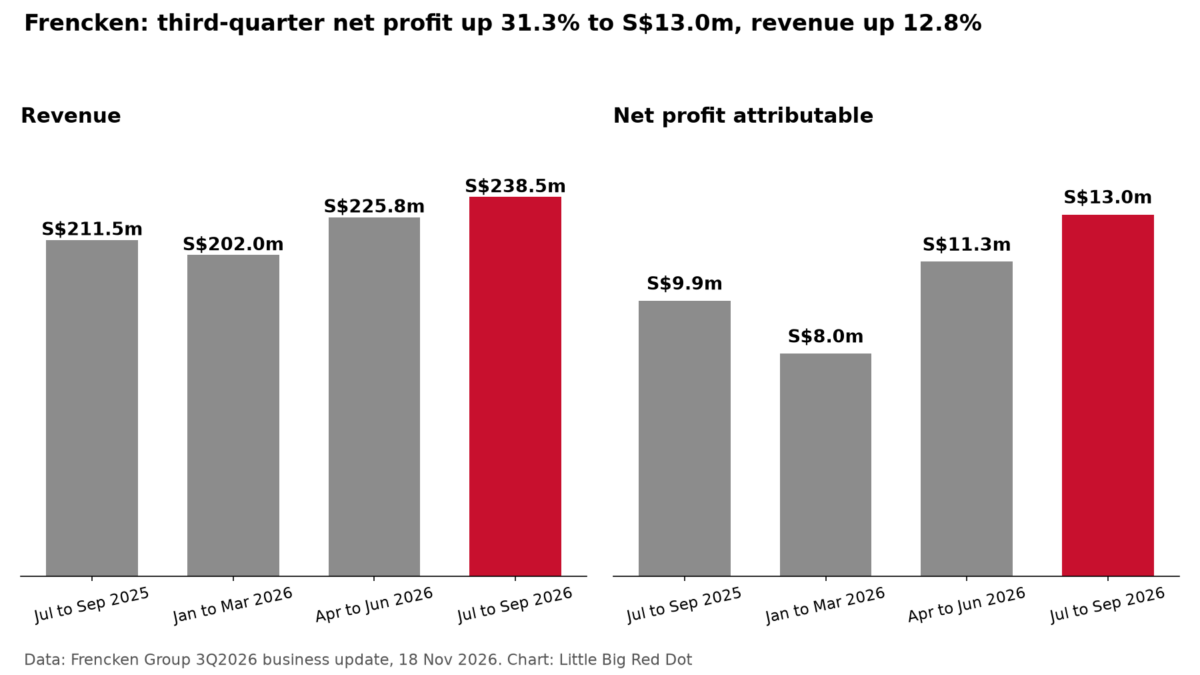
Net profit attributable to equity holders rose 31.3% to S$13.0 million, from S$9.9 million a year earlier and from S$11.3 million in the second quarter. Revenue rose 12.8% to S$238.5 million, from S$211.5 million, and was 5.6% higher than the second quarter’s S$225.8 million. Gross margin widened to 15.9% from 14.8% a year earlier and 15.7% in the second quarter.
For the nine months, revenue rose 3.6% to S$666.3 million and net profit rose 8.1% to S$32.3 million. Gross margin was 15.3%, against 14.3% a year earlier. The third quarter more than accounted for the year-to-date growth. In the first half, revenue was S$427.8 million, down 0.8%, and net profit was S$19.3 million, down 3.4% (SGX: 1H2026 interim statements, 13 August 2026).
Semiconductor and medical, the two largest segments, both grew at a mid-20s pace. Semiconductor revenue rose 25.9% to S$124.8 million and made up 52.3% of group revenue, “boosted mainly by the semiconductor business in Asia which registered strong double-digit sales growth”. The semiconductor segment in Europe continued to improve quarter on quarter through the first nine months. Medical revenue rose 26.1% to S$39.9 million, or 16.7% of group revenue, on “increased orders from a major customer in Europe”.
The weaker parts were analytical life sciences, down 8.6% to S$37.5 million on “soft business conditions in Europe”, and industrial automation, down 39.9% to S$8.1 million, “in line with the Group’s expectation of lower orders from a major data storage solutions provider”. The company says this revenue is “typically lumpy” and “largely dependent on a key customer’s capital expenditure”. Automotive revenue rose 10.0% to S$17.2 million on higher radar-antenna sales.
Guidance was reaffirmed. The group “maintains its view that revenue and net profit for FY2026 are expected to be higher than FY2025”. Total revenue for the second half and the full year is expected to be higher year on year, barring unforeseen circumstances and foreign-exchange volatility. Semiconductor, medical and automotive are all guided higher for both periods. Analytical life sciences is guided stable in the second half but lower for the full year. Industrial automation is guided lower in both. “In view of the favourable backdrop for the global semiconductor equipment industry, the Group envisages continued growth in FY2027.” In its first-half results in August, the group said that, barring unforeseen events, it envisaged it could cross S$1 billion in annual revenue by 2028 if not earlier.
Full-year 2025 revenue was S$865.1 million and net profit S$39.1 million (SGX: FY2025 results, 27 February 2026). Nine-month profit of S$32.3 million means Frencken needs only about S$6.8 million in the fourth quarter to beat last year’s result, against S$13.0 million in the third quarter and about S$9.3 million in the fourth quarter of 2025. Those last two comparisons are our calculations.
The company says the Asia semiconductor business should “expand at a solid pace” in the second half, and that its European operations are ramping to support a major front-end equipment customer whose order book has accelerated, with order inflows expected to “continue growing in 2027”. A new Singapore factory is scheduled to come on stream in the second half of 2027. A plastic-gearbox project for service robots and humanoids is still “at the prototype stage”.
At 30 September 2026 the group had net cash of S$166.8 million, including net proceeds of about S$97.1 million from the share placement completed on 3 September, borrowings of S$55.8 million, equity of S$594.2 million and a debt-to-equity ratio of 9.4%. Net asset value was S$1.25 a share. The placement issued 44,081,591 new shares at S$2.2687, taking the issued share count to 473,560,000 (SGX: completion of placement, 3 September 2026).
The numbers behind the call
These measures use Thursday’s close of S$1.70. The calculations are ours.
| Measure | Value | Basis |
|---|---|---|
| Market value | about S$805 million | 473,560,000 issued shares |
| Price to book | about 1.36 times | Net asset value of S$1.25 a share at 30 September 2026 |
| Price to earnings, trailing | about 19.4 times | Trailing net profit of about S$41.6 million |
| Price to earnings, Maybank FY2026 estimate | about 17.9 times | Core net profit of S$45 million |
| Price to earnings, Maybank FY2027 estimate | about 12.8 times | Core net profit of S$63 million |
| Price to earnings, Maybank FY2028 estimate | about 10.7 times | Core net profit of S$75 million |
| Dividend yield, trailing | about 1.6% | 2.75-cent first-and-final dividend for 2025 |
| Net cash | S$166.8 million, about S$0.35 a share, or about 21% of market value | At 30 September 2026, including the placement proceeds |
| Debt to equity | 9.4% | Borrowings of S$55.8 million |
Trailing profit takes the nine-month 2026 figure of S$32.3 million and adds about S$9.3 million for the fourth quarter of 2025, inferred from the 2025 profit of S$39.1 million less the prior-year nine-month figure of S$29.8 million. The nine-month comparative is given to one decimal place in the update, so the trailing multiple is approximate. The Maybank multiples use profit estimates from its note of 28 October 2026, rebased to S$1.70. No interim dividend was declared for the first half of 2026. The group pays once a year, with the full-year results, and says that since its 2005 listing it has “consistently paid dividends, representing at least 30% of its annual earnings.”
What the brokers say
Four dated broker targets, all Buy or Add, sit between S$2.93 and S$3.76. Each carries the date of the report, and the change is measured from S$1.70. Only DBS Group Research has written since the third-quarter update.
| Broker | Rating | Target price | Report date | Change from S$1.70 |
|---|---|---|---|---|
| DBS Group Research | Buy | S$3.76, under review | 19 November 2026 | about +121% |
| Maybank Research | Buy | S$3.32 | 28 October 2026 | about +95% |
| UOB Kay Hian | Buy | S$3.30 | 17 August 2026 | about +94% |
| CGS International | Add | S$2.93, from S$3.25 | 28 August 2026 | about +72% |
DBS analyst Lee Keng Ling, writing on 19 November, called nine-month revenue and net profit “broadly in line”, at 75% and 78% of the house’s full-year forecasts, and kept a Buy rating (DBS Group Research, 19 November 2026). The S$3.76 target is “under review, pending further updates following management’s briefing.” It was first set on 19 May 2026, at 35 times DBS’s then forecast for 2027, when it modelled net profit of S$45.9 million. That model predates the September placement, so a cut is possible once the review is finished.
Maybank kept a Buy rating and a S$3.32 target on 28 October, set at 25 times its 2027 earnings estimate. It forecasts core net profit of S$45 million in 2026, S$63 million in 2027 and S$75 million in 2028. An earlier Maybank note, on 14 September after the placement, had already lowered the target to S$3.32. Maybank also argues that new products in the deep ultraviolet and extreme ultraviolet segments could add S$50 million to S$100 million of revenue. That range is the broker’s, not the company’s, and the 28 October note predates the update. The Maybank and CGS International figures come from published summaries of their reports.
UOB Kay Hian’s S$3.30 target, from John Cheong’s note on the first-half results, was set before the placement, on 429.3 million shares, with 2026 and 2027 net profit forecasts of S$45 million and S$49 million (UOB Kay Hian, 17 August 2026). No later note from the house was found.
CGS International cut its target from S$3.25 to S$2.93 on 28 August, after the placement was announced, to reflect an estimated 10.6% reduction in earnings per share for 2026 to 2028 and a share count of 473.56 million. The target is set at 28 times its 2027 earnings forecast. No CGS note after the third-quarter update was found. Even so, S$2.93, the lowest dated post-placement target in this set, is still about 72% above Thursday’s close.
The bear case
The market has already seen the numbers and did not bid the shares up. A set of numbers that is strong against last year but only in line with forecasts can leave the stock flat, and volume actually fell on Thursday.
Two of the five reported segments are going backwards, and both are lumpy or concentrated. Analytical life sciences is guided lower for the full year. Industrial automation is, on the company’s own account, tied to one customer’s capital spending. Semiconductor is now more than half of group revenue, so a stall in the two front-end equipment programmes would show up quickly in the totals.
The September placement was dilutive, and several published targets are stale or under review. UOB Kay Hian’s S$3.30 was set on a smaller share count. The DBS target, though dated 19 November, is still the May figure, pending the briefing. The growth projects are still promises: the Singapore factory is not due until the second half of 2027, no acquisition has been announced, and the robot gearbox is “in its infancy”.
The stock has already been a violent rerating in both directions, from S$1.31 in December 2025 to S$3.54 in June and then halfway back. A trailing earnings multiple of about 19 times is not a distressed rating for a mid-cap with this volatility. If the 2027 semiconductor upcycle thesis is wrong, the June peak will look like the top of the cycle, not a base for the next leg.
The case for buying
None of that makes the update a weak one. Earnings accelerated, margins widened and 2026 guidance was left intact, with 2027 growth now on the table. Beating last year’s profit is a low hurdle if the fourth quarter is anywhere close to the third. Against that, the shares have halved from S$3.54, sit at about 1.36 times September book value and about 12.8 times Maybank’s 2027 earnings, and barely moved after the update.
Net cash of S$166.8 million, even after paying for some of it with a dilutive issue, gives the group time and options. The mid-November export-control sell-off looks, on the evidence available, more like sector sentiment than a direct hit to Frencken’s equipment-component books. And the most conservative dated post-placement target still implies substantial upside.
Risks
On the downside: a slowdown or cancellation in programmes with the key Asian or European front-end semiconductor equipment customers; further weakness in analytical life sciences or another sharp drop in the lumpy industrial-automation account; foreign-exchange swings, which the company flags in its outlook and which already produced a larger net foreign-exchange loss in the first half; trade-policy spillover, even where the rules are aimed at AI chips rather than equipment components; a poor acquisition funded by the placement proceeds; and a cut in the DBS target once the review is finished. The company has also pointed to “uncertainties following the US midterm elections.”
On the upside: a post-briefing refresh that confirms or raises earnings estimates; a fourth-quarter result that clears the S$39.1 million full-year mark with margins still expanding; firmer commentary on 2027 orders from the two key semiconductor customers; and a first acquisition or investment that adds capabilities or recurring revenue without overpaying.
What to watch
The next test is what the brokers do after the management briefing. DBS has already said its S$3.76 target is under review. A confirmed, post-dilution target from DBS, or a first post-update note from Maybank, CGS or UOB Kay Hian, would tell us whether brokers are lifting earnings or cutting multiples.
After that, the full-year results, which last year came on 27 February, should show whether full-year profit clears S$39.1 million and what is said about 2027 semiconductor orders. No date has been announced.
The verdict
This was a good update that the market chose not to pay up for. Frencken is earning more, on better margins, with 2026 guidance intact and 2027 growth in view. At S$1.70, the shares are still a long way from June’s high, and still do not reflect this quarter’s acceleration.
We would move to hold if the full-year profit failed to beat S$39.1 million, or if the company turned cautious on the two key semiconductor programmes. We would move to sell if those programmes were delayed or cancelled, or if the placement proceeds were spent on a clearly poor acquisition. A cut in the DBS target, on its own, would not be enough to change the call if the company’s order commentary stayed constructive.
At 1.36 times book, with net cash, semiconductor revenue growing at a mid-20s pace and every dated target we can quote still well above the price, we would buy.
Research by Warren.
This is general information, not financial advice, and does not take into account your objectives or financial situation.