
The Ministry of Manpower’s Labour Market Advance Release for the third quarter came out on 30 October 2026, and the headline looks calm. Unemployment stayed at 2.0 per cent in September. Dig into the MOM labour market 3Q 2026 numbers, though, and there is a less comfortable story about retrenchments and cautious bosses.
If you are job hunting, thinking of switching, or just wondering whether to ask for that raise in December, here is what the figures actually say and which support schemes you can tap on right now.
MOM labour market 3Q 2026: the key numbers
All 3Q figures are preliminary, so expect small revisions when the full report lands. For now, this is the picture:
- Total employment (excluding migrant domestic workers) grew by 27,700, up from 11,400 in 2Q 2026 and 25,100 a year earlier.
- The overall unemployment rate held at 2.0 per cent in September 2026.
- Resident unemployment edged up from 2.9 to 3.0 per cent, and citizen unemployment from 3.0 to 3.1 per cent, between August and September.
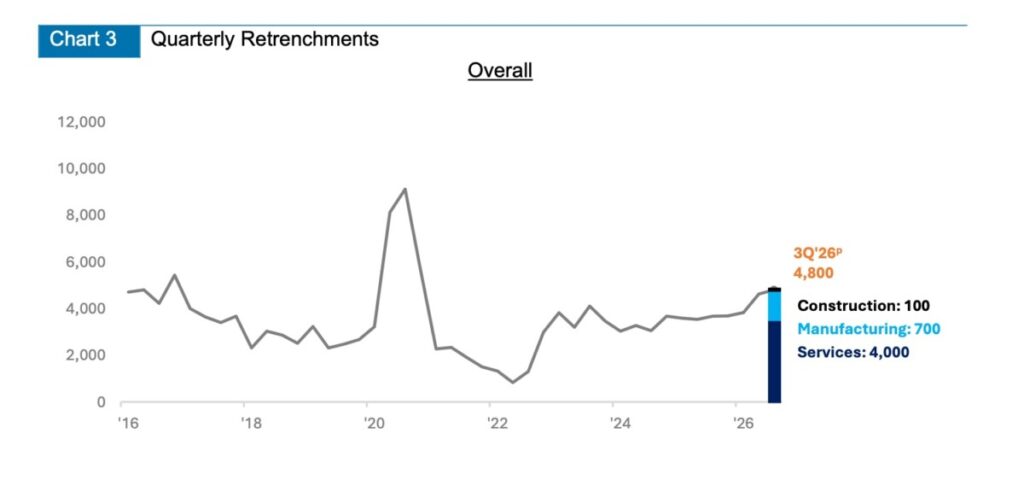
- Retrenchments rose from 4,620 in 2Q to 4,800 in 3Q, although the incidence stayed at 2.0 per 1,000 employees.
So more people are employed, but more people are also being let go. Both things can be true at once, and that is what MOM means when it calls conditions “uneven across sectors”.
Where the job growth is, and where it isn’t
Resident employment growth was carried mainly by essential and public services: public administration and education, transport and storage, and health and social services. Non-residents again made up most of the overall gain, chiefly in construction and manufacturing.
The outward-facing sectors are where it gets patchy. Resident hiring was subdued in information and communications, financial services and professional services. Retrenchments stayed high in information and communications, financial services and manufacturing. Business reorganisation was the main reason given for layoffs, not companies closing shop.
Of the 4,800 retrenchments, MOM’s chart puts about 4,000 in services, 700 in manufacturing and 100 in construction. If you work in tech, banking or a factory role, that is the part of the report to read twice.
Bosses are more willing to hire, but still kiasu
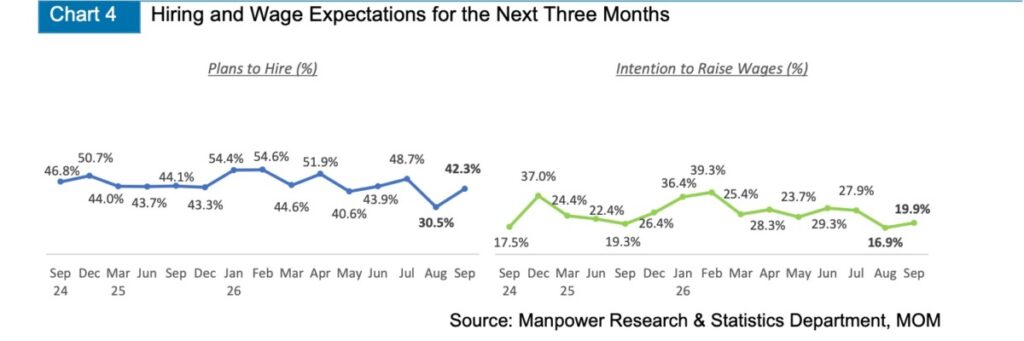
The forward-looking survey is the most useful bit for job seekers. The share of firms planning to hire in the next three months jumped from 30.5 per cent in August to 42.3 per cent in September. Firms intending to raise wages rose from 16.9 to 19.9 per cent.
Both figures are still below July’s levels, and the share expecting to retrench crept up from 2.8 to 3.1 per cent. MOM itself flags “emerging weaknesses in parts of the labour market” that need close monitoring. Translation: hiring has not frozen, but employers are being careful, so applications may take longer and offers may be tighter.
Support schemes you can use now
MOM’s release lists the existing help, and a few of these are worth knowing by name rather than vaguely remembering “there’s some SkillsFuture thing”.
- SkillsFuture Jobseeker Support gives eligible involuntarily unemployed residents up to S$6,000 over six months while they actively look for work.
- Mid-career Singaporeans can use the S$4,000 SkillsFuture Credit (Mid-Career) top-up and a training allowance under the SkillsFuture Level-Up Programme.
- Fresh graduates from the 2026 cohort can apply for GRaduate Industry Traineeships (GRIT) through MyCareersFuture and Careers@Gov.
- Lower-wage workers can upskill with Workfare Skills Support.
- Free career guidance and job matching are available from the Skills and Workforce Development Agency and NTUC’s e2i.
For employers, the SkillsFuture Workforce Development Grant (Job Redesign+) covers up to 70 per cent of job redesign project costs, capped at S$150,000 per enterprise, with higher support for SMEs. Career Conversion Programmes and the Mid-Career Pathways Programme are also still running.
What this means for you before year end
A few practical takeaways, from someone who has watched friends get caught out by “restructuring” emails:
- If you are in ICT, finance or manufacturing, update your CV and LinkedIn now rather than after a town hall.
- Hiring intentions are up, so November and December are not dead months. Our list of November career fairs with walk-in interviews is a good place to start.
- Lower-wage workers should check whether their December pay reflects the NWC’s 2026/2027 wage guidelines.
- Planning a course? The Mid-Career Credit expands to WSQ and sector courses from 1 December, which widens your options.
MOM’s fuller Labour Market Report for 3Q 2026 is due in mid-December 2026, with job vacancy numbers, sector breakdowns and re-entry rates for retrenched residents. That last figure will show how quickly people who lost jobs this year actually found new ones, which matters more than any headline rate.