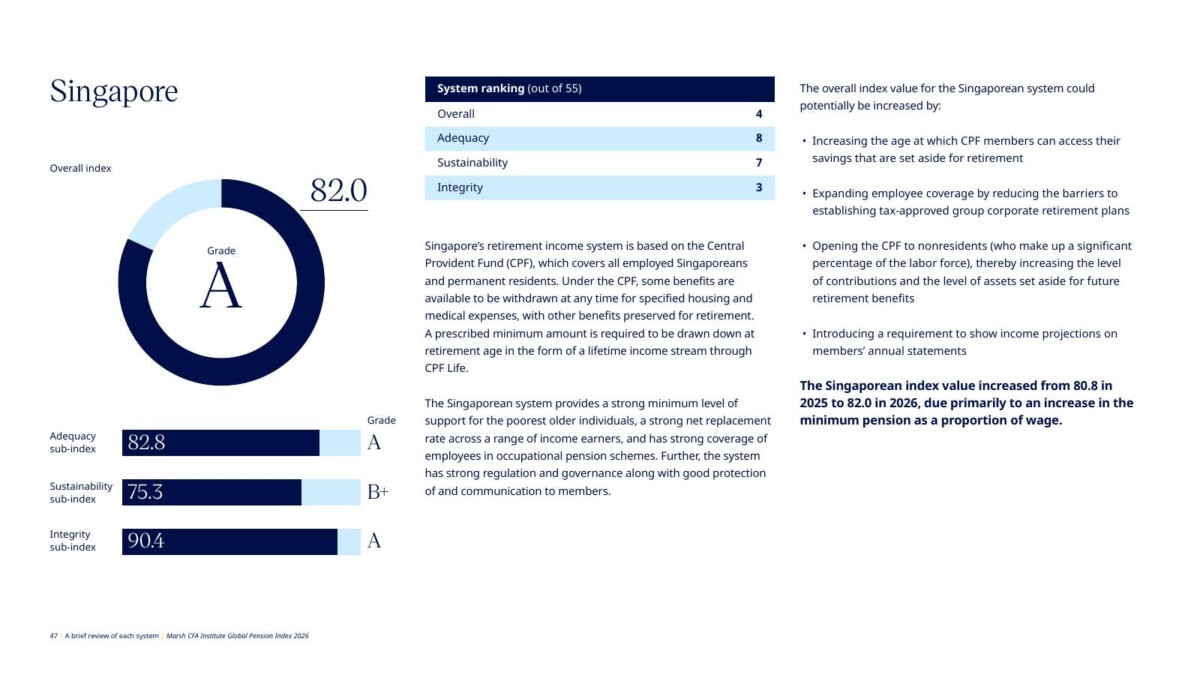
Singapore’s retirement system has kept its A grade in the Marsh CFA Institute Global Pension Index 2026, and its overall score has risen to 82.0 from 80.8 in 2025. The Central Provident Fund (CPF) system ranks fourth of the 55 pension systems in this year’s index.
The index is published by Marsh, the firm formerly known as Mercer, with the CFA Institute and Monash Business School. This is its 18th edition. Each system is graded from A to E on three sub-indices: adequacy (how much retirees get), sustainability (whether the system can keep delivering) and integrity (whether it can be trusted).
Six systems earned an A this year. The Netherlands leads on 85.8, ahead of Denmark on 84.1 and Iceland on 84.0. Singapore follows on 82.0, with Israel on 81.9 and Australia on 80.6 completing the A group.
How the score breaks down
Adequacy is where Singapore gained the most. The sub-index rose to 82.8 from 79.4 and carries an A grade, eighth of 55.
The report puts the rise in the headline score down mainly to an increase in the minimum pension as a proportion of wage.
Sustainability slipped to 75.3 from 75.5 and stays at B+, seventh of 55. Integrity, which covers regulation, governance and member protection, held at 90.4 for an A. Only Finland and Norway rank higher on that measure.
Closer to home, Hong Kong SAR scores 71.2 for a B grade. Malaysia is on 61.1 (C+), China on 60.6 (C+) and Japan on 58.0 (C).
What the grade covers
The A grade is a score for the system as a whole. It is not a measure of any one member’s balance or payout.
The report describes the CPF as it stands today. It covers all employed Singapore citizens and permanent residents, lets some savings be used for housing and medical costs, and requires a prescribed minimum to be paid out from retirement age as a lifetime income through CPF Life.
For an individual, the CPF Life payout depends on the member’s own Retirement Account savings, plan and start age. Those figures sit with the CPF Board, and members can see them in their own CPF account.
Where the report sees room to improve
The authors list four changes that could lift Singapore’s score further. They are the index team’s suggestions, not Government policy.
- Raising the age at which CPF members can access the savings set aside for retirement.
- Widening employee coverage by reducing the barriers to setting up tax-approved group corporate retirement plans.
- Opening the CPF to non-residents, who make up a significant share of the labour force.
- Requiring members’ annual statements to show income projections.