Employers should let staff work from home where the job allows, and must properly consider requests from parents whose children move to home-based learning, under haze guidance from the Ministry of Manpower that comes back into play this week as NEA warns smoke from Kalimantan may return from Tuesday night (20 October) to Thursday.
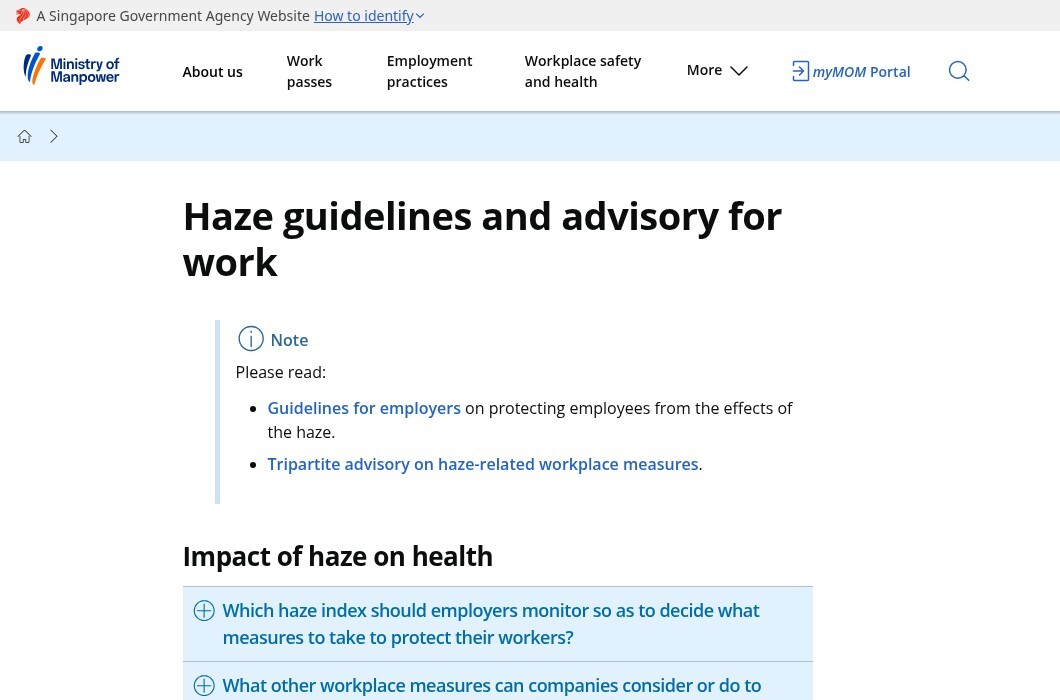
Acting Manpower Minister Jasmin Lau set out the position at the national haze press conference on 16 October, CNA and Mothership reported. Working from home is encouraged especially for the staff most vulnerable to haze: older workers, pregnant employees and those with heart or lung conditions. Under the tripartite guidelines on flexible work arrangements, a request from a parent with a child on home-based learning is one an employer has to consider properly.
“The haze also creates practical problems at home. A child may fall sick, a parent may need more care, or schools may move to home-based learning at short notice,” Ms Lau told reporters, CNA reported.
When the job cannot be done from home
The tripartite advisory from MOM, the Singapore National Employers Federation and NTUC covers the jobs that cannot move home. Staggered hours are one option. Where flexible arrangements are not feasible, employees can use their own annual, sick or childcare leave.
Once that leave runs out, employers are encouraged to grant paid time off, or let staff use advance paid leave, including drawing on next year’s annual leave early. MOM’s position is that wages should not be deducted in those cases. Employers can also be flexible about unpaid infant care leave.
If the company closes for the day
An employer can decide, after its own risk assessment, to pause operations. If that suspension is short and ad hoc, the employer bears the cost and should not deduct pay or leave from the affected staff.
For longer suspensions, the advisory asks employers to agree flexible work, leave and salary arrangements with their union and employees. If a company closes and wants staff to use annual leave for those days, MOM’s guidance is that the employer, the employees and any union discuss it and agree on the arrangement.
Outdoor work at each PSI level
The thresholds are based on the 24-hour PSI forecast. Above 200, in the Very Unhealthy range, employers should avoid prolonged or strenuous outdoor work, minimise outdoor work for vulnerable staff and provide N95 masks to anyone who has to work outside for long periods.
Above 300, in the Hazardous range, outdoor work for healthy workers should be minimised too, with lower work intensity, indoor rest breaks and non-essential jobs deferred. Above 400, non-essential work should stop, and outdoor workers who cannot avoid it need respirators with a higher protection factor, such as full-face respirators, because an N95 mask may not be enough.
Platform workers are covered as well. Operators should not penalise them for taking longer to finish deliveries or other jobs during the haze, whether through incentive schemes, smaller job allocations or pay deductions, Ms Lau told the press conference, CNA reported.
The school trigger parents are watching
The date that matters for many working parents is a school closure. Under the plan the Ministry of Education outlined on 16 October, if the next-day 24-hour PSI forecast is 300 and above, MOE will consider closing schools and moving pupils from preschool to secondary school to home-based learning.
Even then, MOE Kindergartens, KCare, ECDA-licensed preschools, primary and secondary schools and student care centres stay physically open for children who have no other care arrangement. The decision rests on NEA’s forecast issued the evening before.
Where disputes go
Workers who think their employer is ignoring the advisory should raise it first with their supervisor, HR department or union representative. If nothing changes, MOM gives general advice on 6438 5122, and the NTUC Industrial Relations Department takes queries on 6213 8008.
Disputes over leave or salary that cannot be settled with the employer go to MOM. An employee who falls ill or is injured from working outdoors in the haze is eligible to claim under the Work Injury Compensation Act.