Two in three people on the SkillsFuture Jobseeker Support scheme found a new job within six months of joining, in figures from a Ministry of Manpower written parliamentary reply on 7 October. As at 31 July 2026, the scheme had paid out to 5,700 jobseekers, and 66.5 per cent of them had a new role within six months.
The scheme pays up to S$6,000 over six months to people who lost their jobs involuntarily, as long as they keep looking for work. On average, the people on it took four months to land a job.

What MOM told Parliament
The figures came in reply to MP Shawn Loh, who asked how the ministry rated the scheme since its launch in April 2025, and whether people who got the payouts found jobs faster than those who did not.
MOM did not answer the second part yet. It said it is still too early to draw firm conclusions on the scheme’s impact. The ministry is studying whether people on the scheme do better than similar jobseekers without the support, and will use the findings to judge how well the scheme works and how it can be improved.
So the 66.5 per cent figure tells you how many people on the scheme found work.
Who can apply
The scheme is run by the Skills and Workforce Development Agency (SWDA), formed from the merger of SkillsFuture Singapore and Workforce Singapore. SWDA sets six conditions, and you must meet all of them on the day you apply.
- You are a Singapore Citizen or permanent resident aged 21 or above.
- You earned an average gross monthly income of S$5,000 or less in the past 12 months, counting only the months you were working. Bonuses, allowances and overtime count. Employer CPF does not.
- You worked in Singapore for at least six of the past 12 months.
- You lost your job for involuntary reasons, such as retrenchment, the business closing, dismissal, or termination because of illness, injury or an accident.
- You live in a Singapore property with an annual value of S$31,000 or less.
- You have not received a payout from the scheme in the past three years.
The annual value test is the one most people have to look up. HDB flats generally have an annual value below S$21,000, while some lower-value private homes sit between S$21,000 and S$31,000.
How much it pays, month by month
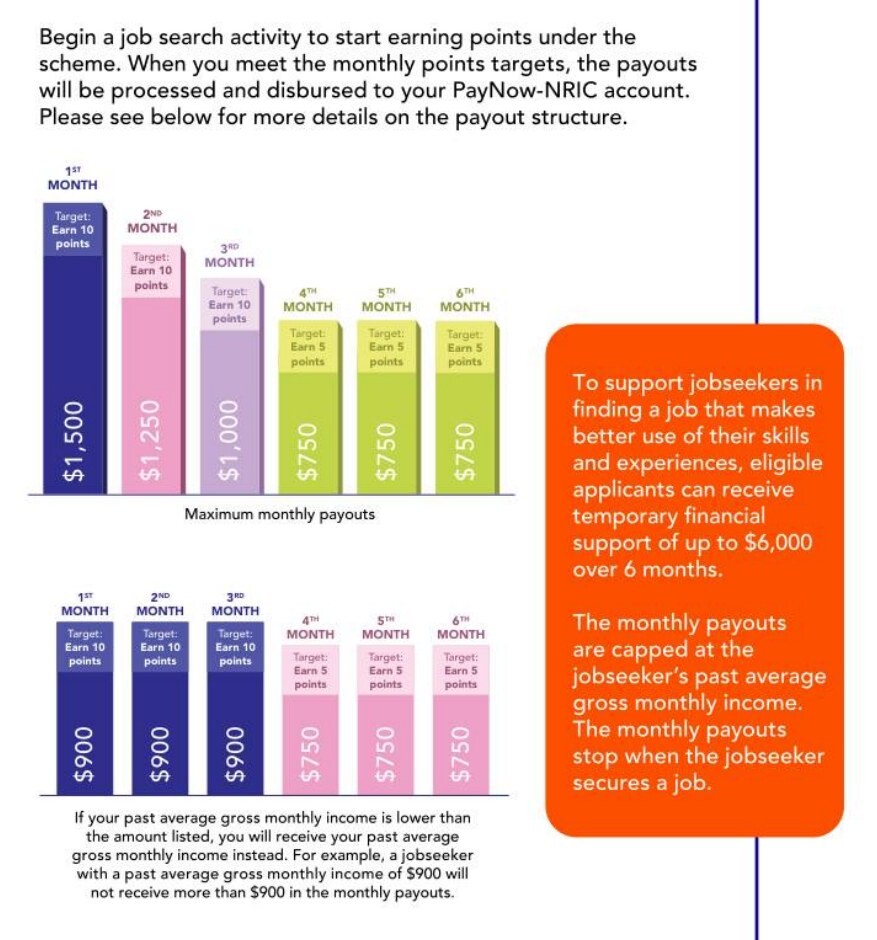
The money is front-loaded. The maximum payouts are S$1,500 in the first month, S$1,250 in the second and S$1,000 in the third, then S$750 a month for the fourth to sixth months. That adds up to S$6,000.
Each payout is capped at your past average gross monthly income. Someone who used to earn S$900 a month, for example, gets no more than S$900 in any month. The payouts stop once you find a job, and they go to your PayNow account linked to your NRIC.
You earn the money with points
The payouts are not automatic. You collect points for job search activities and upload proof on the scheme’s portal. The target is at least 10 points a month for the first three months and at least five points a month for the last three.
A job interview earns four points, with no monthly limit. A career coaching or career advisory session is also worth four points, once a month. Attending a career event or workshop earns two points, up to twice a month, and so does a training course listed on MySkillsFuture, once a month. A job application on MyCareersFuture or another job portal earns one point, up to five times a month.
What to prepare before you apply
You apply online with Singpass at go.gov.sg/jobseekersupport.
Have three things ready: the termination or dismissal letter from your former employer, your CPF transaction history for the past 15 months, and a medical certificate or letter from the doctor or hospital if you were let go for medical reasons. SWDA will contact your previous employer to verify the details. Processing can take up to 10 days, and the outcome comes by email.
SWDA’s hotline for the scheme is 6669 7932, and help is also available in person at Careers Connect at the Lifelong Learning Institute.