I went into Singapore Night Festival 2026 expecting pretty lights. I came out having personally contributed to the noise pollution around a shopping mall by shouting a stranger’s name over and over again. That is roughly the range of this year’s edition, and I mean that as a compliment.
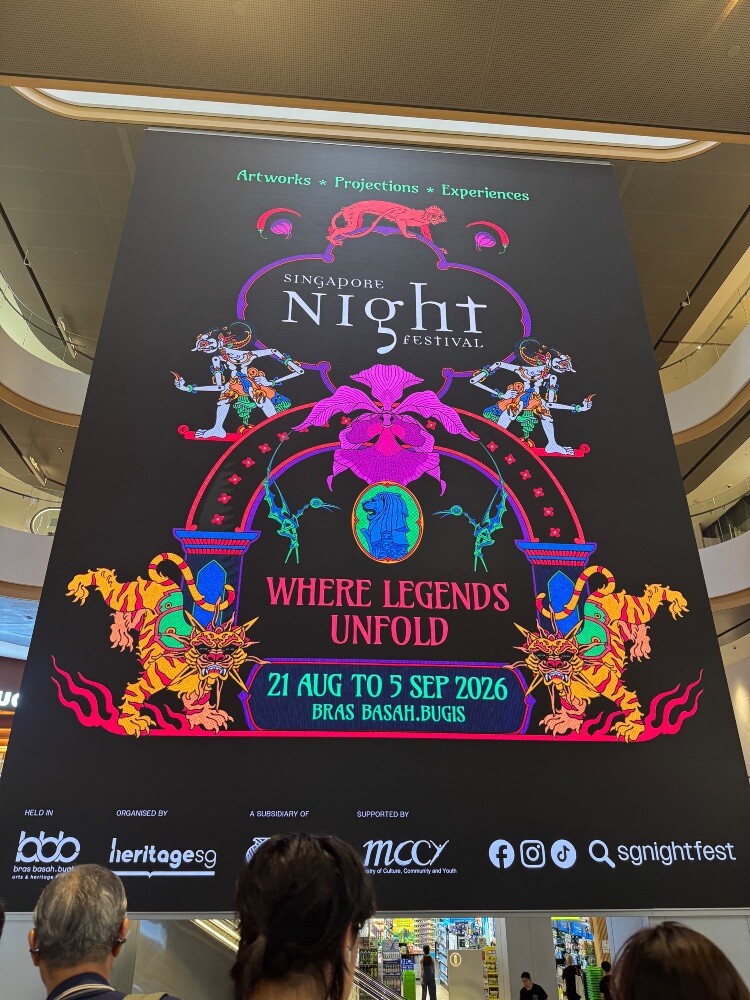
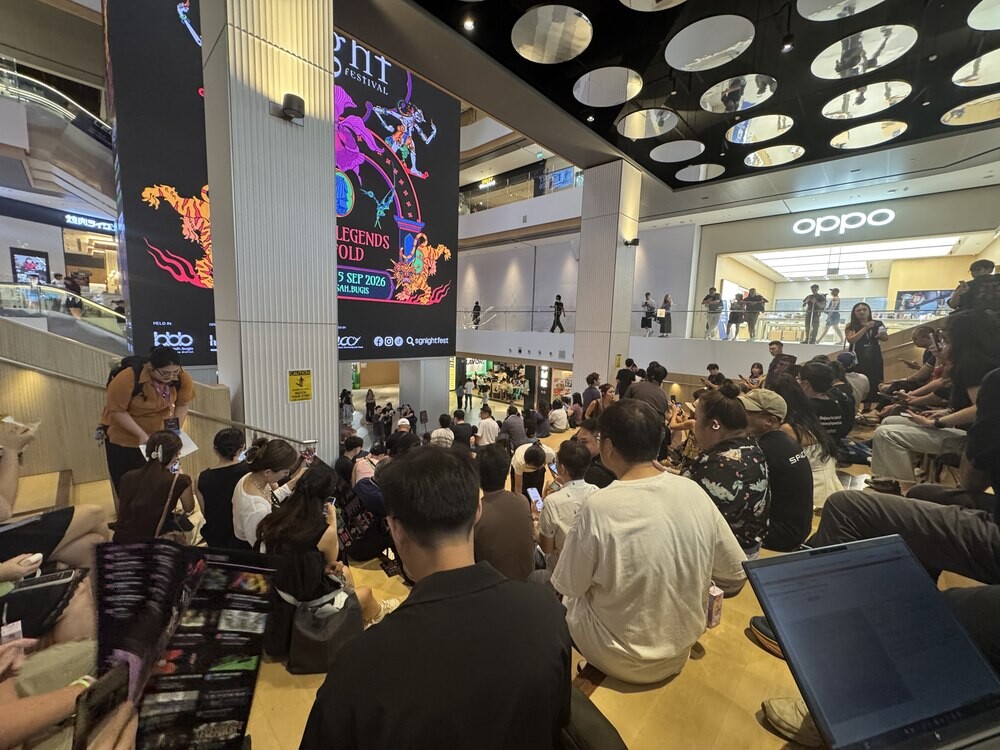
This was a media preview on the festival’s opening night, 19 August 2026, ahead of the public run from 21 August to 5 September. We started at The Cathay for a briefing and some refreshments, which is journalist-speak for “sit on the floor of a mall atrium with your laptop and hope the WiFi holds.” It did. Then we were sent out into Bras Basah.Bugis to see what SNF 2026’s 17th edition, themed Myths and Legends, actually looked like once the sun went down.
Short version: a lot of effort went into every single one of these installations. Long version follows.
Birdmen From the Netherlands (and They Do Not Walk Slowly)
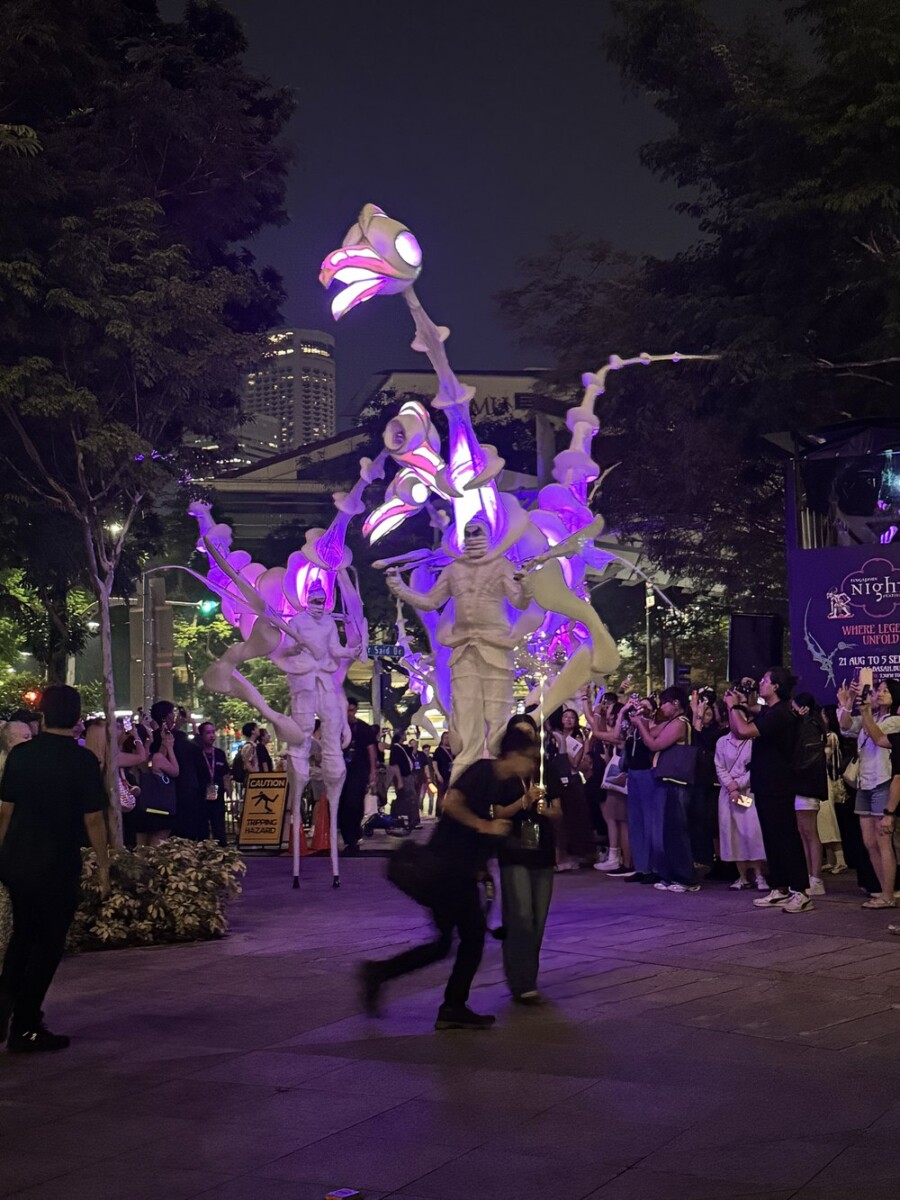
The first thing that stopped me in my tracks was Birdmen, performed by Close-Act Theatre, a street theatre company founded in the Netherlands in 1991 that specialises in exactly this kind of large-scale outdoor spectacle, the sort built for crowds of five to ten thousand rather than a cosy black box theatre. This is their Southeast Asian debut, and it shows: these are not your average stilt walkers.
The performers are strapped into what look like glowing, pterodactyl-like creatures on stilts that must be close to two metres tall, and they move with a coordination that is honestly a bit unfair to the rest of us who struggle to walk in a straight line after one beer. They are not slow either. They stalk, they swivel, they duck their long luminous heads down into the crowd, and then swing back up just as someone leans in for a closer look.
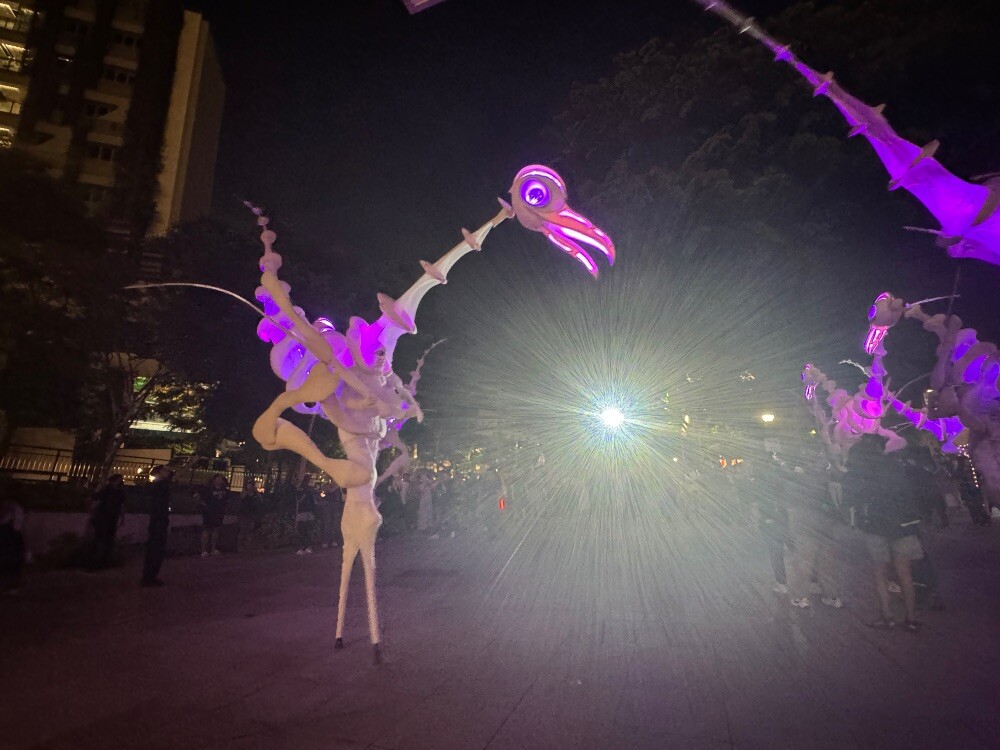
Blinding light from an UFO? No, that’s just the light projector
I watched the bird heads dip toward a cluster of bystanders who scattered like pigeons, and I will admit I was one of the pigeons. Genuinely one of the funniest things I have seen at a heritage festival, and I have seen a fair few.
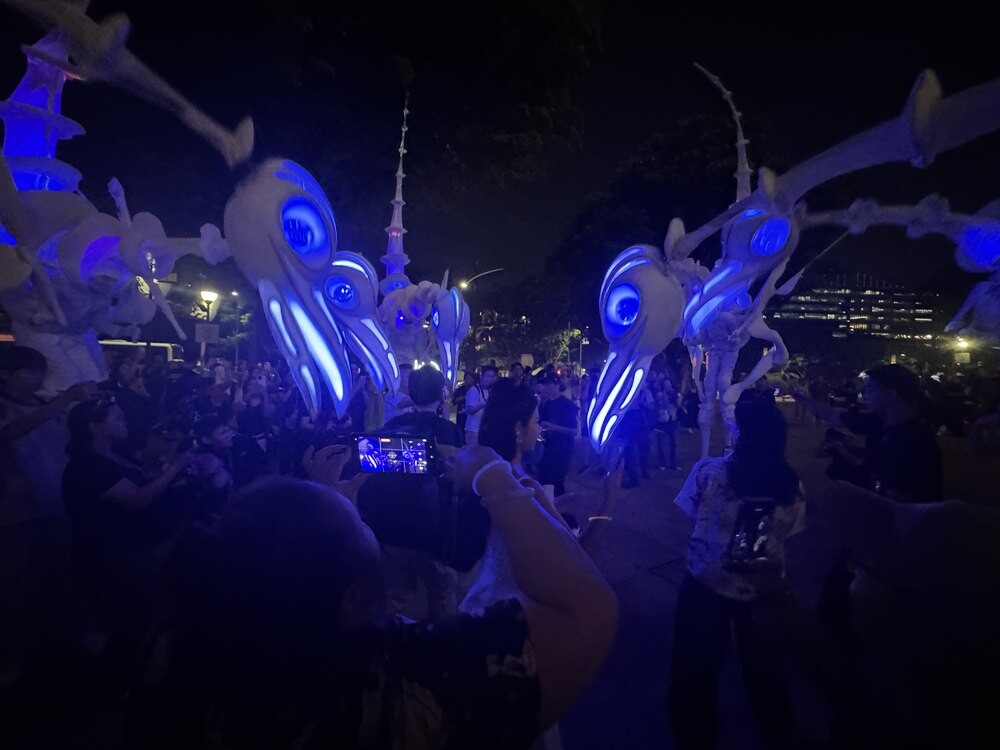
Small detail that told me someone had thought this through properly: there was an actual “Caution, Tripping Hazard” sign planted on the grass next to the performance area, because apparently grown adults backing away from a fake bird will absolutely trip over a kerb. Fair warning, and accurate.
The Cathay’s Facade Goes to War, Nicely
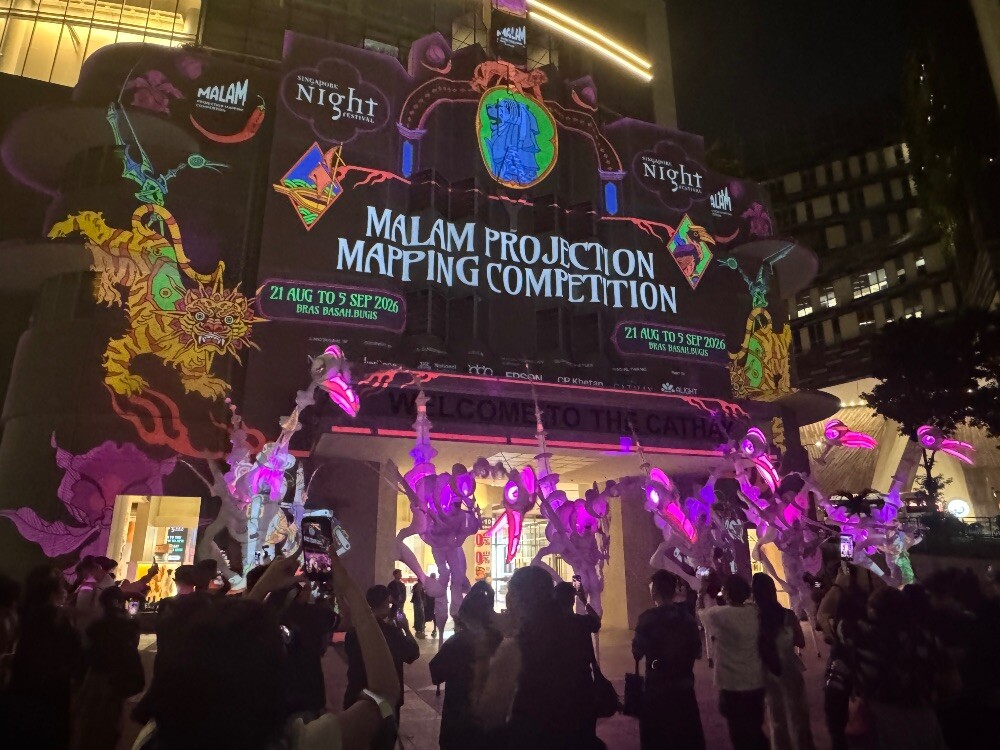
A short walk away, The Cathay’s facade was doing its own kind of performing. This year marks the inaugural MALAM Projection Mapping Competition, supported by Epson, which drew close to 50 submissions from artists, students and collectives across Southeast Asia. The top 20 entries get their turn on the Cathay’s facade during the festival’s first week, and the top five survive as staple projections for the rest of the run. Standing underneath it, phone camera struggling to keep up, I understood why it turned so many heads. This is exactly the kind of platform Singapore does not get enough credit for building: a proper stage for regional creative talent, not just imported spectacle.
Second Chances, One Ribbon at a Time
Over at SMU Campus Green, I found the artwork that got me the most, emotionally speaking. It is called You and I, Believing…, made by the Yellow Ribbon Community Arts Festival Committee 2026, and it is sited where the old 19th century Bras Basah convict jail once stood, which is not a detail you get from just looking at it.
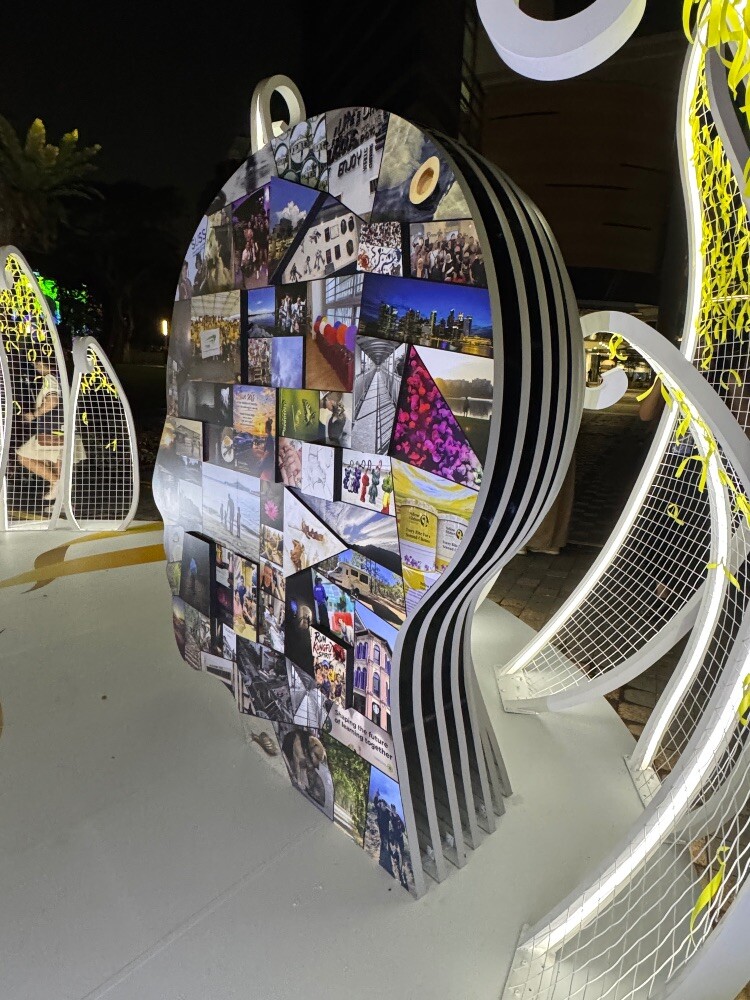
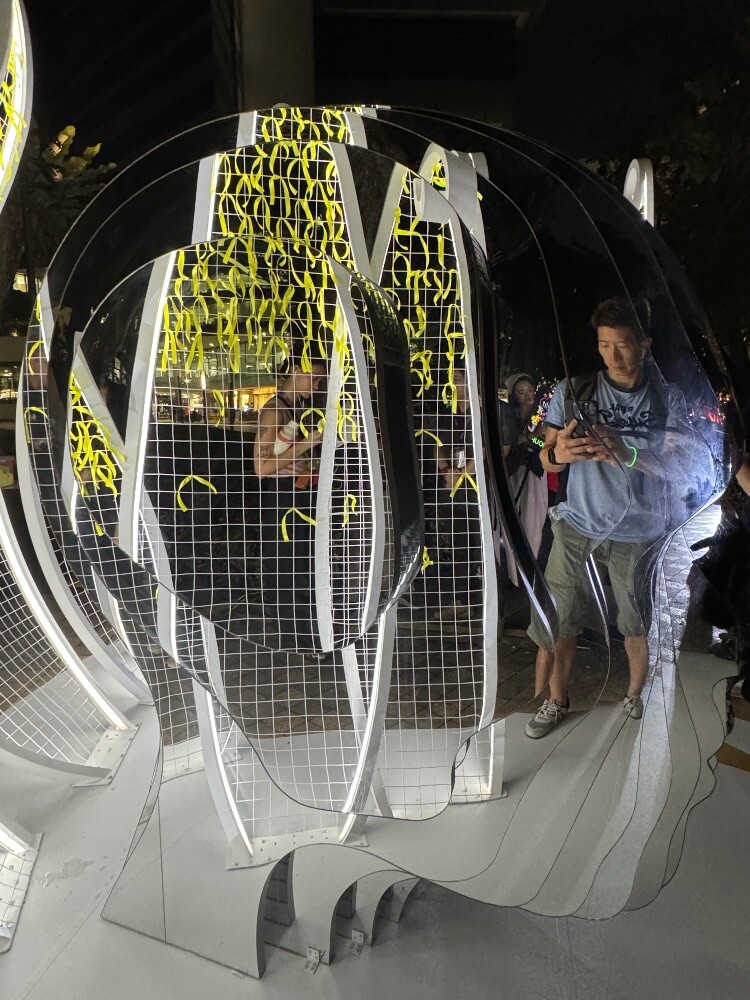
The structure starts out as a set of white wire-mesh petals, almost blank. Visitors are invited to tie a single yellow ribbon onto the mesh, and as more people do it over the course of the festival, the whole sculpture gradually shifts from white to fully yellow.
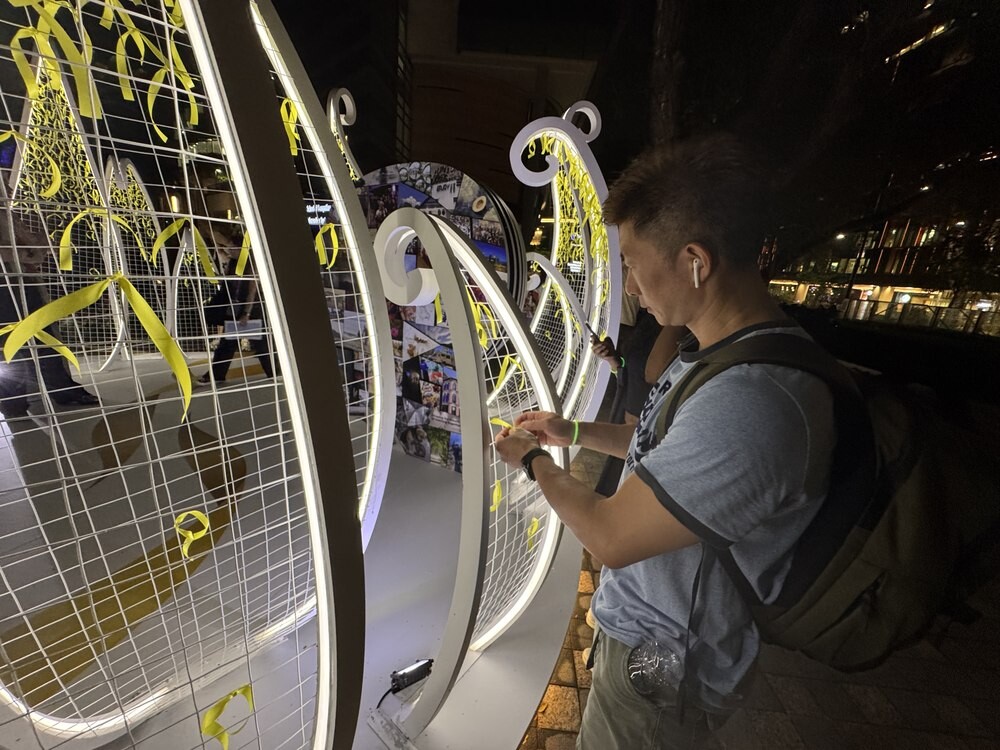
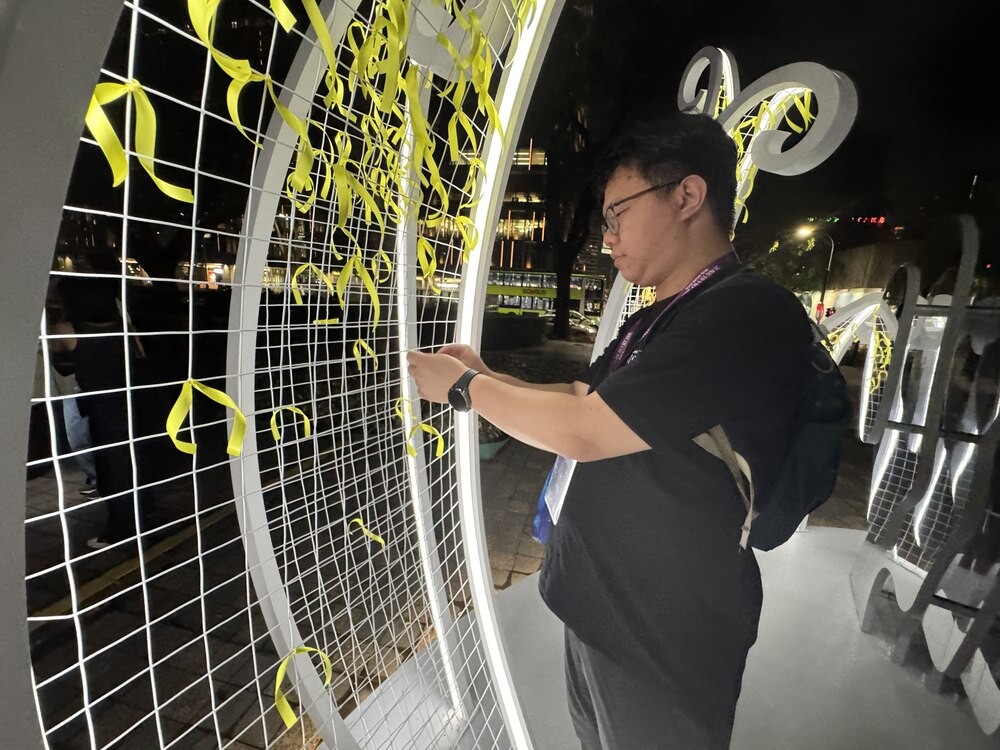
It is a simple mechanic, but the theme, identity and second chances, is not simple at all, and watching strangers quietly tie their own ribbon onto someone else’s story was a genuinely nice moment in the middle of an otherwise very loud night. I tied one. I am not going to tell you what I was thinking about while I did it.
Traces, Where the Trees Do the Talking
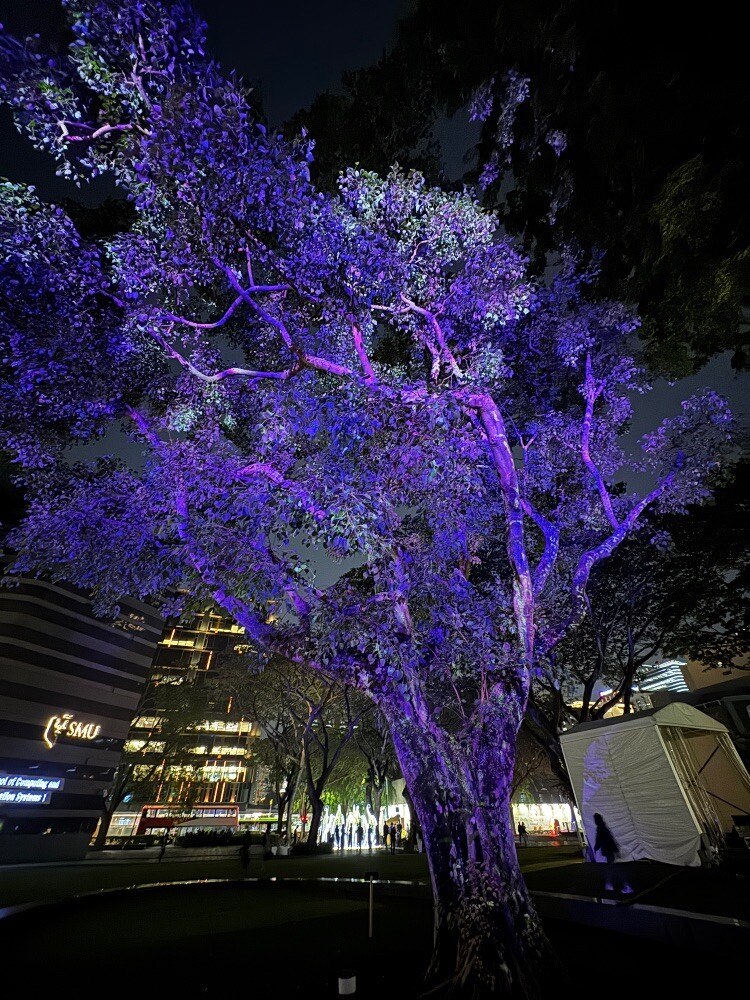
“Light vandalism” on trees is allowed
Also on SMU Campus Green, tucked into a wooden amphitheatre ringed with real trees, is Traces by Filipino multimedia artist Isaiah Cacnio. It is inspired by the Singapore Stone, the fragment of an ancient, still-undeciphered inscription that once stood at the mouth of the Singapore River. The light projections hit the tree canopy and the wooden steps at the same time, so the whole amphitheatre seems to breathe with colour rather than just display it.
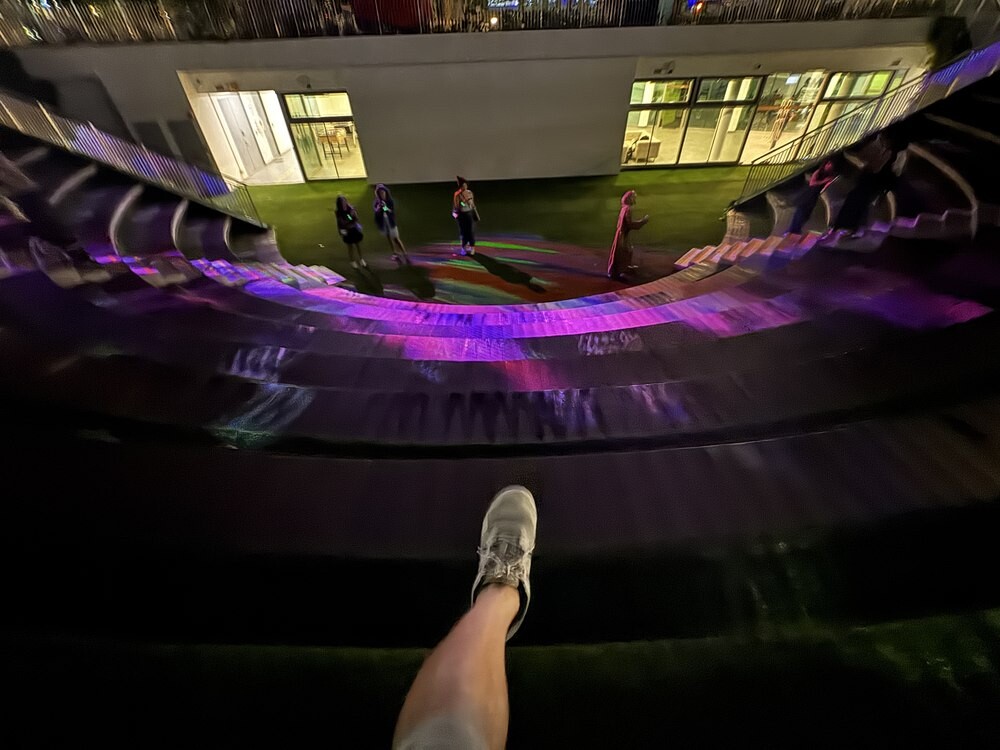
I sat on the steps for longer than I meant to. There is something about watching a light show land on bark instead of a flat screen that does more of the imaginative work for you.
As we boarded our short bus ride to the next location, somewhere along Bras Basah Road I clocked a row of giant chilli and onion skewers glowing on stilts, like the world’s most committed satay stand had wandered off and started praying. Turns out that’s exactly what it was: Plant Chilli Then No Rain! by design firm Arup, sited at the reflection pool by Bras Basah MRT Station as part of Light Together Bras Basah.Bugis, HeritageSG’s separate but overlapping National Day trail. It plays on an old superstition that planting, or burning, chilli and onion keeps the rain away, which somebody at HeritageSG clearly decided was worth invoking for an outdoor festival in Singapore.
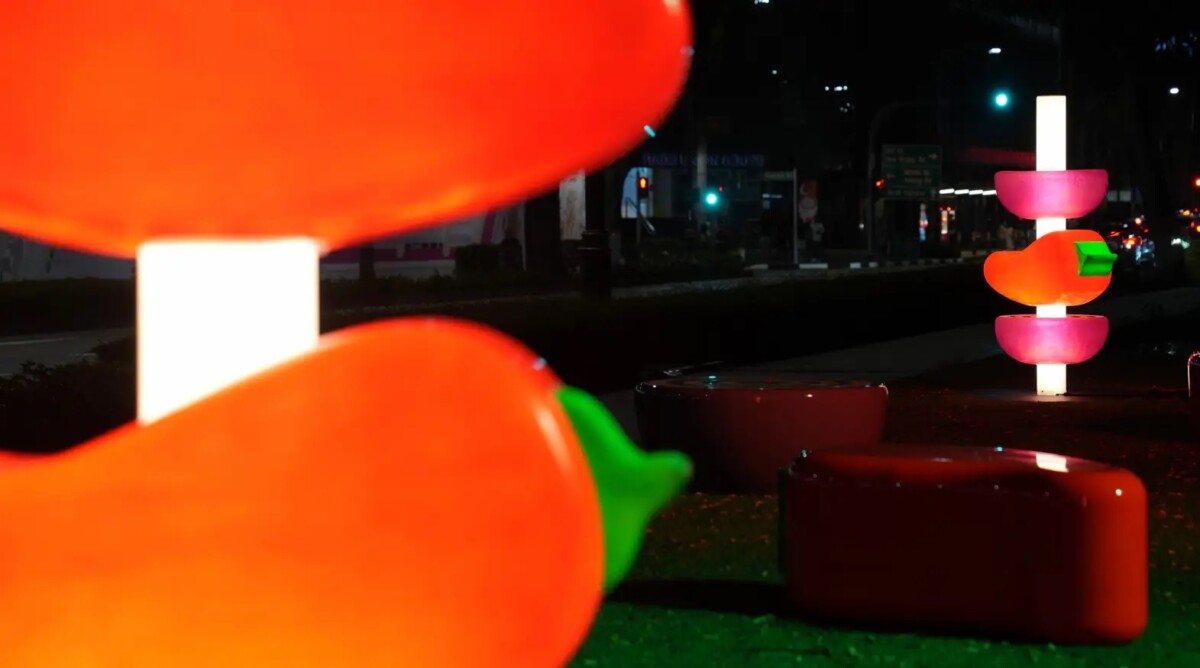 Rain, rain, go away
Shouting “Minah” at Funan (and Nearly Blinding Myself)
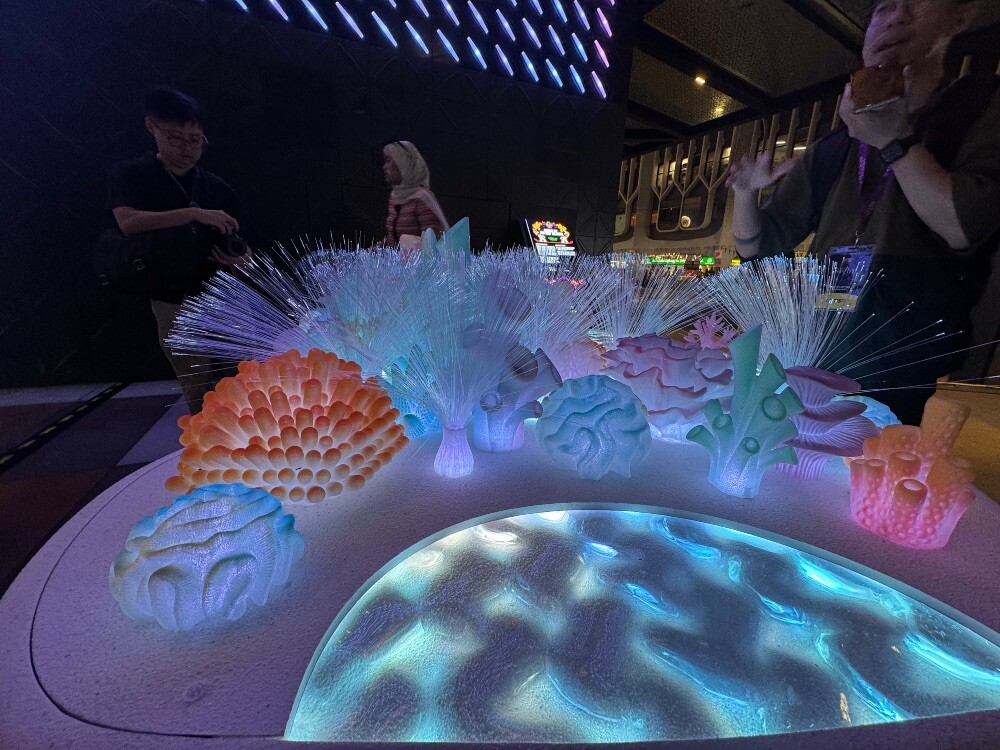
Corals, corals shining bright
Then Funan happened, and I have to be honest, this was the highlight of my night. Rising of Sisters’ Island, by Singapore-based studio SERIAL CO_, sits on Funan’s Level 1 as a kinetic wall of light. It retells the legend of two sisters, Minah and Linah, who braved a violent monsoon while fleeing pirates and were transformed into what are today the Sisters’ Islands, now a marine park. The installation is voice-activated: you call out a sister’s name at your station, a stranger calls out the other name at theirs, and when both names ring out together, the sculpted corals light up in a synchronised burst.
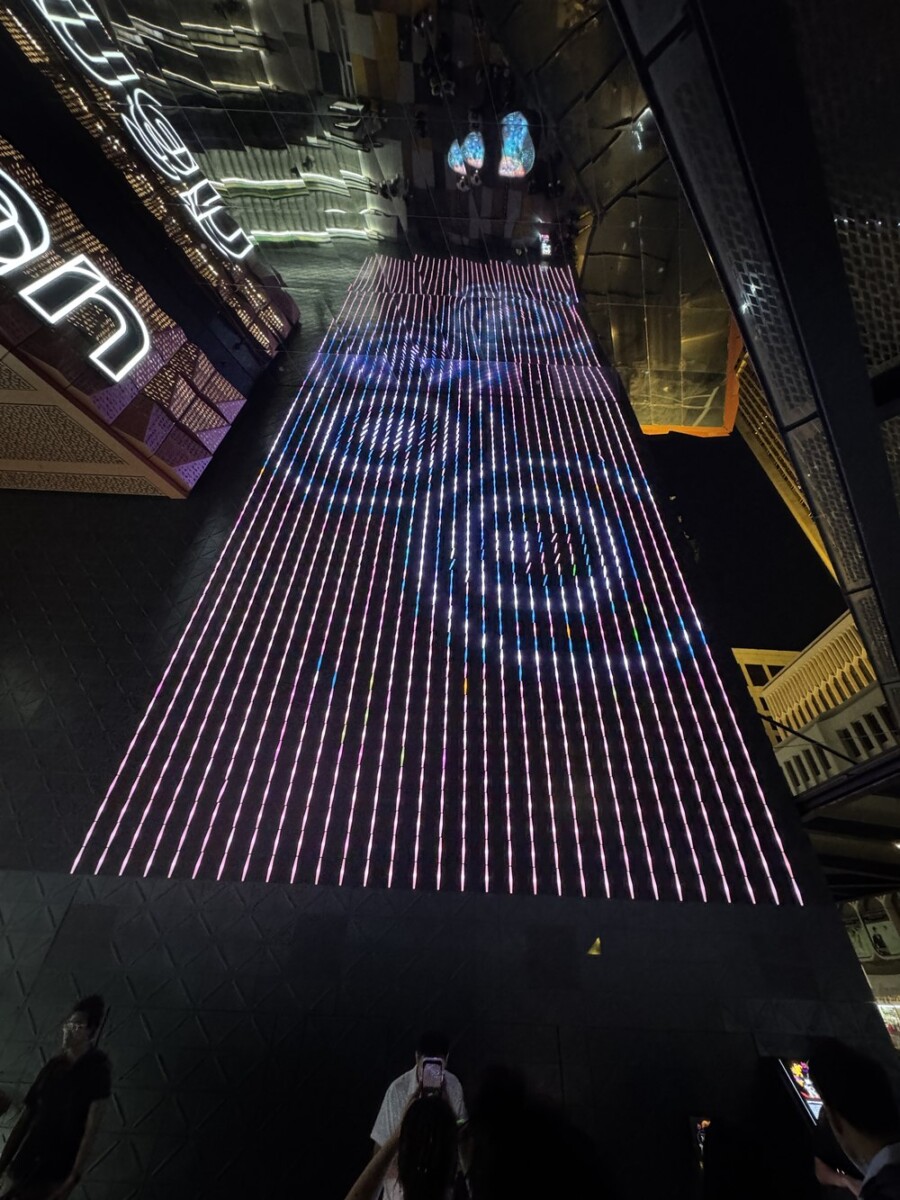
I shouted “Minah” more times than I am willing to admit in print, mostly because the timing with the stranger on the other side kept falling apart, and by the end I had genuinely dazzled myself with my own light show. Worth every slightly hoarse syllable.
Once Upon a Time, Told in Old Uniform
At Capitol Singapore Outdoor Plaza, Once Upon A Time is a community installation co-created by weaver and upcycling artist Natalia Tan with students from the Cora School Recycling League: thirty animal sculptures built entirely from textile waste, retired uniforms and the discarded cloth of daily life. The figures draw on the old Malay tale of Sang Kancil outsmarting Sang Buaya (the mousedeer that outwits the crocodile), plus a watchful tiger and a tapir borrowed from the historic William Farquhar natural history drawings, arranged into a dramatic hourglass shape suspended from an overhead truss. Visitors can add their own stitches and buttons to the ground-based pieces, and the whole thing is backed by Official Sustainability Partner Cora Environment and Official Partner Capitol Singapore.
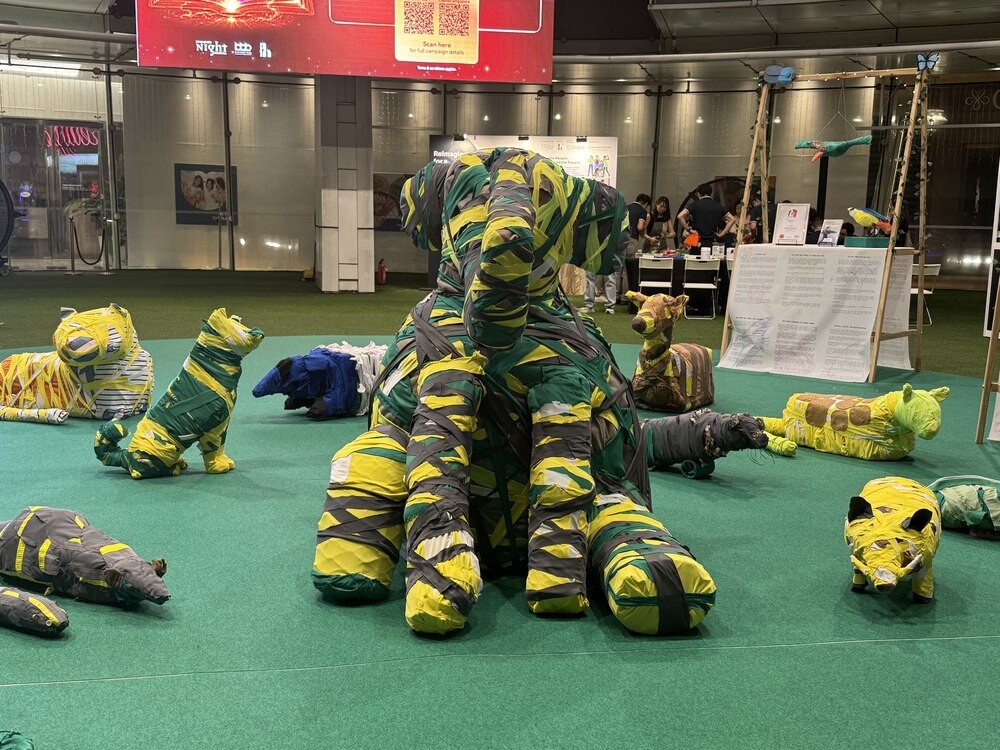
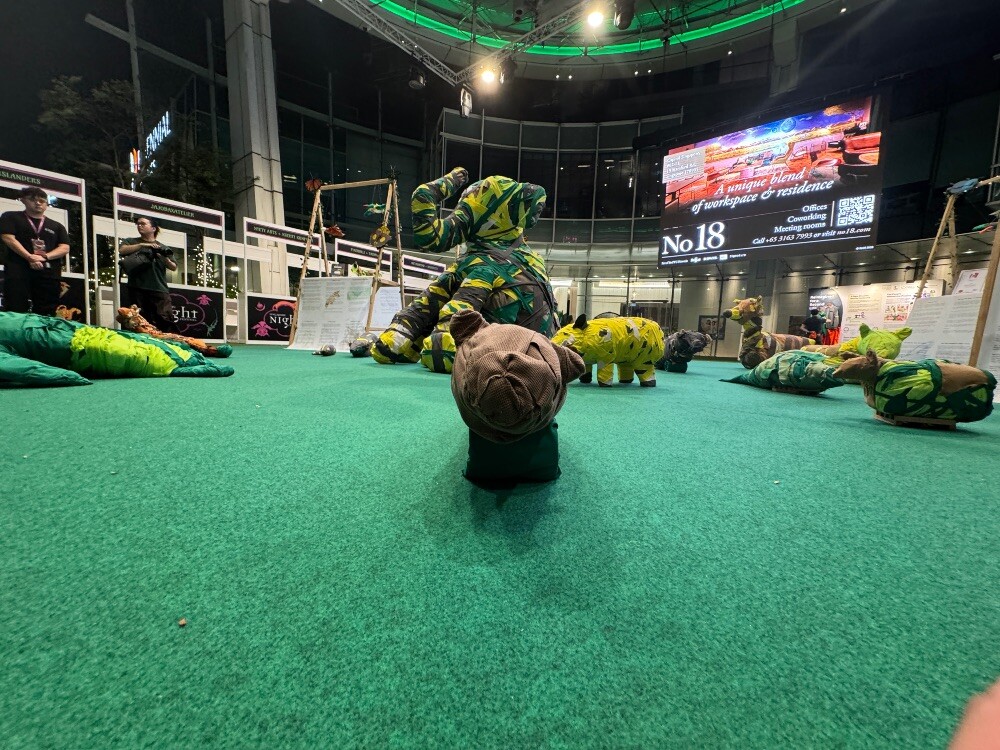
I can’t make out what you are, I’ll just call you piglet
It is quietly one of the more thoughtful pieces on the trail, precisely because it does not shout for attention the way a projection does.
Walking Through Inter-Light, One Shadow at a Time
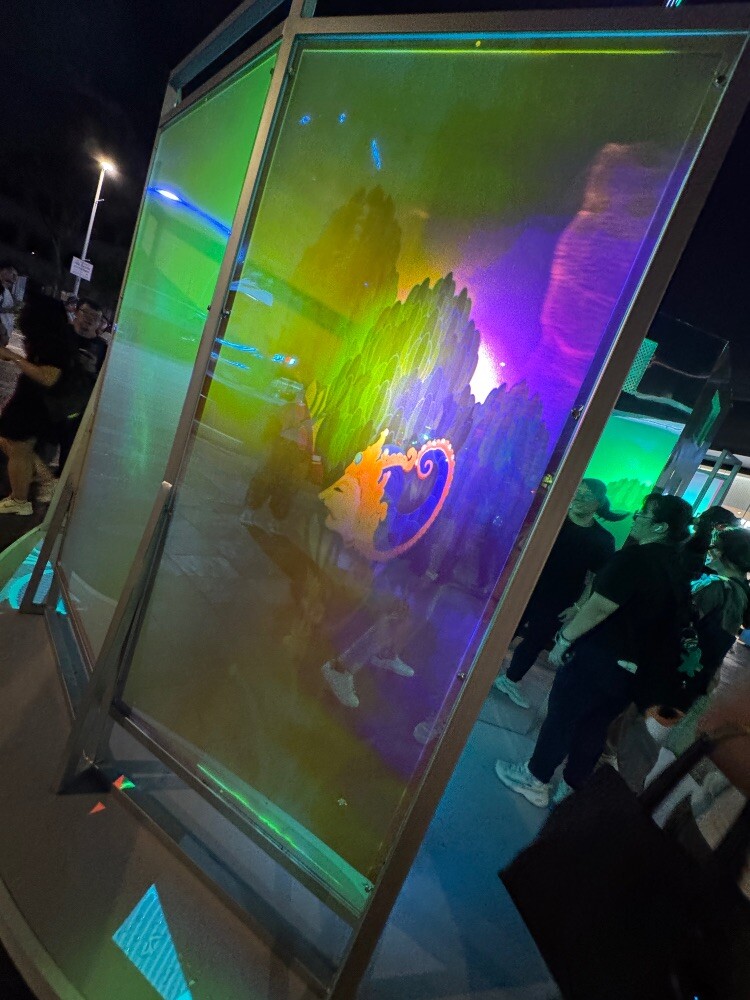
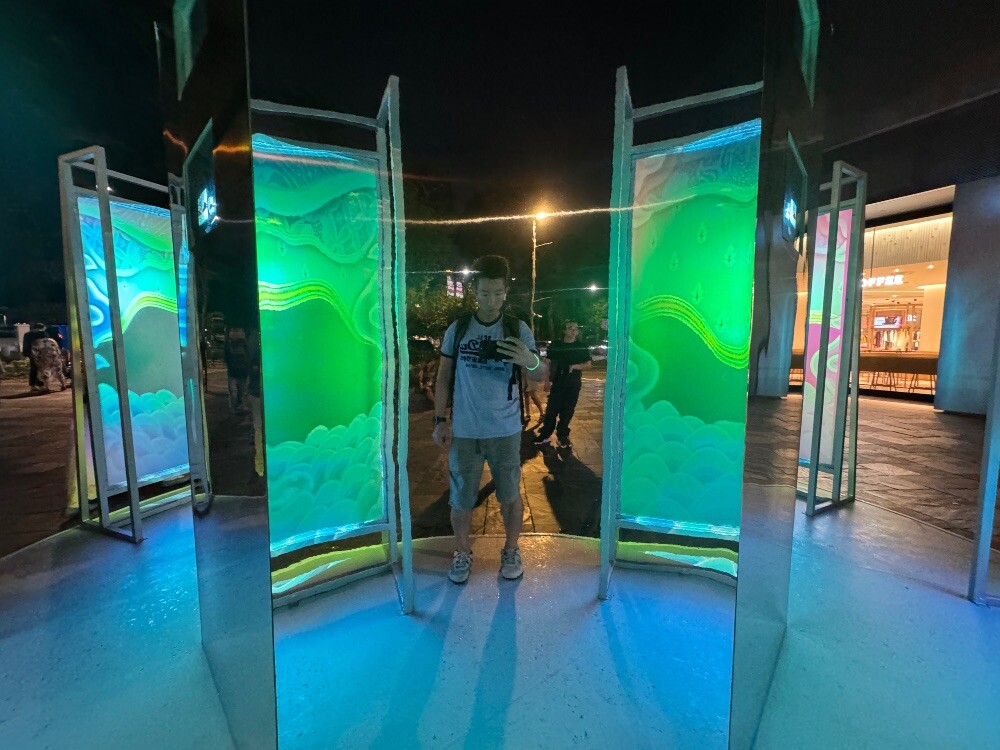
At Raffles City, Inter-Light by Singapore-based visual artist Ching Kai draws on more than 20 years of work across paper art, installation, scenography, photography and moving image. By day the structure is a tapestry of shifting colours and reflective surfaces that respond to sunlight and whoever happens to be walking past. By night it becomes a walk-through of animated shadow projections and wayang-inspired silhouettes, including a rather regal-looking lion that had me standing in a stairwell far longer than the shot deserved, all set to live music and sound. You are meant to step into the projections yourself and become part of the shared story, which is either participatory art or an excellent excuse to loiter in a mall stairwell, depending on your mood.
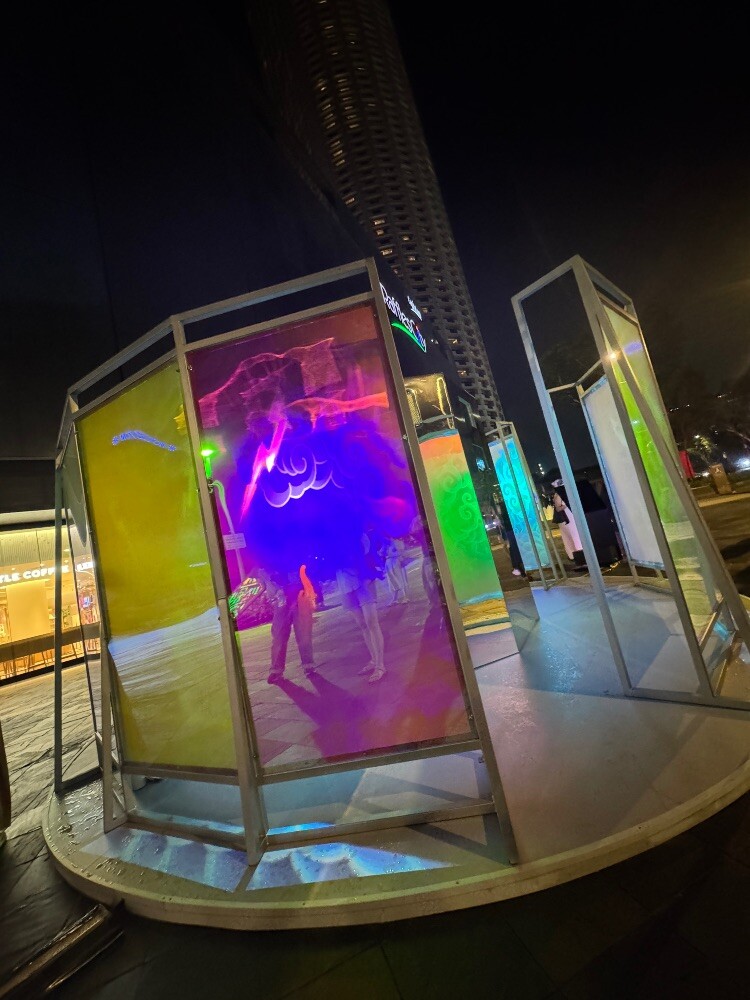
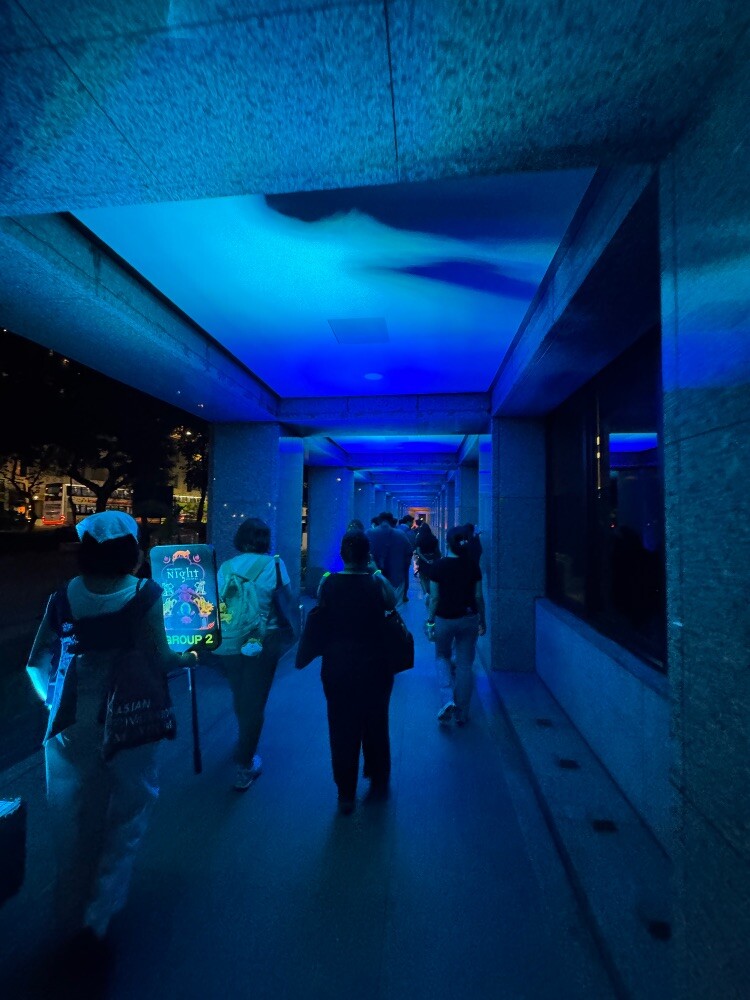
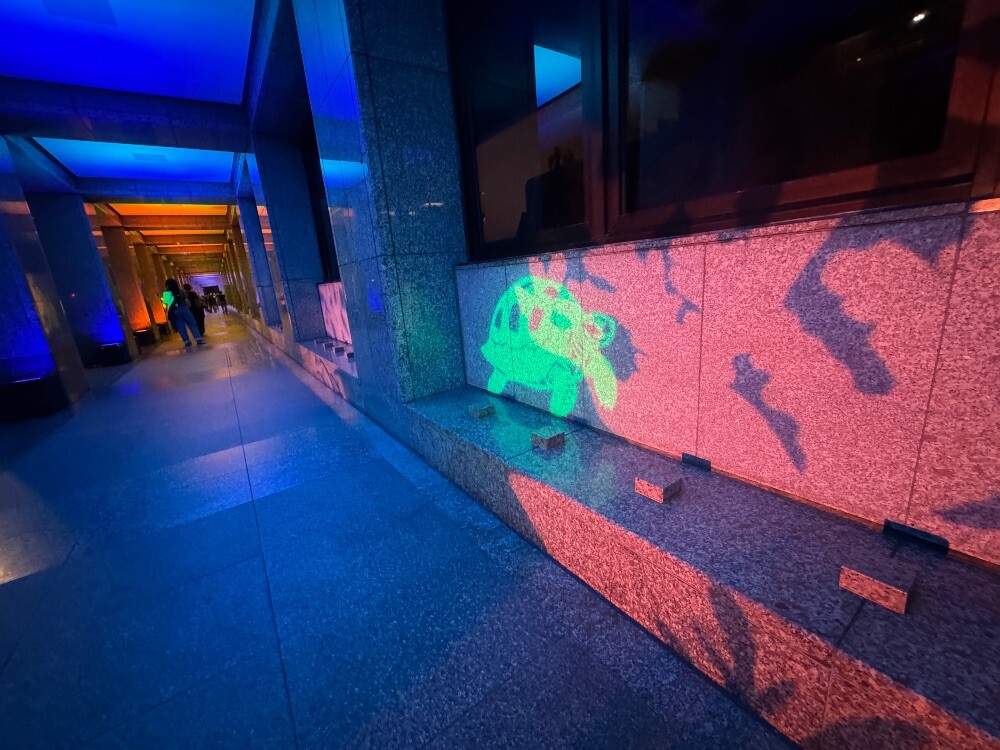
Small, green and in absolutely no rush to be anywhere.
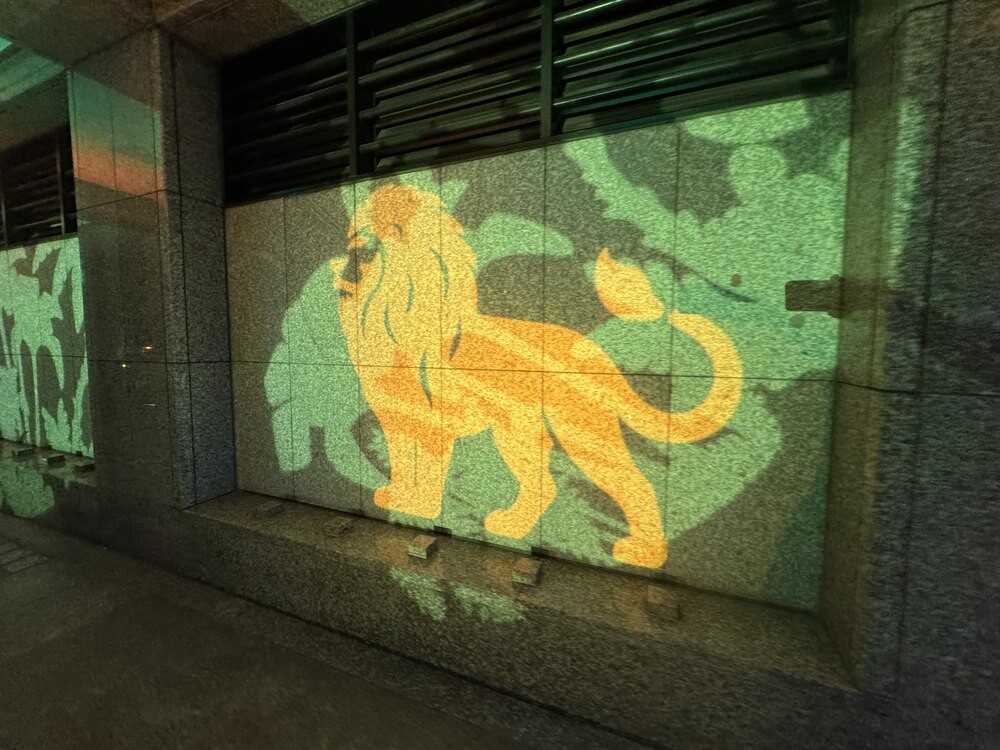 The most dignified lion I met all night.
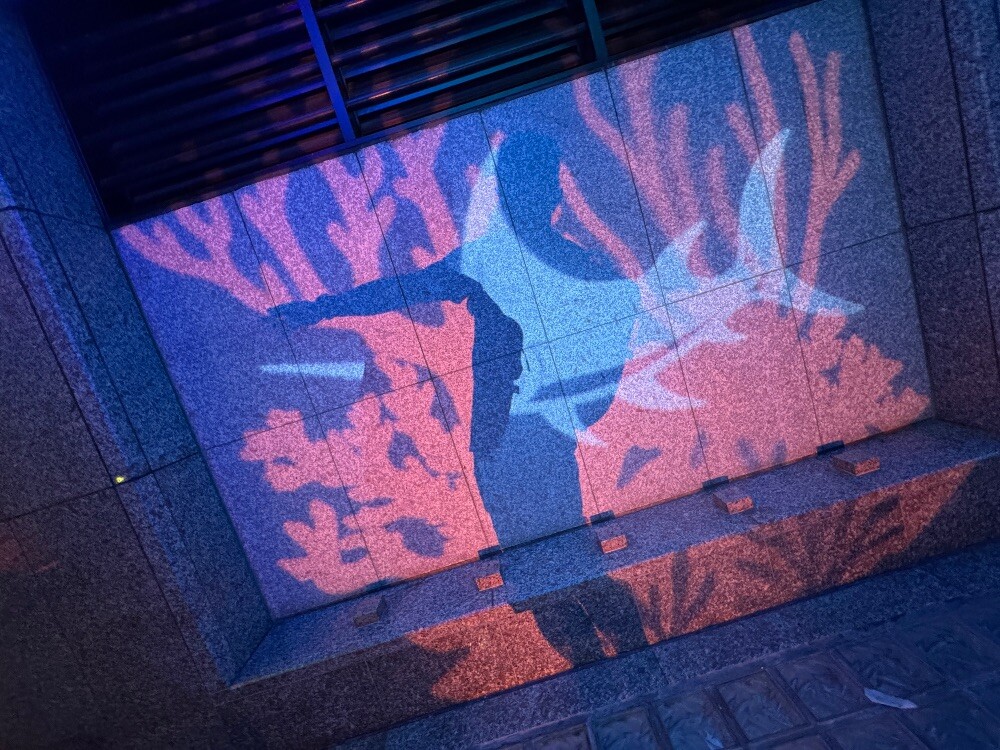 Proof I can strike a pose. Proof I probably shouldn’t.
When the Peranakan Museum’s Own Myths Escape
Just off Armenian Street, the Peranakan Museum gets properly surreal treatment. The Great Mythical Stampede, by local production studio CHUNKIE Filmhouse, imagines the museum’s own mythical creatures breaking loose from the antiques they are usually stuck on. Winged horses soar off carved wood, lion-dogs leap from porcelain, and phoenixes burst out of embroidered silk, all rendered as glowing neon frames against the museum’s own 1910 facade.
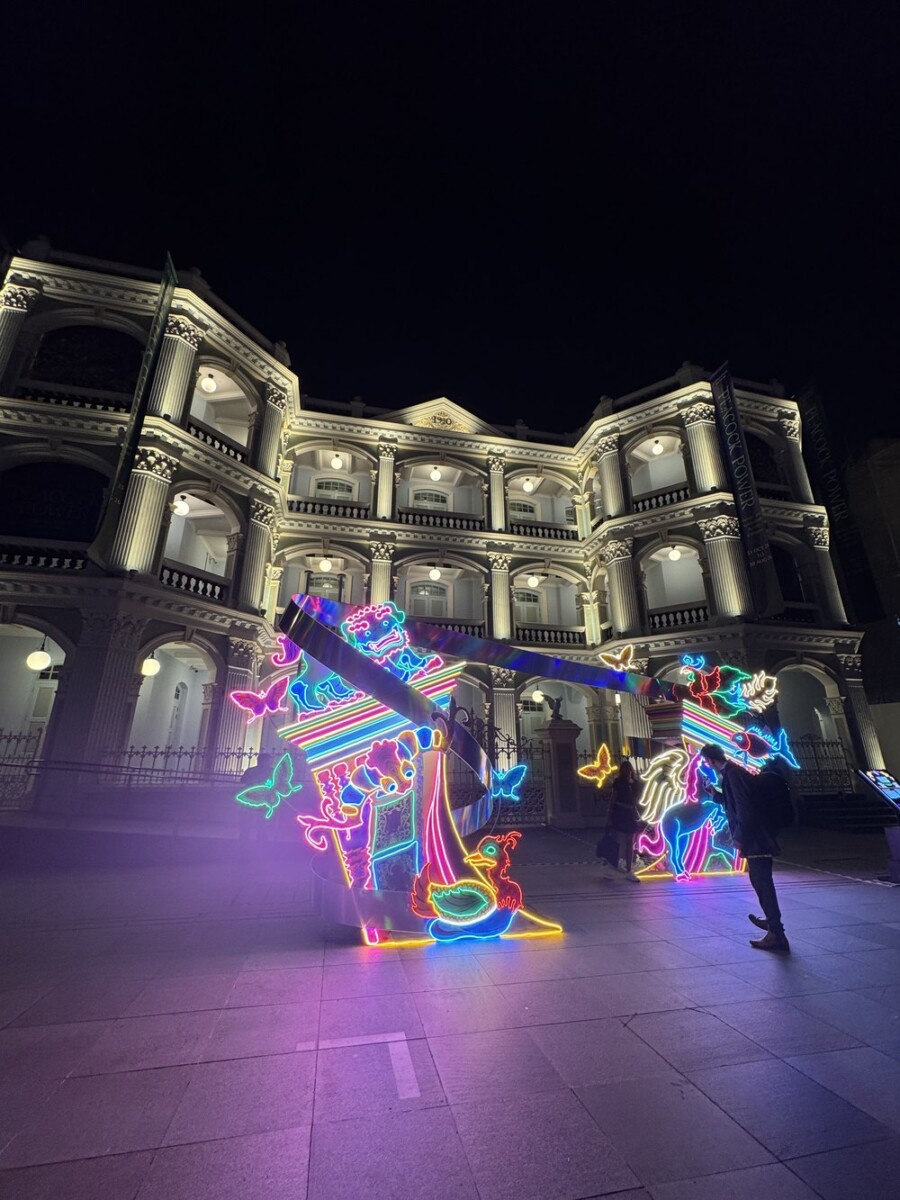 Peacock power, literally, according to the building plaque behind it.
I am amusing myself with my twisted image. Men.
Vikings of the Tropics Sail Into Armenian Street
A short walk further, Armenian Street Lawn belongs to Vikings of the Tropics by local creative studio TELL YOUR CHILDREN, a culture-led IP studio founded in Singapore in 2014 and known for its eclectic, whimsical visuals. The installation is a nautical piece rooted in the La Galigo epic and the so-called Vikings of Nusantara, and it exists to remind you that Bugis and Buginese sea traders used Singapore as a port hub long before anyone here called it a hub for anything else. Expect a wall’s worth of intricately inked ships and sea creatures inside what is essentially a themed alley, tracing the old maritime trade routes that shaped the multicultural, merchant character of the district we now call Bugis.
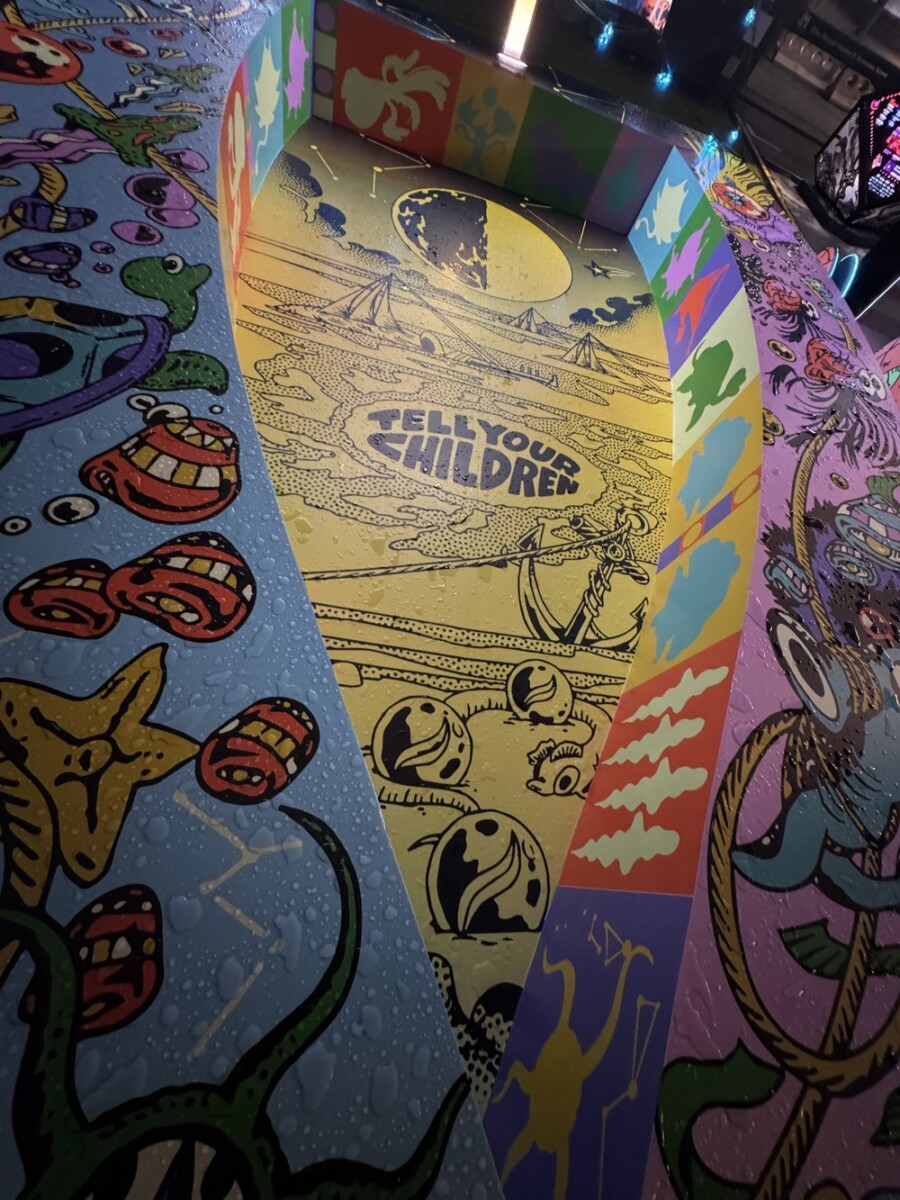 Tell your children. I am telling you instead.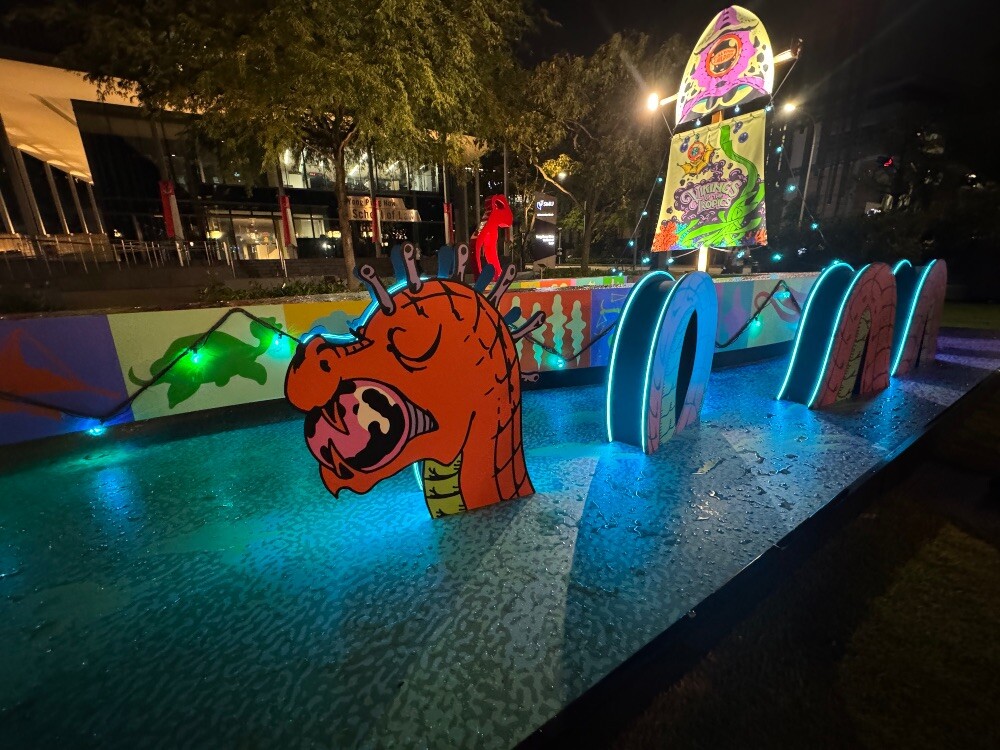
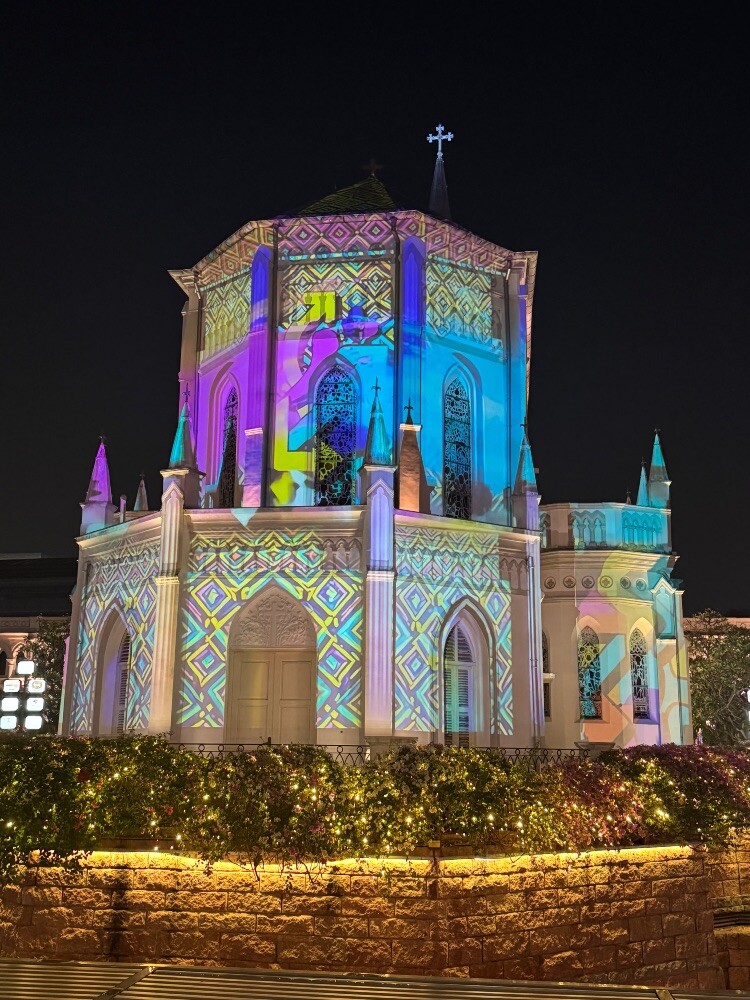
A few minutes from there, CHIJMES Hall gets its own projection treatment with Textures Through Time by Race Krehel, a Southeast Asia-based creative with more than 15 years in immersive media. The facade moves through the building’s own material history: the woven earth of early kampongs and colonial-era marble, then post-war half-tone prints and CRT static, before settling into a digital pixel grid and a slow, futuristic, bioluminescent pulse. It runs nightly from 7pm to 11.30pm across all three weekends, which makes it one of the easier big-format pieces to catch if your evening runs long.
Worth Braving the Crowds For?
Yes, without much hesitation. SNF has been running for 17 editions now, and the thing that struck me this year was how consistently thought-through the work was, right down to a tripping hazard sign and a wire mesh that slowly changes colour over three weeks because strangers keep showing up to tie ribbons on it. That is not something you fake with a big projector and a bigger budget. Someone actually sat down and designed for the small moments, not just the big ones.
Official Details
Singapore Night Festival 2026
Theme: Myths and Legends
Dates: 21 August to 5 September 2026, across three weekends
Location: Bras Basah.Bugis precinct (Museum Zone, Zones 1 to 3), Singapore
Hours: 7.30pm to 11pm, Sunday to Thursday. 7.30pm to midnight, Friday and Saturday
Admission: Free for most programmes. A small number of ticketed experiences range from roughly $10 to $60, including The Lost Legacy of Fort Canning: The Forbidden Hill
Nearest MRT: Bencoolen, Bras Basah, Bugis, City Hall and Dhoby Ghaut stations all sit within reach of the precinct, depending on which zone you are heading for
Parking: Limited on-site parking at the National Museum of Singapore during the festival period; nearby carparks in the Bras Basah.Bugis area are the more reliable option
Website: heritage.sg/sgnightfest
Instagram/Facebook: @sgnightfest
TikTok: @sg.nightfest
Have you been down to Bras Basah.Bugis for Singapore Night Festival 2026 yet, or do you have a favourite Myths and Legends installation I should chase down before 5 September? Drop it in the comments.