Singapore is not heading for a social media ban for teenagers. The plan on the table is tiered access by age, with the work of proving age and making apps safer placed on the platforms, and the Government intends to legislate in 2027.
The outline came from the Ministry of Digital Development and Information (MDDI) in a written parliamentary answer on 5 August. Under-13s would be restricted from the designated social media services. Users aged 13 to 18 would get an age-appropriate experience, which could cover content, interactions and platform features. A platform that cannot meet those requirements “may be restricted from providing their services to users aged between 13 and 18”.
Which apps are covered
“Designated” has a fixed meaning here. IMDA designated six social media services under the Broadcasting Act from 18 July 2023: Facebook, HardwareZone, Instagram, TikTok, X and YouTube. All six already operate under the Code of Practice for Online Safety, which requires enhanced protections for users under 18.
WhatsApp, Telegram, Discord and Roblox are not among the six.
How age would be proven
The planned law would require platforms to run effective age assurance, within the Personal Data Protection Act.
MDDI splits age assurance into two kinds. Age verification confirms age against an identity document such as a passport or driving licence. Age estimation works out a likely age range, including through AI and facial age analysis.
In MDDI’s engagement, close to 80 per cent of parents agreed that verification, estimation or both should be used. Parents and youth both rated verification as more workable than estimation or self-declaration, and favoured an ID verification scheme run by the Government rather than by the platforms. Both groups also wanted privacy protected and no excess personal data collected.
What a teen account could look like
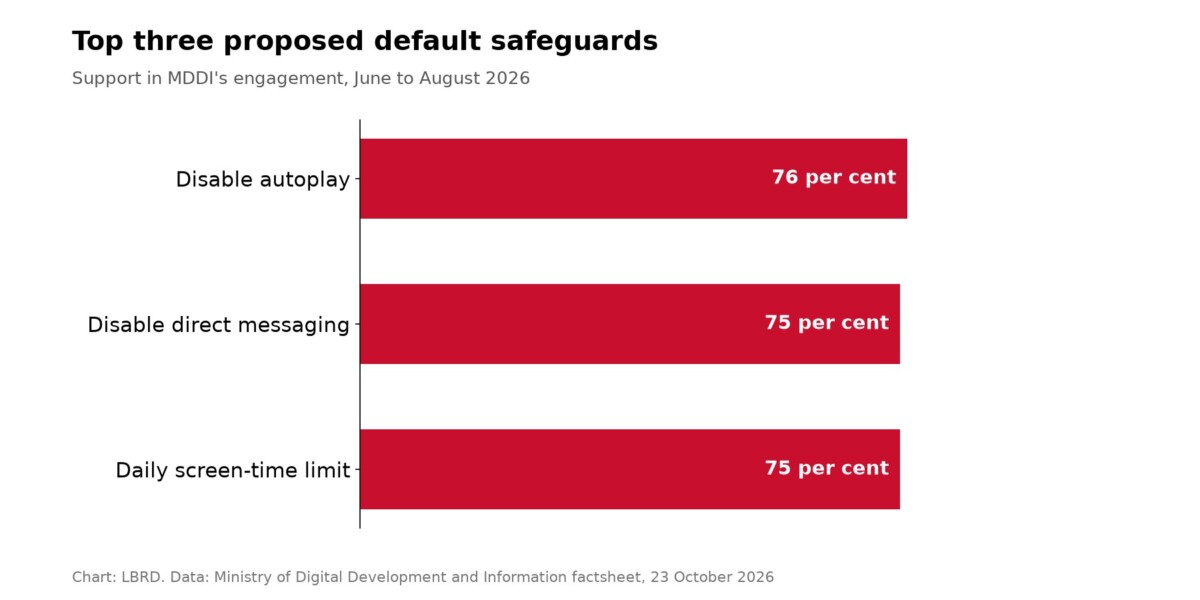
For teenagers, the Government is looking at social media that is safer by design: restrictions on inappropriate content and unwanted contact, and on features such as autoplay, plus a daily time limit.
The three proposed defaults with the most support were disabling autoplay at 76 per cent, disabling direct messaging at 75 per cent and a daily screen-time limit, also at 75 per cent. Parents wanted room to adjust those settings to their own child. Youth worried that fixed limits would get in the way of schoolwork and extracurricular activities.
Where parents and teens part ways
MDDI’s engagement ran from June to August 2026 and reached over 2,000 parents and youth through focus groups, school dialogues and a CrowdTaskSG survey, with extra sessions run by TOUCH Community Services, Fei Yue Community Services, YouthTechSG and Singapore Children’s Society. More than 80 per cent of parents and nearly 70 per cent of youth backed a tiered approach, and neither group favoured an outright ban.
The split comes at 16. Youth generally backed greater access from 16, seeing teens of that age as mature enough to manage their own use. Parents wanted age-appropriate access to continue until 18. Both groups agreed on no access up to age six.
Their worries differ too. Screen addiction and overuse topped the youth list at 71 per cent. For parents, inappropriate content came first at 84 per cent.
What is not settled
The Government intends to legislate next year, and no start date has been given. The cut-off ages and the age checks each platform must use are still to be written into law. In its August answer in Parliament, MDDI said consultations with the public and with the platforms were ongoing.