RINA Singapore Open Innovation Hub is one of the Singapore stories worth having on your radar this week.
The Singapore business angle
RINA Singapore Open Innovation Hub is now a more important piece of Singapore’s maritime and energy innovation landscape. The Economic Development Board said on 4 May 2026 that RINA is strengthening the hub with EDB support, with the aim of turning applied research into practical solutions for the maritime and energy sectors.
For companies watching Singapore’s industrial policy, the useful detail is not only that another multinational is expanding here. It is the kind of work being anchored: integrated digital twins that connect vessels, ports and hinterland systems, decarbonisation solutions such as alternative fuels and new operating models, and AI-enabled learning platforms that help workers adopt emerging technologies.
That mix fits where Singapore has been pushing hard: a port and maritime economy that cannot stay competitive by being only efficient, a green transition that needs testbeds rather than slogans, and a workforce agenda that has to move beyond classroom upskilling into tools people can use on the job.
What RINA says the hub will work on
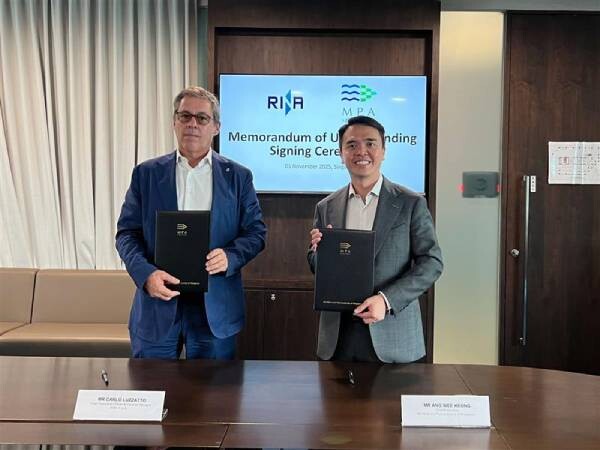
RINA’s own open innovation hub material describes these hubs as places where research becomes reality through collaboration with start-ups, universities, entrepreneurs and industry leaders. Its Singapore profile is especially pointed: port decarbonisation, alternative fuels, electrification and power infrastructure, with the local ecosystem used as a base for pilots and partnerships.
The EDB announcement adds a current operational layer. The hub is expected to support applied research, industry pilots and larger deployment, including multi-dimensional digital twins, alternative-fuel adoption pathways and advanced training systems. RINA also plans to expand its Singapore research and innovation team with 13 specialist roles over the next three years.
For readers outside the sector, a digital twin is best understood as a living operational model. In shipping and ports, that can mean linking vessel, terminal, route and hinterland data so operators can test scenarios before they affect real schedules, fuel use or emissions. The point is not a dashboard for its own sake; it is a way to make decisions earlier and with fewer blind spots.
Why maritime innovation keeps landing in Singapore

Singapore’s maritime advantage has always been partly physical and partly institutional. The city sits on one of the world’s busiest sea lanes, but its ability to attract maritime technology work comes from regulators, research bodies, port operators, classification societies and universities being close enough to test ideas in realistic settings.
That matters for lower-carbon shipping because many solutions need industry coordination before they become commercially useful. Alternative fuels, battery systems, port digitalisation and emissions accounting all involve more than one company. A shipowner cannot solve fuel infrastructure alone; a technology company cannot validate a maritime safety system in isolation; a training provider cannot close skills gaps without live industry use cases.
If you have been following Singapore’s wider technology calendar, this also sits beside other industry-facing events such as our ATxEnterprise 2026 visitor guide. The difference is that RINA’s hub is not a public exhibition. It is a capability-building node for companies trying to move maritime and energy ideas into actual deployment.
What SMEs and workers should watch
The immediate audience is maritime, energy and industrial technology firms, but the knock-on effects are wider. Local engineering companies may find new partnership routes if pilots need integration, training, testing or specialist services. Workers in marine engineering, data operations, sustainability reporting and industrial systems should also pay attention to how AI-enabled learning platforms are framed.
The best signal to watch over the next year is whether the hub produces named pilots with clear commercial partners. Announcements are easy; deployment is harder. Useful follow-up indicators would include port or vessel digital-twin trials, alternative-fuel demonstrations, new training modules for specific job roles, and evidence that Singapore-based teams are being hired for specialist technical work rather than only regional coordination.
RINA’s Singapore push is therefore worth reading as a business-development story and a jobs story. It is a small headcount commitment on paper, but in a specialised field, 13 research and innovation roles can point to deeper work being anchored locally.
Official details are available from the main official source, supporting official source, supporting official source.
What To Watch Next In The Hub Build-Out
The next useful milestone is whether RINA names local collaborators for specific pilots. For maritime companies, that could mean port-call optimisation, vessel-performance modelling, safety assurance for new fuels or emissions data that can survive commercial scrutiny. For energy companies, the more interesting thread is how electrification, power infrastructure and alternative fuels move from feasibility work into operating environments.
Singapore readers should also watch whether the hub connects with universities, polytechnics and specialist training providers. RINA’s stated interest in AI-enabled learning platforms is not a decorative point. Maritime and energy transitions often fail when frontline teams are expected to adopt new systems without role-specific training. If the hub produces practical training modules for marine engineers, port planners, inspectors or sustainability officers, that would make the announcement more consequential.
The commercial value will be measured in use cases. A strong Singapore hub should be able to show which operational decision became faster, which safety check became clearer, which emissions pathway became more credible or which worker group gained a new applied skill. Until those examples emerge, the RINA expansion is best read as an important capability signal rather than a finished transformation.
Why It Matters To Smaller Firms
Large maritime and energy names usually dominate announcements like this, but smaller Singapore firms should not ignore the hub. Many pilots need vendors who understand sensors, compliance documentation, simulation, training content, cybersecurity, maintenance workflows and customer deployment. SMEs that already serve shipyards, marine operators, logistics companies or industrial clients may find opportunity at the edges of bigger innovation projects.
The practical move is to follow RINA and EDB updates for named programmes rather than waiting for a broad grant call. When a pilot becomes public, the useful questions are concrete: what problem is being tested, what kind of partner is needed, what data access is required, and whether the solution has a path beyond one demonstration. Singapore’s strongest innovation stories usually come when testbeds become references for exportable services.