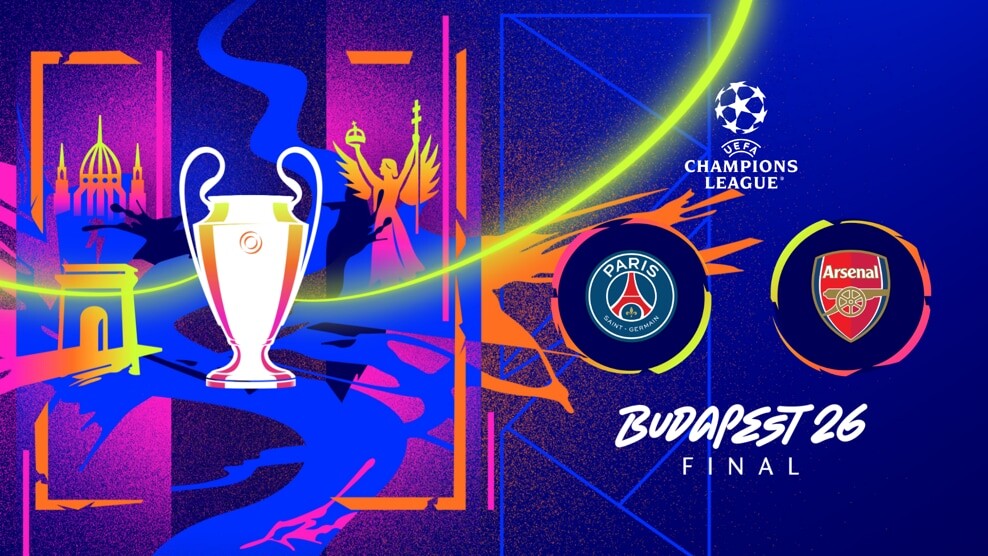
The PSG vs Arsenal Champions League Final 2026 in Budapest on 30 May promises to be one of the great European finals of this era. Two clubs transformed by visionary managers, two squads brimming with world-class talent, and one gleaming trophy. Mikel Arteta’s Arsenal arrive as Premier League champions; Luis Enrique’s Paris Saint-Germain come as Ligue 1 overlords who dismantled Real Madrid and Bayern Munich en route to the Puskás Aréna. Before the first whistle echoes around Budapest, here are the five tactical battles that will decide who lifts the Champions League trophy on 30 May 2026.

1. Bukayo Saka vs Nuno Mendes: The Game’s Most Explosive Duel
Every Champions League Final has its marquee individual battle, and this one starts on Arsenal’s right flank. Bukayo Saka has been the heartbeat of Arsenal’s season — 19 Premier League goals, 14 assists, and a performance against Atlético Madrid in the semi-final that left the Metropolitano stunned. Against him stands Nuno Mendes, PSG’s Portuguese left-back who combines blistering pace with an aggressive, high-stepping defensive style.
The tension here is delicious. Saka prefers to receive the ball to feet, dribble inside on his left, and either shoot or play the killer through-ball. Mendes prefers to press early and engage before Saka can turn. If Arteta can isolate Saka in 1v1 situations before PSG’s midfield can recover across, Arsenal will generate their clearest chances of the night. If Mendes can force Saka wide and deny the inside cut, PSG will have neutralised Arsenal’s most potent weapon.
Watch for Arsenal’s use of third-man combinations — Saka-Ødegaard-Saka triangles have unlocked compact defences all season. If Mendes steps up aggressively, Ødegaard’s late runs into the right half-space could be devastating.
2. Khvicha Kvaratskhelia vs William Saliba: Arteta’s Biggest Defensive Test
On the opposite flank, PSG will ask Khvicha Kvaratskhelia to do what he does best: receive the ball wide left, shift his body, and burn past defenders on that electric diagonal drive toward goal. The Georgian winger has 16 Champions League goal contributions this season and has been PSG’s most unpredictable attacker in the knockout rounds.
Standing in his path is William Saliba, the France international who has arguably been the best centre-back in the Premier League this season. Saliba is disciplined, aerially dominant, and almost impossible to beat in a straight race. But Kvaratskhelia doesn’t race in straight lines — he shifts, feints, and accelerates in unexpected directions. When Kvaratskhelia drops deep to receive, will Arsenal’s right-back (likely Ben White) press, or will Saliba step out? Getting that decision wrong even once could cost a final.
Saliba’s positioning and Arteta’s defensive shape on the right side will be one of the most scrutinised aspects of the pre-match press conference. Expect Arteta to set a compact defensive block that funnels Kvaratskhelia inside, where Declan Rice and Martín Zubimendi await.
3. Vitinha & João Neves vs Declan Rice & Martín Zubimendi: The Engine Room Collision
If the wide battles are about flair, the midfield battle is about control. Vitinha and João Neves form one of Europe’s best double pivots — Vitinha the metronome and creative force, Neves the relentless ball-winner and vertical passer. Together, they allow Luis Enrique’s team to dominate possession and dictate tempo, playing those quick, low passes through narrow channels that carve open organised defences.
Arsenal counter with their own formidable engine room. Declan Rice has grown into one of the world’s best all-round midfielders this season, combining defensive tenacity with a remarkable ability to drive forward and score goals at critical moments. Alongside him, Martín Zubimendi — in his first full season in red and white — has provided the composure and positional intelligence that allows Rice to roam.
The team that wins the midfield battle controls the pace of the game. If Vitinha gets time on the ball, PSG can unpick defences methodically. If Rice presses high and disrupts PSG’s build-up, Arsenal can hit on the break. This is where the final could be won and lost without either goalscorer getting a headline mention.
For more on Arsenal’s tactical evolution this season, read our full PSG vs Arsenal Champions League Final preview.
4. Viktor Gyökeres vs Marquinhos & Juan Bernat: Arsenal’s Target Man Challenge
When Arsenal signed Viktor Gyökeres from Sporting CP last summer, the sceptics asked whether his Primeira Liga form would translate at the elite level. The answer has been emphatic: 28 goals in all competitions, including the header that sealed the Atlético Madrid semi-final tie. Gyökeres is not a traditional hold-up striker — he presses relentlessly, runs in behind, and punishes any space left by a high defensive line.
PSG’s central defensive pairing of Marquinhos, the veteran captain, and Nuno Mendes-shifted Pacho (depending on Luis Enrique’s final selection) face a physical and positional test they haven’t fully experienced in this campaign. Real Madrid’s and Bayern’s strikers were more technically refined than physically imposing. Gyökeres offers both.
The key question: will PSG defend deep and invite Arsenal to play in front of them, or press high and risk the space in behind for Gyökeres to run onto? Marquinhos’ reading of the game and PSG’s defensive line management will be crucial. One poor offside trap could hand Arsenal the lead from the simplest of through-balls.
5. Ousmane Dembélé’s Set-Pieces vs Arsenal’s Defensive Organisation
The fifth battle may be the least glamorous but could prove decisive. Ousmane Dembélé has developed into one of the most dangerous wide forwards in Europe — direct, fast, and capable of scoring from seemingly impossible angles. But in this final, his role as PSG’s set-piece delivery specialist deserves particular attention. Luis Enrique has drilled PSG’s dead-ball routines to a high standard, and Dembélé’s delivery from wide positions is consistently accurate and driven.
Arsenal, for all their brilliance this season, have occasionally looked vulnerable from corners and free-kicks when the delivery is whipped in quickly at the near post. Marquinhos and Achraf Hakimi have been PSG’s most productive aerial threats from set pieces in the Champions League knockout rounds.
Arteta’s preparation will include extensive video analysis of PSG’s set-piece patterns. Arsenal’s defensive structure at corners — whether they zone-mark or man-mark — will be a tactical decision made in the final days of preparation at their Budapest base. A goal conceded from a dead ball in a tight final can shift everything.
The Verdict: Marginal Gains In A Final Without Margins
Champions League Finals are rarely decided by dominant performances. They are decided by moments — a clinical finish, a goalkeeping save, a defensive error under pressure. Both Arsenal and PSG are tactically sophisticated enough to nullify each other’s primary threats for long periods.
If Saka wins his battle with Mendes and Saliba handles Kvaratskhelia, Arsenal’s defensive solidity should be enough to keep PSG to minimal chances. If Rice and Zubimendi control the midfield, Arsenal will have enough possession to create the one or two moments that a final demands.
But if PSG’s press disrupts Arsenal’s build-up and Vitinha gets time to pick passes, the Parisians have the quality to make any score line look routine. Expect a tight, tense affair decided by a single moment of individual brilliance — which is precisely why we watch.
Kick-off in Budapest is on 30 May 2026. For complete tournament coverage, visit our Sports section and read our match preview of Arsenal’s semi-final win over Atlético Madrid.