A knock to the head in sport does not have to knock you out to be a concussion. SingHealth describes concussion as a brain injury after a sudden bump, blow or jolt to the head, face or neck, and says it may or may not involve losing consciousness. Its advice is simple: stop playing, get checked, and come back to sport in stages.
What a concussion looks like
Changi General Hospital’s Sport and Exercise Medicine team, writing for SingHealth, lists headache, nausea, memory loss, forgetfulness, poor concentration, confusion, poor balance, unsteady walking, giddiness, vision changes and sleep problems. Symptoms can show up straight away or over the following days.
Writing about children, KK Women’s and Children’s Hospital (KKH) adds feeling sluggish, hazy or slow, mood changes such as irritability or sadness, blurry or double vision and sensitivity to light or noise. If one or more of these appear, it says to see a doctor immediately.
When it is an emergency
Go for emergency care straight away for loss of consciousness, nausea and vomiting, an unsteady gait, numbness or weakness in the arms or legs, slurred speech, seizures, or concussion symptoms that get worse, says the CGH team.
HealthXchange, SingHealth’s health site, adds three more reasons to head to the Emergency Department: blood or fluid coming from the nose or ears, open wounds that are bleeding, and a change in behaviour. Anyone aged 65 and above, or on blood thinners such as aspirin or warfarin, counts as high risk after a head injury.
The first 24 hours
After a check at the Emergency Department, HealthXchange says the injured person should not be left alone, should not drink alcohol and should not take medicines that cause drowsiness for 24 hours after the injury. Keep watching for changes in alertness or behaviour, or new weakness, over the following days and weeks, and go back to the Emergency Department if you see them.
The CGH team says paracetamol such as Panadol is fine for symptoms, but anti-inflammatory painkillers are best avoided after any head injury because of a theoretical higher risk of bleeding. Do not drive. Rest means resting the brain too, so cut back on phone and computer use, multitasking and schoolwork, along with vigorous exercise.
Coming back to sport
Do not return to your sport until a doctor has assessed you and cleared you after a period of rest, the CGH team says, because coming back too soon can make symptoms worse.
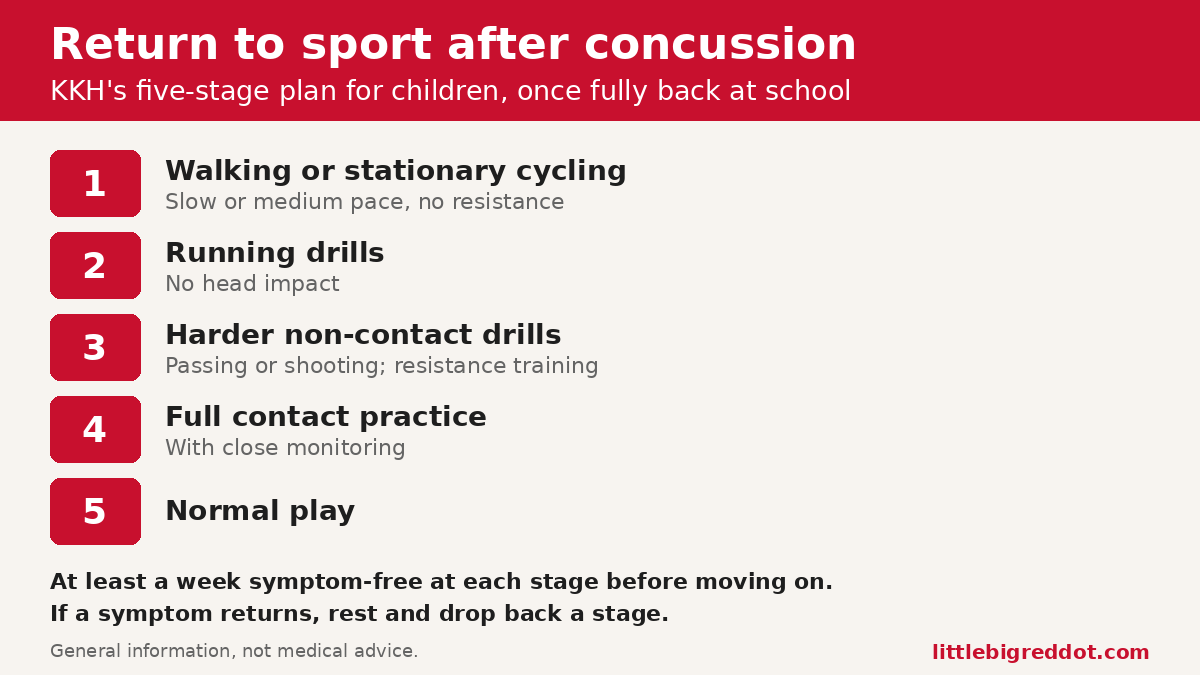
For adults, the CGH team says a doctor will supervise a graded return to sport. KKH sets out a five-stage plan for children, to start once they are fully back at school:
- Stage 1: walking or stationary cycling at a slow or medium pace, without resistance
- Stage 2: running drills with no head impact
- Stage 3: harder non-contact drills such as passing or shooting, and resistance training
- Stage 4: full contact practice, closely monitored
- Stage 5: normal play
Children should be free of symptoms for at least a week at each stage before moving on, and if a symptom returns, they rest and drop back a stage. A second head injury before a concussion has healed can be more serious.
Lowering the risk
Wear the protective gear your sport recommends, such as an approved helmet that fits properly. For young players, KKH suggests learning proper technique from coaches, following the rules of the game, and reporting every head knock, even if it means sitting out.
HealthXchange says the symptoms of a mild head injury usually last a few days. In rare cases they persist for six to 12 months, and those cases need a specialist’s review.
This article is general information, not medical advice. If you are worried about a head injury, see a doctor.