
From Tuesday, 1 December 2026, a driver in Singapore who holds a mobile phone while the vehicle is moving commits an offence, whether or not the phone is in use. The Ministry of Home Affairs (MHA) announced the start date on Friday, 27 November, for a set of Road Traffic Act amendments that also create a new offence of purposeful endangerment, raise jail terms for dangerous driving and tighten the rules on lorry speed limiters.
The changes come from three Acts passed by Parliament: the Road Traffic (Miscellaneous Amendments) Act 2026, the Land Transport and Related Matters Act 2026 and the Road Traffic (Miscellaneous Amendments) Act 2025. The rest of the 2026 Act, including other drink- and drug-driving changes, follows in early 2027. A month after the phone rule starts, ERP 2 replaces the old gantries on 1 January 2027.
What changes for a phone in the car
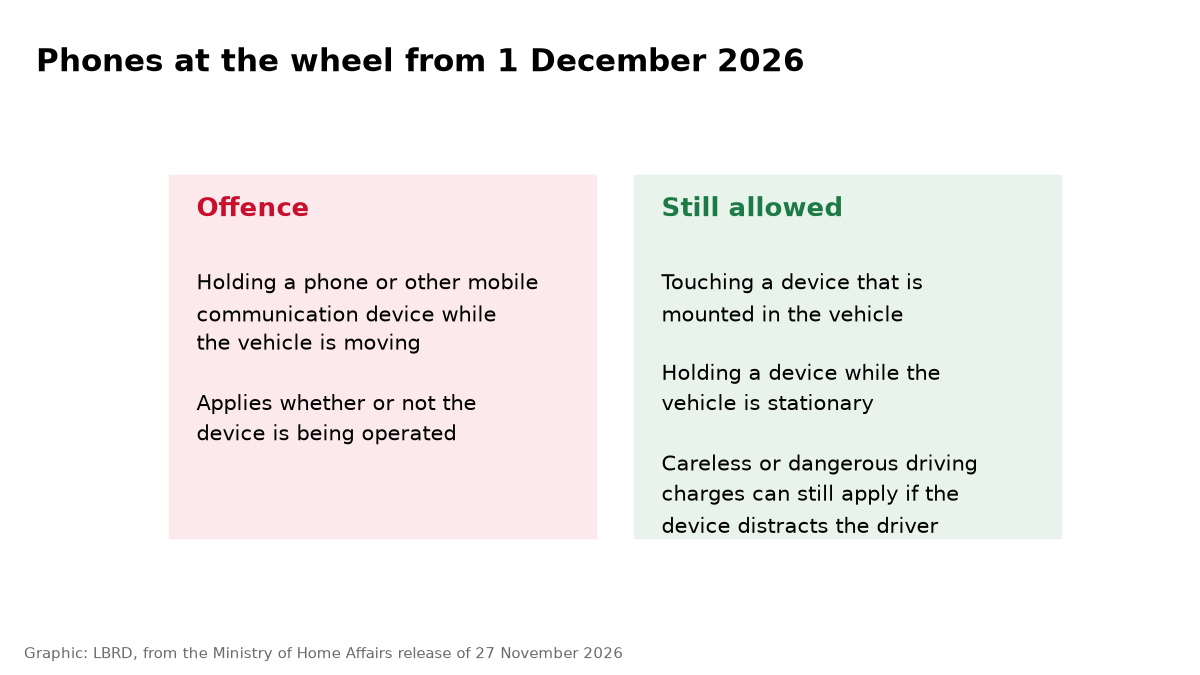
The new offence turns on the hand, not the screen. Holding a mobile communication device, such as a handphone, while the vehicle moves is enough. The driver does not need to be texting, scrolling or on a call.
Until now, a charge needed proof that the driver was operating the phone while holding it, so officers had to confirm it on the spot. Dropping that requirement lets the Traffic Police enforce the offence with cameras, and with photos or videos sent in by members of the public.
Two things stay legal. Drivers can touch a device mounted in the vehicle, and they can hold a device while the vehicle is stationary. In practice the phone holder becomes the line: tapping a mounted phone to change a route stays within the rule, while lifting a phone off the passenger seat once the car pulls away does not.
The mount is not a blanket pass. A driver whose use of a device distracts them and affects their driving can still face a charge of careless or dangerous driving.
A new offence for drivers who endanger on purpose
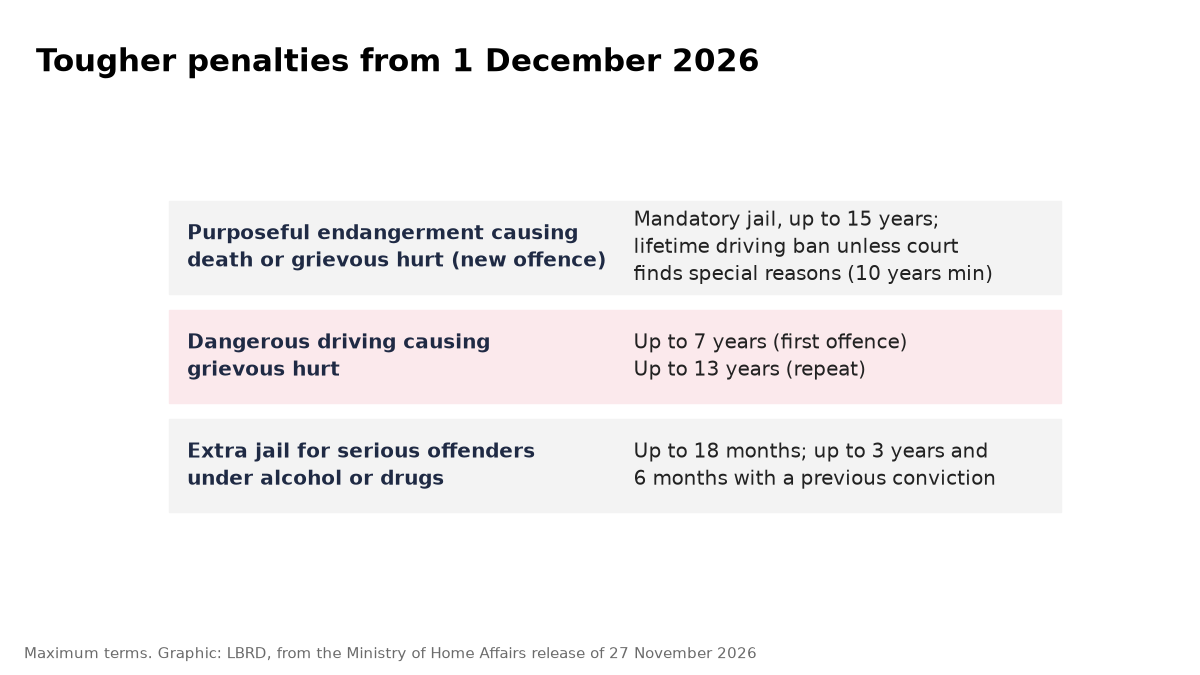
Purposeful endangerment covers a motorist who deliberately uses a vehicle to endanger another person’s life or safety and causes death or grievous hurt. Conviction carries mandatory imprisonment of up to 15 years, and the court can add a fine, caning or both.
The driving ban is for life, unless the court finds special reasons for a shorter disqualification of at least 10 years. The vehicle can also be forfeited. The illustrations written into the Act include a driver who cuts in front of another car and brakes suddenly, and one who tailgates a motorcyclist while sounding the horn, where someone dies as a result.
Maximum jail for dangerous driving causing grievous hurt rises from five years to seven for a first offence, and from 10 years to 13 for a repeat offender. For serious offenders who drive dangerously or carelessly under the influence of alcohol or drugs, the maximum additional jail term rises from one year to 18 months, and from two years to three years and six months for those with a previous drink- or drug-driving conviction.
Lorries and speed limiters
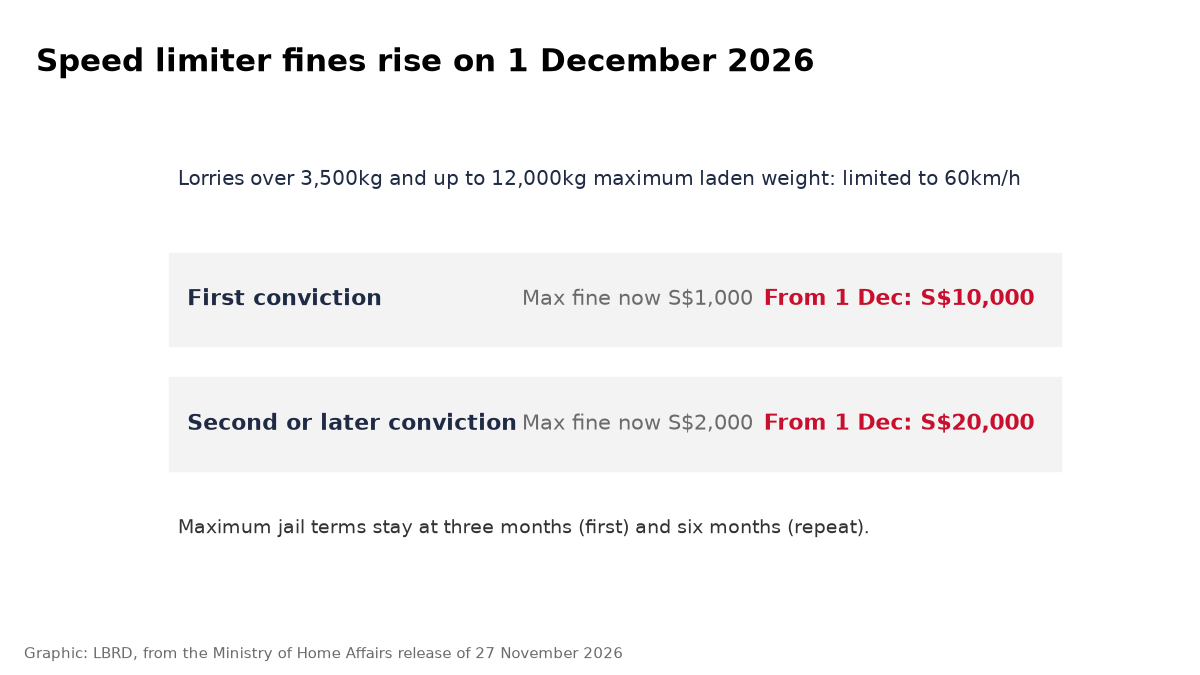
Speed limiters that cap speed at 60km/h will be mandatory for lorries with a maximum laden weight above 3,500kg and up to 12,000kg. From 1 December, it is an offence to knowingly use, or let someone use, a non-compliant vehicle without reasonable excuse. That reaches owners and fleet operators who instruct or permit drivers to take one out, as well as the person at the wheel.
Altering a vehicle or its limiter so that it no longer complies is an offence, as is selling or offering non-compliant vehicles or limiters. So is selling limiters or doing limiter work without being an Authorised Agent, and an Authorised Agent who finds a tampered vehicle has five working days to tell the Traffic Police.
Maximum fines for existing speed limiter offences go from S$1,000 to S$10,000 for a first conviction, and from S$2,000 to S$20,000 for a second or later one. Maximum jail terms stay at three months for a first conviction and six months for a repeat. Updated speed limiter rules will also require owners and drivers to keep the speed limiter label visible on the vehicle.
Other changes on 1 December
Authorised individuals, alongside Traffic Police officers, will process straightforward violations such as speeding and red-light offences. The Traffic Police keeps enforcement decisions and continues to handle appeals.
Owners who claim a seized vehicle or trailer but leave it past the collection period must pay storage charges before it is released, and one left uncollected can be sold or disposed of a month after that period ends. It comes after an LTA blitz that impounded 126 deregistered vehicles this month.
In drink- and drug-driving cases involving a patient in hospital, a blood sample no longer needs separate authorisation from the doctor in charge. The medical professionals taking or overseeing the sample must be satisfied that it will not endanger the patient.