
The call
Seatrium (SGX: 5E2), the STI-listed offshore and marine engineering group, is our pick today. We rate it a hold on a 12-month view.
The shares closed at S$1.71 on Wednesday, 18 November 2026, down one cent on the day and the lowest close of the past year. They traded between S$1.68 and S$1.73 on about 12.5 million shares. That is the latest price before this morning’s session, which opens after the update came out. The stock has closed lower in each of the last five sessions, from S$1.86 on 11 November, and is about 21% down this year from S$2.16 at the end of 2025. The 52-week high was S$2.51 on 8 April.
What the update said
Seatrium released its third-quarter business update before the market opened on Thursday, 19 November (Seatrium: 3Q2026 business update, 19 November 2026). It is an operating update, so there is no income statement and no revenue or margin figure for the quarter.
The execution news is the best part. During the quarter to date, Seatrium delivered the Revolution Wind offshore substations to Ørsted and the Sparta floating production unit to Shell, and sailed away Petrobras FPSOs P-80 and P-82 together. P-80, P-82 and Sparta were the three large projects the company had flagged in July for sailaway in the second half, and they were the most obvious source of a late provision or slippage. That risk has now largely passed.
Margins kept moving the right way. The company says gross margin improved relative to the first half, when it was 8.6%, helped by a better project mix, cost control and savings from selling non-core businesses. It did not give a number. Annualised cost savings of more than S$50 million from completed divestments remain on track. Management expects the same margin drivers to continue for the rest of the year and says underlying net profit for 2026, excluding one-off items such as divestment gains and legal and corporate claims, will be “materially higher than FY2025”.
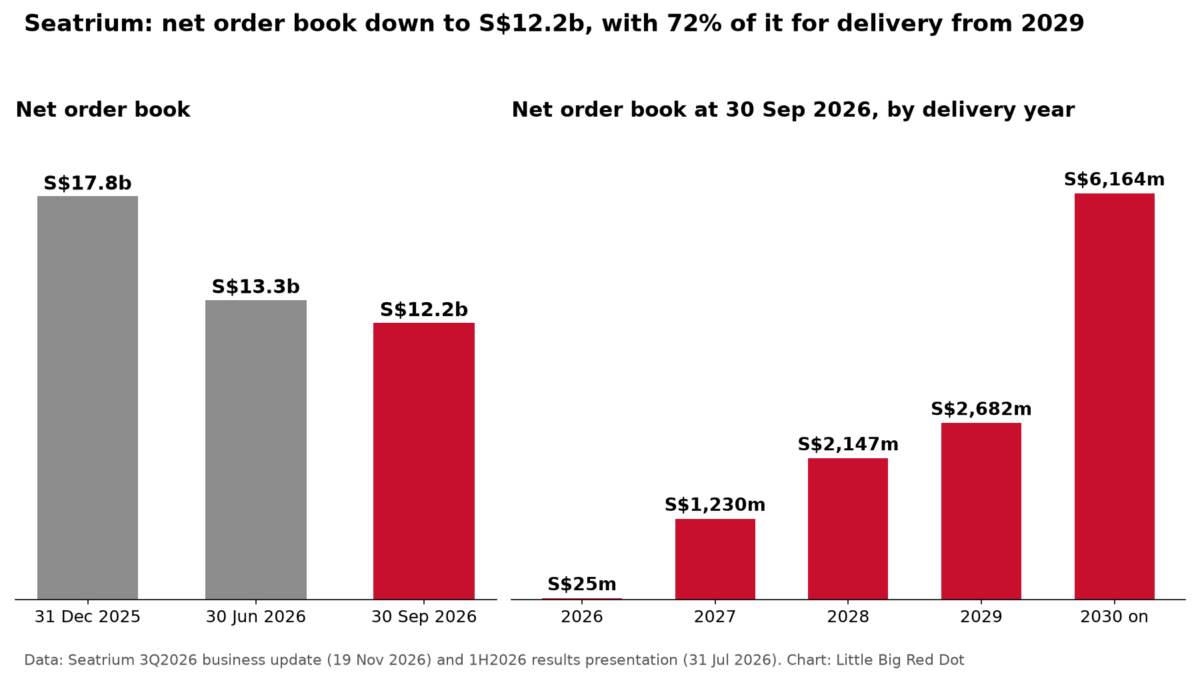
The order book is the weaker part. New orders for the year to date come to S$1.7 billion. They include three FSRU conversions for Karpowership and Excelerate Energy, FPSO integration work for SBM Offshore and MODEC, and the conversion of five Powerships for Karpowership. The net order book stood at S$12.2 billion across 35 projects at 30 September, with deliveries running to 2033. It was S$13.3 billion at 30 June and S$17.8 billion at the end of 2025 (Seatrium: 1H2026 results presentation, 31 July 2026). That is a fall of about 8% in the quarter and about 31% this year.
Two larger jobs sit alongside it. Seatrium will complete four offshore rigs for RigCo, a job Keppel put at “over S$500 million” (Keppel, 26 October 2026), and all four rigs appear in the 30 September order book, though the update does not say whether they count towards the S$1.7 billion. The letter of intent with Golar for a third floating LNG conversion is “still targeted for contract finalisation by the end of 2026” and is not in the order book. Maybank Research and CGS International have both put that project above S$2 billion. Neither broker figure comes from the company.
Chief executive Chris Ong said order momentum “has picked up in recent weeks” and that the group is “confident on our ability to replenish our order book with high quality projects”, while noting final investment decision timings “that we do not control”.
The numbers behind the call
These measures use Wednesday’s close of S$1.71. The calculations are ours.
| Measure | Value | Basis |
|---|---|---|
| Market value | about S$5.79 billion | 3,383.79 million shares, excluding treasury shares, at 30 June 2026 |
| Price to book | about 0.79 times | Net asset value of 216.87 cents a share at 30 June 2026 |
| Price to earnings, trailing, reported | about 10.5 times | Trailing net profit of about S$552 million |
| Price to earnings, trailing, excluding the 1H2026 divestment gain | about 15 times | About S$391 million; approximate |
| Dividend yield, trailing | about 1.75% | 3.0-cent final dividend for 2025 |
| Net order book to 2025 revenue | about 1.1 times | S$12.2 billion against S$11.5 billion |
| Net debt, excluding leases | about S$678 million | About 9% of S$7,338 million equity at 30 June 2026 |
Trailing profit takes the 2025 net profit of S$323.6 million, removes the first-half 2025 profit of S$144.4 million and adds the first-half 2026 profit of S$372.9 million (SGX: 1H2026 interim financial statements, 31 July 2026). About S$161 million of that first-half figure came from divestment gains. Net profit excluding divestment gains rose 54% to S$212 million in the half, on revenue up 4.7% to S$5,618.8 million and gross profit up 22.1% to S$482.3 million (Seatrium: 1H2026 press release, 31 July 2026).
The delivery schedule shows the pressure. Of the S$12.2 billion net order book, S$25 million is due for delivery in 2026, S$1,230 million in 2027, S$2,147 million in 2028, S$2,682 million in 2029 and S$6,164 million from 2030 onwards. Revenue is recognised as work progresses, so this is not a revenue forecast. Still, against 2025 revenue of S$11.5 billion, the book needs new contracts soon to keep the yards busy in 2027 and 2028.
What the brokers say
Every target below was set before this morning’s update. Each carries the date of the broker’s report, and the change is measured from S$1.71.
| Broker | Rating | Target price | Report date | Change from S$1.71 |
|---|---|---|---|---|
| DBS Group Research | Buy | S$3.00 | 2 November 2026 | about +75% |
| Maybank Research | Buy | S$2.85 | 27 October 2026 | about +67% |
| CGS International | Add | S$2.60 | 23 October 2026 | about +52% |
| UOB Kay Hian | Hold | S$2.30, from S$3.15 | 3 August 2026 | about +35% |
| J.P. Morgan | Sell | S$1.60 | 31 July 2026 (data services only) | about -6% |
Morningstar, an independent research house rather than a broker, put fair value at S$2.90 in early August.
The bulls argue that the order drought is about timing. DBS analyst Ho Pei Hwa says slow wins this year come from award delays, partly linked to uncertainty in the Middle East, rather than a broad deterioration in demand, calling it “a timing issue”. Maybank expects gross margin above 10% in 2027 and 2028 as older contracts finish, and notes that the first-half 8.6% is still well below management’s mid-teens hurdle for risk-adjusted project margins. CGS values the stock at 1.2 times its 2026 book value forecast, which it describes as a 20% discount to the ten-year average.
UOB Kay Hian analyst Roy Chen took the other side in August. He downgraded to hold, saying a S$13.3 billion order book “does not provide good revenue visibility beyond one year”, and said he would want it back at S$15 billion to S$18 billion, with order wins of at least S$9 billion a year, before turning more positive. Today’s figures move further away from both of those marks. The J.P. Morgan rating and target appear in S&P Global consensus data; we have not seen the report.
CGS estimated year-to-date wins at about S$3.3 billion in late October, including the Golar letter of intent. The company’s own figure of S$1.7 billion does not include Golar, which is still a letter of intent. Expect some brokers to trim order assumptions after today.
The bear case
The net order book has fallen from S$17.8 billion to S$12.2 billion in nine months, and S$1.7 billion of wins in more than ten months is a small number next to annual revenue of S$11.5 billion. The awards that would change the picture, the Golar conversion, further Petrobras FPSOs and more TenneT high-voltage platforms, depend on customer investment decisions that Seatrium says it does not control.
Cash conversion was weak in the first half. Operating cash flow was S$40.6 million, against S$518 million before working-capital changes, and contract assets rose to S$6,485 million from S$4,891 million at the end of 2025. The update gives no cash figures for the third quarter.
About S$21 billion of the more than S$32 billion pipeline the group cited in July is oil and gas, so lower oil prices or conflict in the Middle East could push decisions back again. The stock is also at a 52-week low, and momentum has been against it.
The case for patience
None of that makes the stock expensive. At about 0.79 times book, the market is pricing a business that is shrinking. Yet margins are improving, the three big second-half deliveries have gone out with no problem flagged in the update, net debt is modest, and management has committed to materially higher underlying profit this year. More than 95% of the order book at 30 June was Series Build work, which the company says brings more execution certainty, and lower-margin legacy projects were down to about 1%. The company also bought back 14.11 million shares in the first half.
Risks
On the downside: the Golar contract slipping into 2027 or falling away, no large Petrobras or TenneT award, further falls in the order book, provisions or disputes on legacy projects, weak cash conversion, and lower oil prices. On the upside: Golar signed by year-end, a large FPSO or HVDC award, a gross margin figure in the full-year results that moves closer to the double digits, and a higher dividend or bigger buyback.
What to watch
The Golar conversion comes first, with the company still targeting a signed contract by the end of 2026. After that, the full-year results, which last year came on 26 February, should give the second-half gross margin, cash flow, the dividend and an updated order book. No date has been announced.
The verdict
This was a mixed update. Seatrium is doing what it can control well: projects are shipping, costs are falling and margins are rising. What it cannot control yet is the pace of new orders, and at S$12.2 billion the order book is now low enough to matter for 2027 and 2028 revenue.
At 0.79 times book, much of that worry is in the price, and every target we could confirm from the brokers’ own published calls sits above it. But those targets were set before today’s order figure, and a re-rating needs a large contract, not just cheaper shares. We would hold.
We would move to buy if the Golar FLNG contract is signed on terms close to the brokers’ S$2 billion-plus estimates, or if a Petrobras or TenneT award lifts the order book back above S$13 billion. We would move to sell if Golar slips beyond 2026 with no large award to replace it, or if the full-year results bring a provision or a margin setback.
Research by Warren.
This is general information, not financial advice, and does not take into account your objectives or financial situation.