The Ministry of Health (MOH) has opened a public consultation on mental health guidelines for young persons, and anyone can send in views until 6pm on 8 December 2026. The draft deals with a question many Singapore families have quietly wondered about: can a teenager see a counsellor or therapist without a parent signing off?
Right now, the answer varies. Singapore treats a person as an adult at 21, but there is no minimum age at which a young person can consent to mental health services alone. MOH says practices on parental consent differ from one setting to another.
Why MOH is asking now
MOH cites two numbers from local studies. About one in three young persons aged 10 to 18 reported symptoms such as depression and anxiety, based on the 2023 Singapore Youth Epidemiology and Resilience (YEAR) study. Yet 70% of those with symptoms did not seek professional support, according to the 2024 National Youth Mental Health Study.
The ministry also says the need for parental consent is one reason some under-21s hesitate to ask for help. Age matters too. Roughly one-third of people with mental health conditions see them start before 14, rising to nearly half by 18.
What the mental health guidelines for young persons propose
The consultation paper splits support into three tiers and sets consent rules for each. Here is how it reads in plain terms:
- Basic care, such as emotional support, helplines and text services, can be given even without parental consent.
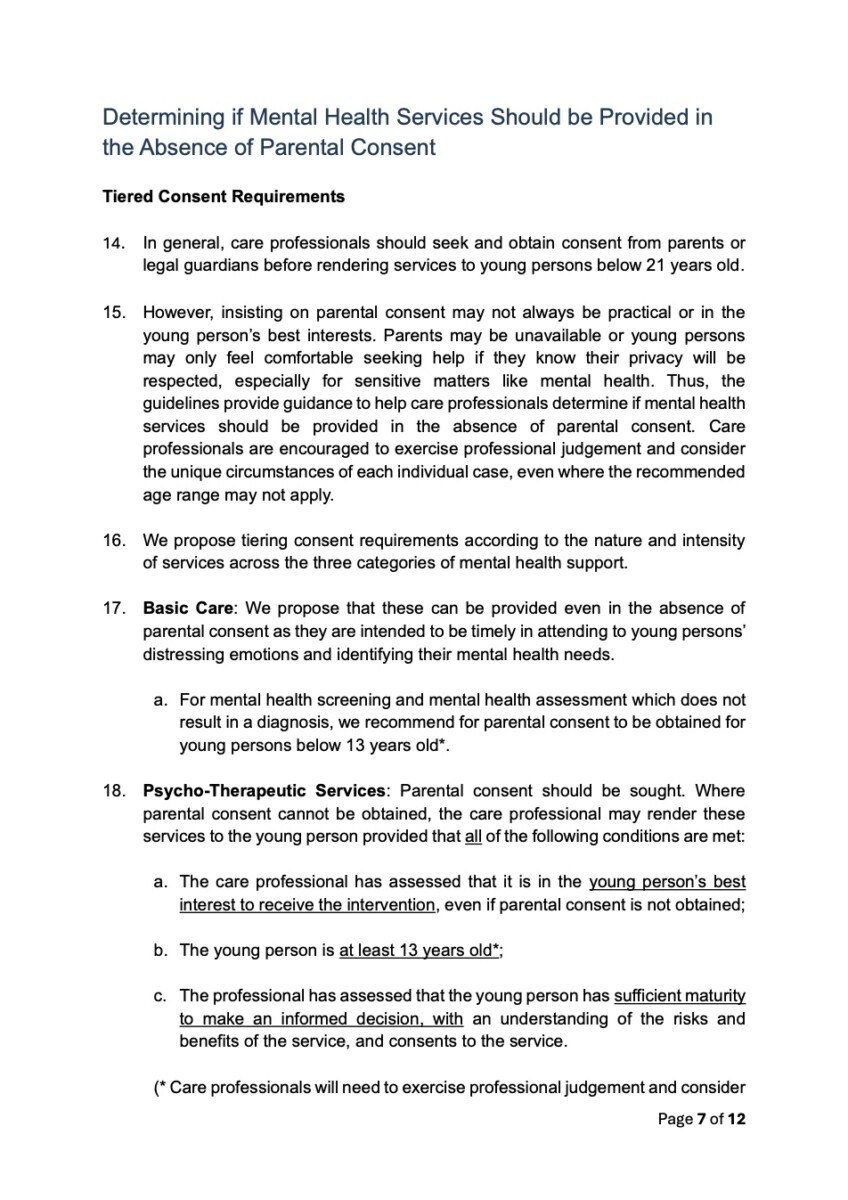
- Mental health screening, and assessments that do not lead to a diagnosis, would need parental consent for those below 13.
- Psychological therapies, school counselling and complementary therapies such as art or music therapy: parental consent should be sought first.
- If a parent cannot be reached or refuses, a professional may still go ahead when three conditions are all met: it is in the young person’s best interest, the young person is at least 13, and the professional judges them mature enough to understand the risks and benefits.
- Psychiatric diagnosis and medication fall under the Singapore Medical Council’s ethical guidelines instead.
The age of 13 comes with an asterisk. Care professionals are told to use their judgement case by case, even where the recommended age range does not apply.
Parents stay in the picture
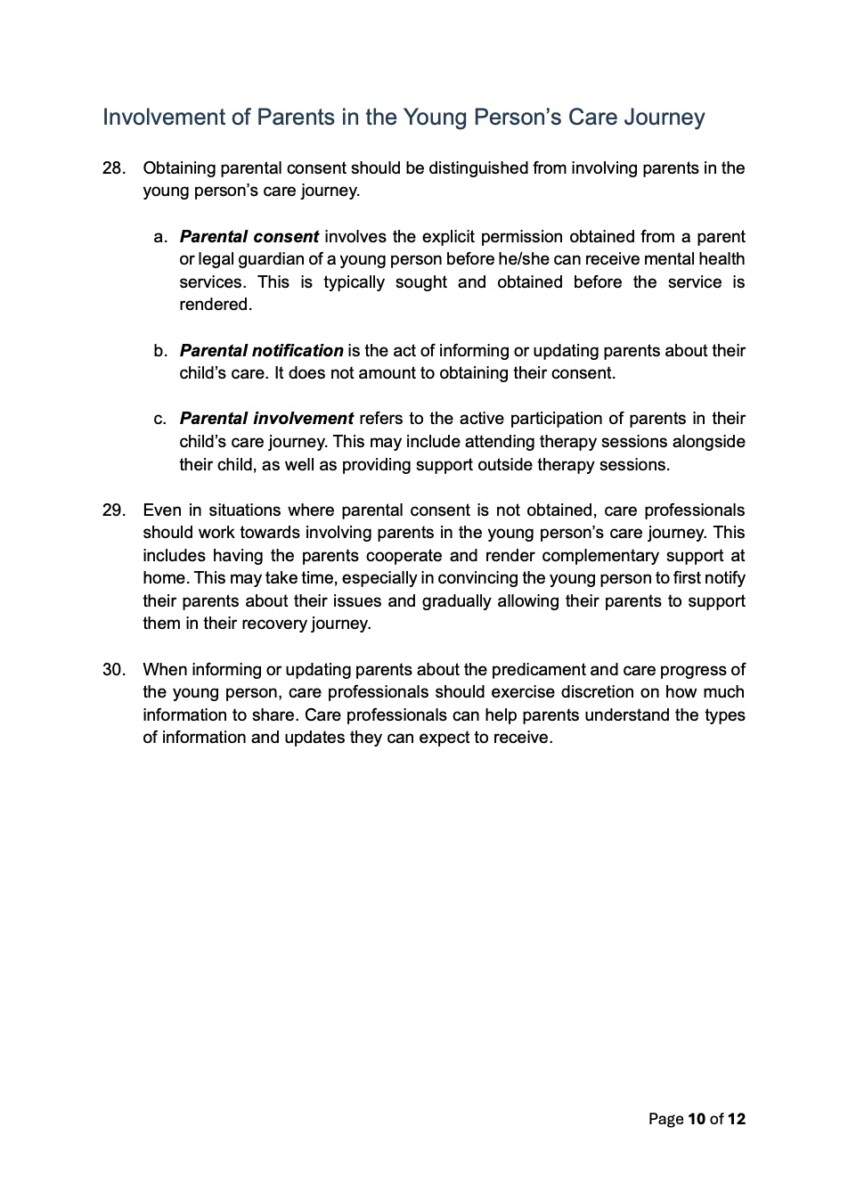
The draft does not push parents aside. It separates three things: consent (permission before a service starts), notification (telling parents about the care) and involvement (joining sessions or helping at home). Even where consent was not obtained, professionals are asked to work towards bringing parents in, though it may take time to convince a teen to tell them first.
Confidentiality has limits. What a young person shares should stay private, but if their safety is at risk, the professional may need to tell parents or the relevant authorities.
How to give feedback
Submit your views through the online form at go.gov.sg/youth-mental-health-access. The consultation opened at 10am on 11 November 2026 and closes at 6pm on 8 December 2026. The full consultation paper is linked from MOH’s announcement, so you can read the examples and questions before you reply.
This is a draft only, and MOH has said it does not yet represent final policy. Students, parents, teachers, counsellors and clinicians are all fair game to respond.
If you or your child need support now
You do not have to wait for any guideline to reach out. The national mindline is 1771, and the HealthHub MindSG page has self-care tools for adults and young people. For a wider look at how community services are being organised, see our piece on the HealthierMind SG network.
We also covered the NPHS 2025 results on distress and help-seeking and how much sleep adults need, which is a quiet but useful place to start on wellbeing.