
Singapore’s retirement age is set to rise from 64 to 65 on 1 January 2029, with the re-employment age moving from 69 to 70 on the same day. That puts the retirement age to 65 one year ahead of the original 2030 timeline. The change comes from the Tripartite Workgroup on Senior Employment, which released its report on 26 October 2026, and the Government has said it fully accepts all its recommendations.
The workgroup was convened in July 2025 and spoke to more than 1,000 stakeholders. It builds on the 2019 workgroup on older workers. Details on the new schemes will follow in the first half of 2027.
The retirement age to 65: what changes and when
The retirement age is the earliest age an employer can retire you on grounds of age. The re-employment age is the age until which an employer must offer eligible workers re-employment. Both go up by one year on 1 January 2029, and the implementation date also moves forward from July to January.
The aim is to let senior workers continue working if they wish to.
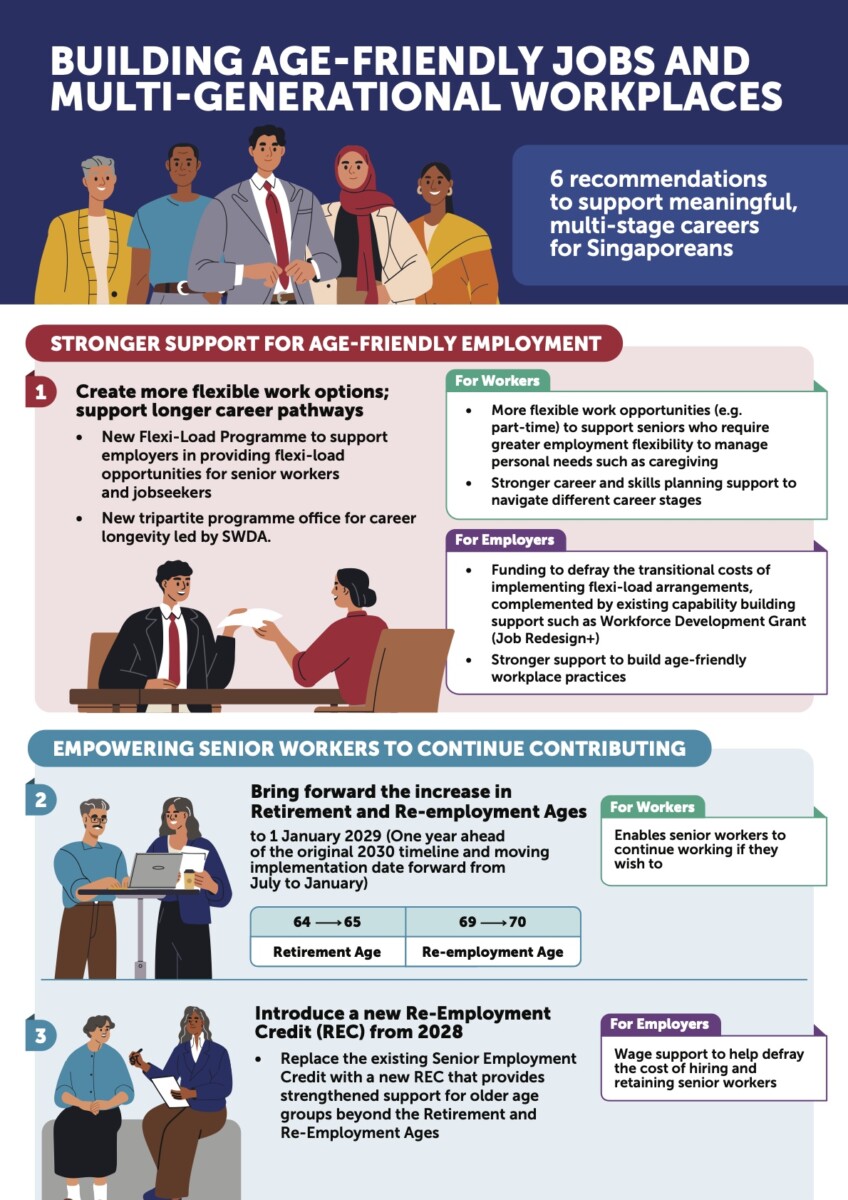
Six recommendations at a glance
- Create more flexible work options. A new Flexi-Load Programme will help employers cover transitional costs of part-time or fractional roles, replacing the Part-Time Re-employment Grant when it expires at the end of 2027. A tripartite programme office for career longevity, led by the Skills and Workforce Development Agency (SWDA) with NTUC and SNEF, will help workers plan career and skills transitions.
- Bring forward the higher retirement and re-employment ages to 1 January 2029.
- Raise the recommended minimum and maximum Employment Assistance Payment (EAP), last updated in 2022, to reflect wage growth. EAP is a one-off payment for eligible seniors who want to keep working but are not offered re-employment.
- Enhance Earned Income Relief for seniors who work beyond the retirement and re-employment ages, so they keep more of their pay.
- Introduce a Re-Employment Credit from 2028, replacing the Senior Employment Credit that expires in 2027, to help employers hire and keep older workers beyond the two ages.
- Strengthen support for lower-wage seniors with an enhanced Workfare Income Supplement and an updated Progressive Wage Credit Scheme.
The dollar amounts for the EAP, tax relief and Workfare changes have not been announced yet.
What it means if you are in your 50s
The workgroup highlighted people in their 50s who leave work early because of caregiving, skills mismatches or health concerns. Its answer leans on flexibility, not just higher age limits. Part-time and fractional roles are meant to make staying in the workforce easier for carers.
If you are planning your next move, two things are worth doing now:
- Ask HR whether your company already offers job redesign or part-time arrangements.
- Look at skills funding while it lasts. Our guide to the SkillsFuture Mid-Career Training Allowance covers up to S$3,000 a month for eligible learners.
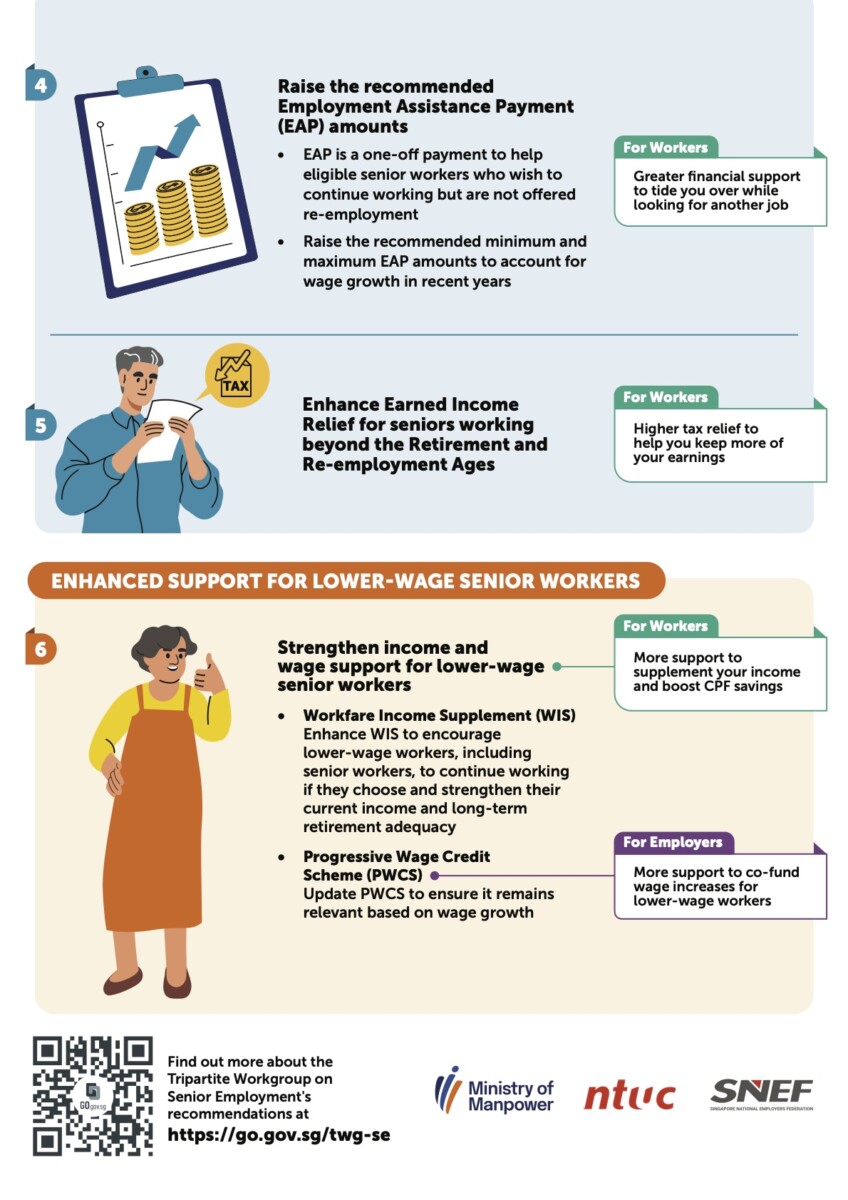
What employers should note
Employers get new funding tools rather than just new obligations. The Flexi-Load Programme ties support to creating additional flexi-load roles, and the Re-Employment Credit is meant to offset the cost of hiring and retaining older staff. The workgroup also points to existing capability support such as the Workforce Development Grant (Job Redesign+).
The Alliance for Action on Empowering Multi-Stage Careers for Mature Workers piloted solutions with 30 organisations and helped more than 1,600 senior workers. Those pilots informed the report.
Where to read more
The full report and an infographic are available at go.gov.sg/twg-se. If you want to have a say on wider policy, public feedback for the next national budget is open too, and we explain where to send your views.