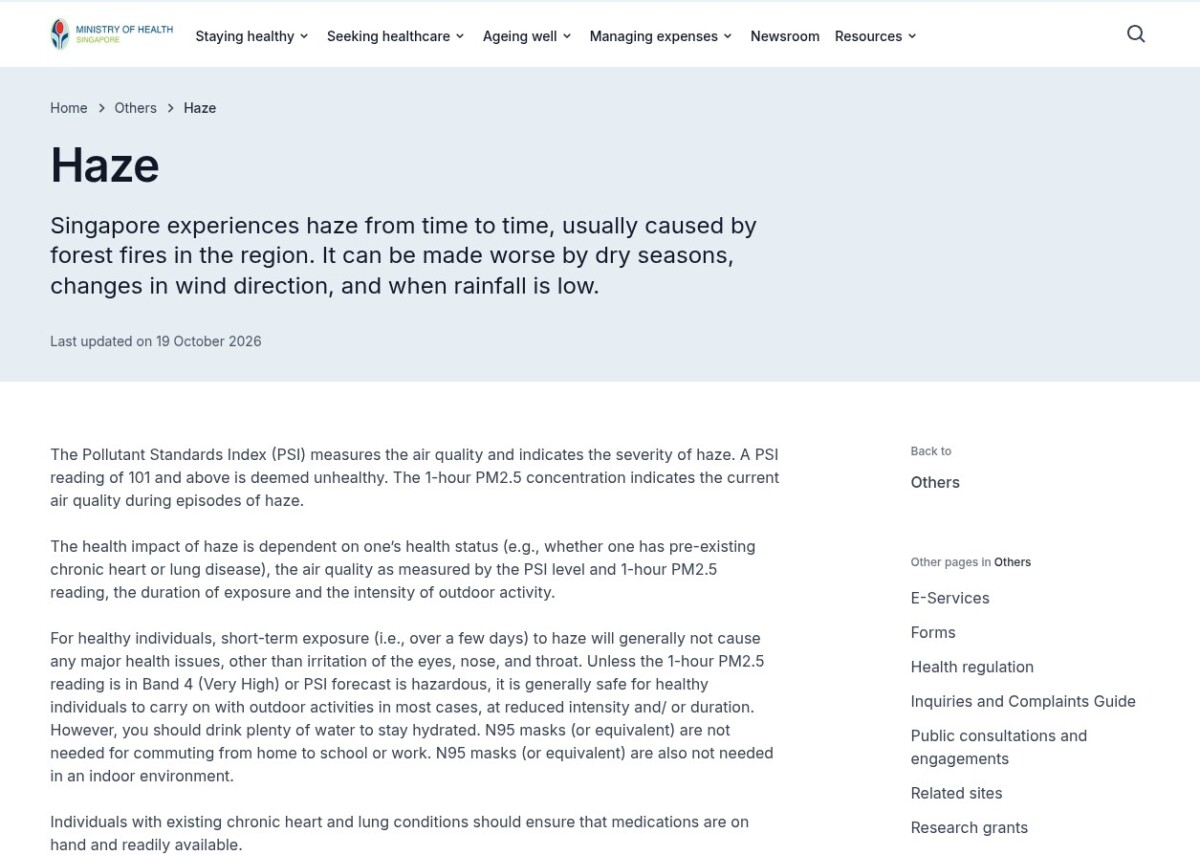
N95 masks are not needed at home, at work indoors or on the commute, as smoke from Kalimantan may drift back towards Singapore from Tuesday night. MOH’s haze advisory keeps the N95 for people who have to stay outdoors for several hours when PM2.5 readings are high.
The National Environment Agency forecasts a 24-hour PSI of 90 to 160 for Tuesday, with winds likely to turn east-southeasterly from Tuesday night until Thursday. For households, that puts the focus back on the air inside the home.
Keeping haze particles out
NEA and HealthHub give the same household routine. When outdoor air appears to be getting worse, close doors and windows to slow the rate at which haze particles come in. Open them again once the outdoor air improves.
A sealed home has its own problem. NEA notes that heat, carbon dioxide and other pollutants can build up in enclosed rooms, especially where many people are at home, so windows and doors should be opened from time to time when the air outside clears.
Fans and air-conditioners can be used for cooling and circulation. Window units that draw in unfiltered outdoor air are the exception: NEA’s advice is to close the outdoor air intake on those.
Cleaning without stirring up dust
Settled dust is better wiped or mopped. Wet cleaning raises less dust than dry dusting or vacuuming.
NEA also asks households to cut other sources of indoor pollution while haze lasts, naming cigarettes and candles. Smoking in an enclosed room adds particles to the same air the windows are keeping clean.
Choosing an air purifier
Portable air purifiers can lower indoor particle levels further, and NEA’s technical guide sets two tests for choosing one. The filter should be efficient at removing fine particles, such as a HEPA filter. The size should match the room, using the smoke figure on the Clean Air Delivery Rate (CADR) label, which should be at least three times the room’s volume in cubic metres.
NEA’s own worked figure is a 40 sq m room with a 3m ceiling, which needs a smoke CADR of at least 360 cubic feet per minute. A purifier works to its rating only when the room’s doors and windows are shut, and its airflow should not be blocked.
Who the masks are for
MOH’s mask rules turn on the 1-hour PM2.5 reading, not on being indoors. In Band 3 (151 to 250 micrograms per cubic metre), the elderly, pregnant women and people with chronic heart or lung disease should avoid outdoor activity, and may wear an N95 or equivalent if they have to go out. In Band 4 (251 and above), healthy people should keep outdoor activity to a minimum and may wear one too.
KN95, FFP2 and KF94 masks count as equivalents. An N95 can be reused while it is clean, dry and keeps its shape, but should not be shared, and it only works if it fits without leaks around the nose and mouth.
Some households need extra care. Women in the second and third trimesters of pregnancy should not wear an N95 for long periods, and older people, pregnant women and anyone with severe heart or lung problems who has difficulty breathing at rest or on exertion should check with a doctor before using one.
There is no international certification standard for children’s masks. The AIR+ KN95 mask can be used, only where necessary, by children without heart or lung conditions, as long as it keeps a good seal.