
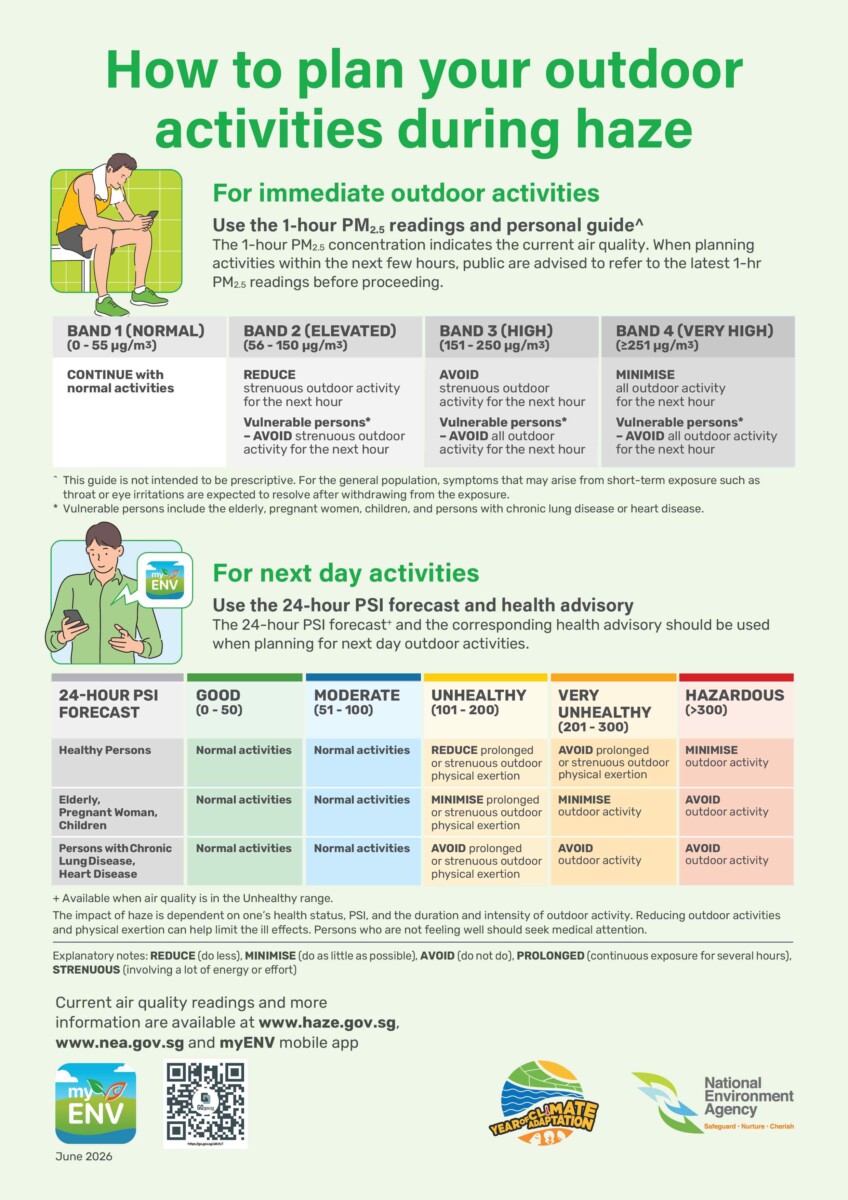
Schools and kindergartens run by the Ministry of Education (MOE) step up their haze measures in stages as the 24-hour PSI forecast climbs, with smoke from fires in Sumatra and Kalimantan drifting towards Singapore this weekend. Below a PSI of 100, classes and activities carry on as normal. From 101, outdoor exertion is cut back, and above 300, lessons are scaled down and schools may close.
PSI bands, mask advice and precautions for vulnerable groups are in our 30 September haze guide, and Sunday’s readings are in our PSI update.
What schools do at each PSI level
The plan covers the ministry’s kindergartens, primary schools, secondary schools and special education schools. Each step follows the 24-hour PSI forecast, and schools also change the level and nature of activities through the day as one-hour PM2.5 readings rise and fall. Every classroom has an air purifier.
In the unhealthy band of 101 to 200, schools avoid strenuous outdoor physical activities that take a lot of energy or several hours of continuous exposure. Students who are unwell, or who have lung or heart conditions, are exempted from all outdoor physical activities, and air purifiers are switched on in enclosed indoor spaces. A student or staff member who falls ill waits in an air-conditioned room with an air purifier before being taken to a doctor, and parents are notified.
At very unhealthy levels of 201 to 300, outdoor activities and indoor physical activities both stop, and all students stay in enclosed indoor spaces with air purifiers. If the PSI reaches the hazardous band above 300 during school hours, lessons are scaled down as well. Teachers keep watch for students who are unwell or have existing lung or heart conditions, and parents are expected to make sure children carry their own medication, such as asthma inhalers, or keep them at home.
School closures and national exams
Closing schools comes into consideration when the next day’s air quality forecast is hazardous, a 24-hour PSI above 300. Any closure is announced alongside the health advisory, and schools contact parents directly, sometimes at short notice. Children whose parents cannot arrange care may still go to school, where teachers supervise them, and school-based student care centres stay open for existing students.
Junior colleges, Millennia Institute, polytechnics, ITE and the autonomous universities follow the same health advisories, and may move outdoor activities indoors, postpone them or cancel them. Their closure decisions work differently because the students are older and most teaching already happens indoors, in spaces such as lecture theatres.
National examinations are rescheduled if schools close, with the new arrangements announced alongside the closure. School candidates hear through their schools, and private candidates hear from the Singapore Examinations and Assessment Board (SEAB). While exams go ahead, every candidate sits papers in an enclosed space with air purifiers, so a sudden turn in the haze does not interrupt a paper. Candidates who are medically certified unwell and cannot sit a paper inform their schools, or SEAB for private candidates, and haze-related illness goes through the same process as any other illness during the exams.
Cleaning the air at home
At home, start with doors and windows. Shutting them when outdoor air turns bad slows the rate at which haze particles get in, and reopening them once the air improves clears the heat and carbon dioxide that build up in a sealed room, especially a crowded one. Fans and air-conditioners can stay on for cooling, but a window unit that draws unfiltered outside air should have its outdoor intake closed. Mopping and wiping lift settled dust.
A portable air purifier keeps particle levels low in an enclosed space, and works best with a High Efficiency Particulate Air (HEPA) filter. Its Clean Air Delivery Rate (CADR) measures how much clean air it returns to a room. A CADR label carries three figures, for smoke, dust and pollen, and the smoke figure is the one that matters for haze.
The smoke CADR in cubic feet per minute should be at least three times the room’s volume in cubic metres. A 40 sq m room with a 3m ceiling holds 120 cubic metres of air, so it needs a smoke CADR of at least 360, while a 30-cubic-metre bedroom needs at least 90. A higher figure only cleans an enclosed room faster.
Purifiers reach their rated performance only with doors and windows shut and nothing blocking the airflow. Plenty of effective models carry no CADR rating, and for those, the manufacturer should be able to back any claim about removing fine particles. For homes that need more fresh air, a fan-filter unit with a MERV 13 or F7 filter, or better, brings outdoor air in through the filter.