Price-per-kilo and price-per-litre labels reach more supermarket shelves, and two online grocery stores, from Thursday, 1 October 2026. The Competition and Consumer Commission of Singapore (CCS) and the Consumers Association of Singapore (CASE) said on 28 September that the second stage of their unit pricing pilot adds Don Don Donki and RedMart and widens coverage to 40 grocery types, from flour and butter to diapers and detergent.
The first stage ran from September to December 2025 at NTUC FairPrice, Sheng Siong, Prime Supermarket, Cold Storage and Giant, with unit prices on selected categories such as rice, meat, eggs, cooking oils, fruit and vegetables. CCS says shoppers found the labels useful for comparing brands and pack sizes.
Where do the labels appear, and from when?
FairPrice, Sheng Siong, Prime Supermarket, Don Don Donki and RedMart start on 1 October. Cold Storage and Giant follow on 1 November. Each operator takes part for eight weeks, so the first group’s run takes it to late November.
CCS says the labels will be in all FairPrice, Sheng Siong, Prime, Cold Storage and Giant outlets. Don Don Donki has only five stores in the pilot: Jewel Changi Airport, PLQ Mall in Paya Lebar, Tiong Bahru Plaza, Bukit Panjang Plaza and Waterway Point in Punggol. Product coverage may vary from outlet to outlet.
Online is new this time. Sheng Siong’s and RedMart’s online stores show unit prices for selected categories from 1 October. The other operators will add them to their platforms progressively, and no dates have been given.
Which groceries are covered?
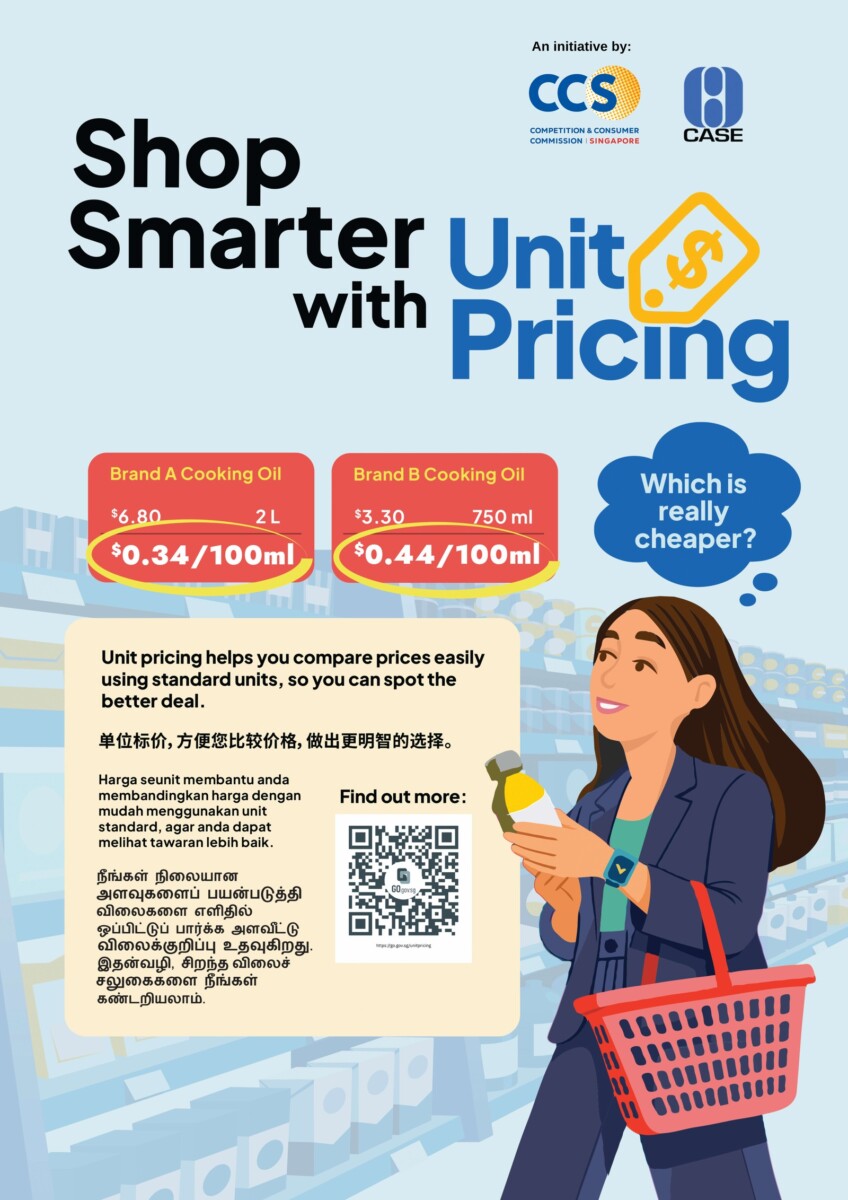
The list runs to 40 product types in 13 groups. Staples such as rice, bread, noodles, chilled and frozen meat, fish, eggs and fresh produce are on it. Formula milk powder, butter, sugar, soups, sauces, snacks and biscuits, and coffee and tea in powder or sachet form are named too.
Four household lines are in: detergents, paper and tissue, shower products and diapers. Fresh-cut and ready-to-eat fruit is excluded.
How does a unit price work?
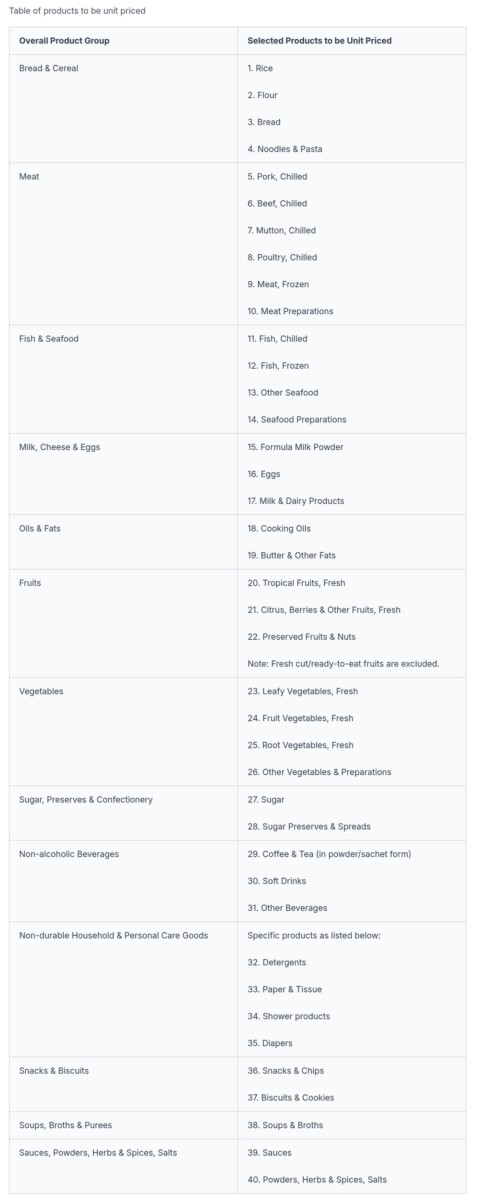
The label shows the price for a standard quantity next to the selling price. Eggs are priced per 100g, cooking oils per 100ml and leafy vegetables per item.
The CCS and CASE poster for the scheme uses two cooking oils. A 2-litre bottle at S$6.80 works out to S$0.34 per 100ml. A 750ml bottle at S$3.30 is S$0.44 per 100ml, so the cheaper bottle at the till costs about 29 per cent more for the same amount of oil.
What happens after the pilot?
CCS has hired Blackbox Research to survey shoppers during the pilot, at selected outlets and online, and says the feedback will shape any wider roll-out later. Neither body has said whether unit pricing will become a requirement for retailers.
“When products come in different pack sizes, it can be difficult to tell which one really offers better value,” CCS chief executive Alvin Koh said. CCS pairs the pilot with its checks that the weights and quantities stated on products are accurate. CASE’s Price Kaki app already compares unit prices for more than 13,900 daily essentials.