
The Transboundary Haze Pollution Act fines will go up tenfold, to S$1 million a day and a cap of S$20 million, after Parliament passed the amendment Bill on 4 November 2026. Today the main offence carries a maximum of S$100,000 a day, capped at S$2 million. The changes, explained by gov.sg, are meant to make it easier to trace and penalise firms linked to fires that send smoke our way.
What the Transboundary Haze Pollution Act fines change
The Act first came into force in 2014. Enforcing it has been hard because the fires, and often the companies behind them, are overseas. Complex ownership structures and supply chains make it tricky to pin responsibility on anyone.
The amendments tackle that on several fronts. Here are the main ones:
- Maximum fine for the main offence: S$1 million a day, capped at S$20 million. Other penalties rise proportionately.
- Civil penalty: NEA, with the Public Prosecutor’s consent, can ask the court for up to S$10 million. No one faces both a civil penalty and criminal prosecution for the same case.
- Profit-based penalty: the court may add a penalty based on profits gained or losses avoided.
- Arrest powers: the Director-General of Environmental Protection and authorised officers can arrest in Singapore where necessary.
- Trial in absence: in specified cases, proceedings can continue without the accused, once the court is satisfied they were properly served.
Independent assessors and business restrictions
Entities with suspected links to haze in Singapore can be told to appoint private-sector assessors, at their own cost. The assessors report straight to NEA, which establishes the facts and decides whether to act. Being told to appoint one does not mean the entity has committed, or is suspected of, an offence.
The Minister for Sustainability and the Environment can also designate people or entities who have been convicted, are reasonably suspected of an offence, or ignore directions. Restrictions can cover goods, services, loans and other financial support, and dealing with a designated party becomes an offence. Where financial institutions are involved, the Minister-in-charge of MAS administers the orders.
Supply chains and the "someone else did it" defence
Large forestry and agricultural companies connected to burning may be required to identify and manage haze risks in their supply chains. They do not have to guarantee zero risk, but they must take appropriate steps. Failing to comply without reasonable excuse is an offence.
Blaming another party will also get harder. To use that defence, an entity must prove the fire was started by someone else without its knowledge, and that it took reasonable measures to prevent and fight it. Singapore can also act when an overseas fire poses a risk of haze reaching us, not only after the smoke arrives.
Will this stop the haze?
Not on its own, and the Government says so. The Bill strengthens what Singapore can do within its own jurisdiction, and the powers will be used in a measured way that respects other countries’ sovereignty. Regional cooperation to stop fires at source continues. I could not find a commencement date in the sources I checked, so watch NEA and gov.sg for when the amendments take effect.
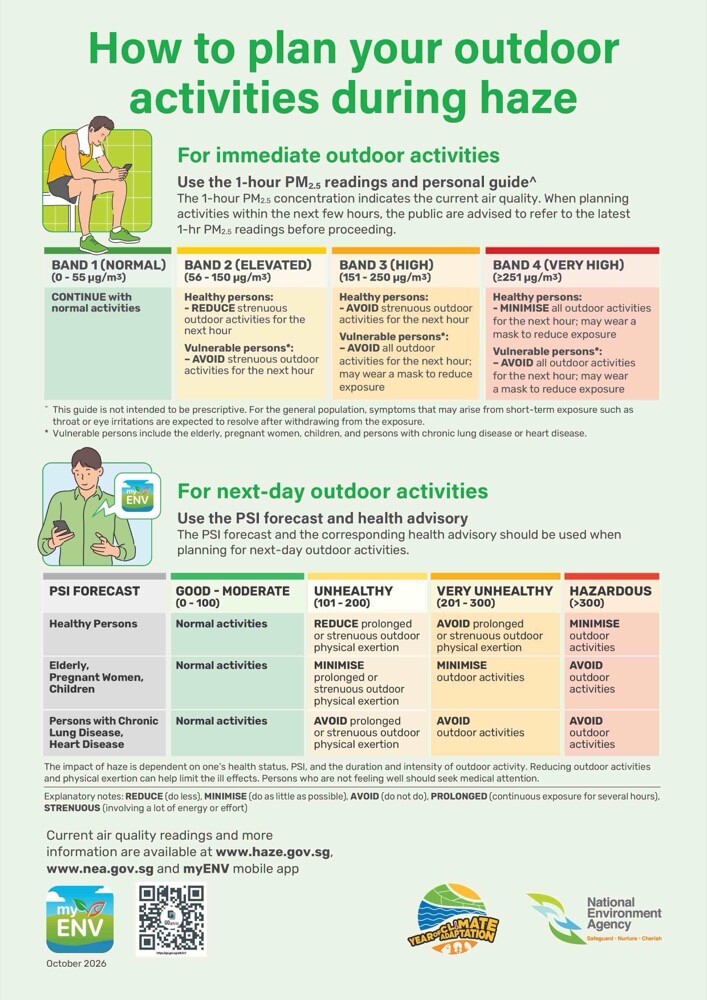
For the haze season itself, NEA’s guide uses the 1-hour PM2.5 reading for immediate plans. In Band 2 (56 to 150 µg/m³), healthy people should reduce strenuous outdoor activity, while vulnerable groups such as the elderly, pregnant women, children and those with chronic lung or heart disease should avoid it. For next-day plans, use the PSI forecast and health advisory. Live readings are on haze.gov.sg, nea.gov.sg and the myENV app.