Anyone who trains dogs in Singapore, from training businesses to dog walkers and pet boarders, now has a set of minimum welfare standards to meet. The Animal & Veterinary Service (AVS), a cluster of the National Parks Board, added a new dog trainers annex to its Code of Animal Welfare for the pet industry on Saturday 3 October, and updated the annex for pet groomers on the same day.
Failing to meet the minimum standards may be used as evidence to support prosecution under the Animals and Birds Act. Where a business is licensed, its licence conditions apply on top of the code.
The dog trainers annex covers any individual, group or business offering dog training, whether it is the main service or a side one. Pet boarding, pet sitting and day care operators, dog walkers, breeders and pet shops all fall within it.
Positive reinforcement comes first
Trainers must follow the Least Intrusive, Minimally Aversive (LIMA) approach, with positive reinforcement as the foundation of any behaviour plan. They have to work through each step of the Hierarchy of Behaviour Change Procedures without success before turning to more aversive methods, and only if the benefit outweighs the potential harm. Escalating because it is convenient, or because a trainer prefers it, is prohibited.
Equipment must not cause unnecessary pain, injury, fear or prolonged stress. Trainers must look for the root cause of problem behaviour and advise owners to see a vet to rule out pain or illness. A dog must be allowed to withdraw from a task, and a session has to stop if the dog is physically or emotionally unfit to carry on.
Class sizes, leashes and supervision
Group sessions are capped at 12 dogs per trainer. The code recommends no more than eight, and no more than six in classes for puppies or reactive dogs. At least one person trained in safely separating dogs must supervise every group session, with separation equipment within reach.
Dogs must be leashed in public areas unless inside a securely fenced training area, and must never be left tethered and unattended. Clean drinking water has to be available throughout. Unwell dogs are kept out of group classes, and trainers must check whether puppies joining a group have been examined by a vet for parasites and infectious diseases.
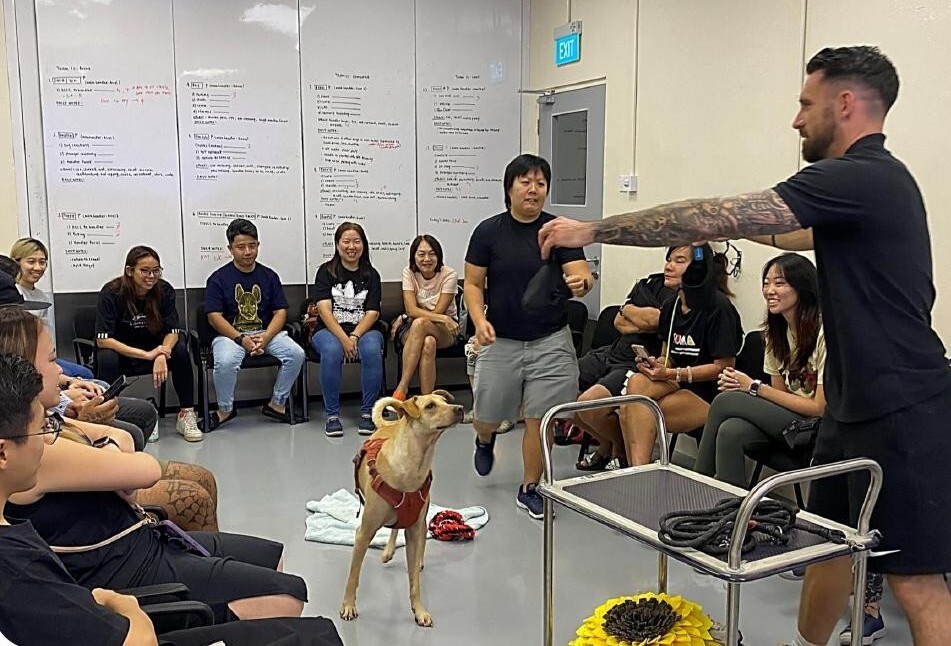
Trainers with less than a year of documented experience must work under one with at least a year. All trainers must complete continuing education every year, with 15 hours recommended. They may not diagnose, prescribe medication or recommend prescription diets unless they are qualified vets.
Records and consent
Trainers must keep detailed records for at least two years and make them available for NParks inspection, get informed consent for every method and tool used, and check whether a dog is vaccinated, microchipped and licensed. On request and with the owner’s consent, records must be passed to other vets or trainers free of charge. Board-and-train programmes need a valid AVS pet boarding licence, and the code recommends CCTV over training and holding areas.
Rules for pet groomers
The updated pet groomers annex bars leaving an animal unattended at any point during grooming. Staff must physically supervise animals on grooming tables, in bathing areas and during blow-drying, and animals in cage or box dryers must be closely and frequently monitored.
Whiskers of cats and small mammals must not be trimmed, and small mammals must not be given full wet baths unless there is a health or hygiene reason. Students, trainees and grooming assistants must work under a trained groomer’s physical supervision. Groomers must keep records of each session, including the groomer’s name, procedures and any incidents, for at least two years, and back up electronic records.