
PayNow gets four changes a payer will notice over 2027 and 2028, under a roadmap the Monetary Authority of Singapore (MAS) and the Association of Banks in Singapore (ABS) published on Wednesday (18 November): one QR code that any participating app can pay, starting with a limited roll-out, online checkouts that open straight into your banking app, bigger government payments with instant confirmation, and clearer rules for refunds and scams when you pay a merchant.
The roadmap is the second phase of PayNow Generation 2, MAS and ABS’s review of Singapore’s instant payment system. None of it changes how you pay today. What it does is put a year against each change.
One QR code, any app
At a counter today, you still need to know which payment schemes a merchant’s QR code takes before you scan. SGQR+ is meant to remove that step. A common routing layer, the SGQR+ switch, connects participating payment apps, so you scan with the app you already use.
Work on the switch has started. A limited roll-out with local and regional payment networks follows in 2027, and the scope widens in 2028. Tourists get the same convenience in reverse: as Singapore connects to more regional QR networks, more shops here can take payments from foreign apps, and Singapore apps work in more countries.
Two things are not in the roadmap yet: which apps join in the first wave, and which countries’ networks connect first.
Checkout without the screenshot
Paying by PayNow on a shopping site often means saving a QR code to your phone gallery, opening a banking app and loading the image back in. Deep-linking skips that. The checkout hands you straight to your preferred banking app to approve the payment.
It is already live in some places, including Lazada’s checkout and CPF Board payment pages through the OCBC app. Common technical standards and a central deep-linking facility are due by end-2027, and more checkouts are added through 2028 as institutions join.
Bigger government payments, starting with the CPF Board
Higher PayNow limits are planned for paying and receiving government money, with immediate confirmation. The CPF Board goes first, in a limited roll-out in late 2027. IRAS and Singapore Customs follow as the roll-out widens to other agencies from 2028.
The new limit itself has not been set out. Until it is, any figure you see for it is a guess.
Refunds, disputes and scams on merchant payments
The Singapore Payments Network (SPaN), the not-for-profit entity MAS and ABS set up to run the national payment schemes, will write the rules for person-to-merchant PayNow payments. They cover disputes, refunds, fraud and scams, and the annex infographic adds surcharging. They come in stages over 2028.
For a customer, this is the part with the most weight, because a PayNow transfer to a shop is instant. What a refund window or a scam claim will look like is not spelt out yet.
What changes for a stallholder or a small shop
From end-2027, PayNow payments can carry richer data. MAS and ABS give merchant identifiers, merchant category codes, invoice references and payment-purpose codes as examples of what could be included. The aim is to let businesses and government agencies match incoming payments to invoices automatically, with services built on that data from 2028.
For QR merchants, SGQR+ widens who can pay them, including more tourists on foreign apps. The roadmap does not mention any change to merchant fees.
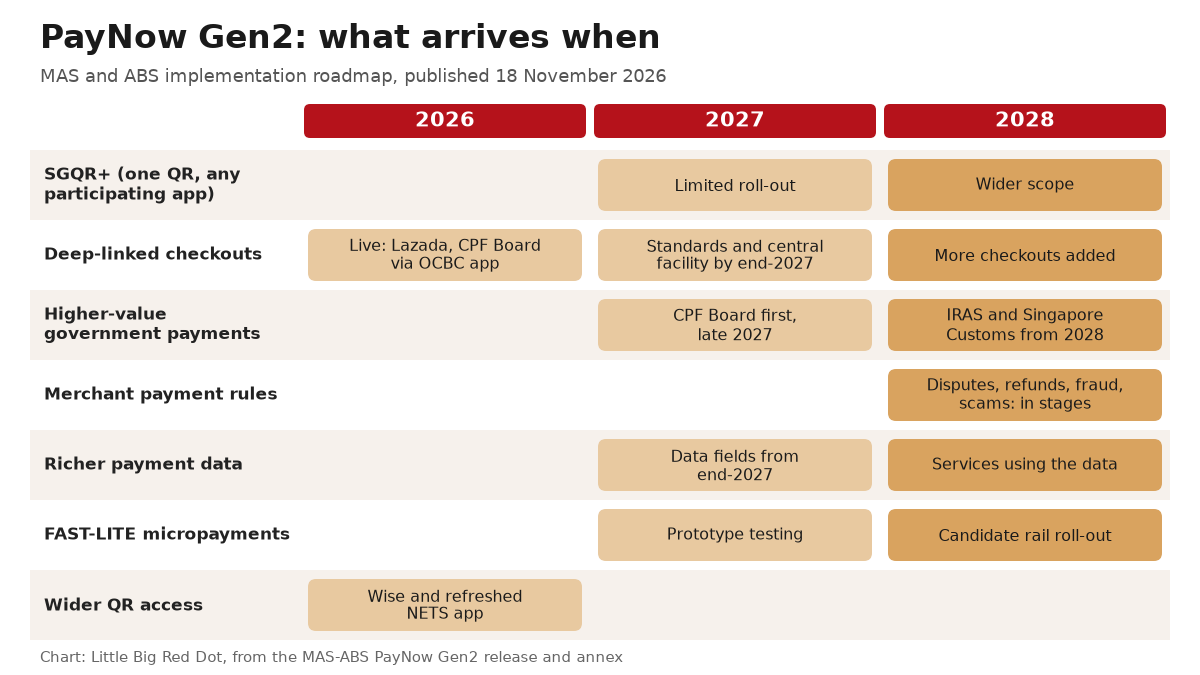
The dates in one place
- 2026: Wise and a refreshed NETS app widen QR payments for visitors and financially dependent residents
- 2027: limited SGQR+ roll-out; deep-linking standards and central facility by end-2027; higher-value payments start with the CPF Board in late 2027; richer data fields from end-2027; MAS develops a Future Payment Rails Blueprint
- 2027 and 2028: testing, then a candidate rail called FAST-LITE for very small, high-frequency payments, such as usage-based AI and automated payments
- 2028: SGQR+ widens; more deep-linked checkouts; IRAS and Singapore Customs on higher-value payments; merchant dispute, refund, fraud and scam rules in stages
None of this is advice, and bank-by-bank PayNow limits sit outside the roadmap. The joint release is on MAS’s website, with the roadmap infographics in its annex.