
From 1 December 2026, the HBOC genetic testing subsidy lets eligible Singaporeans get tested for hereditary breast and ovarian cancer genes at public hospitals for as little as S$0 cash. The Ministry of Health (MOH) announced the details on 5 November, eight months after first flagging the scheme at its Committee of Supply debate in March. A test episode that costs about S$1,000 before help can be fully covered by subsidies and MediSave.
HBOC stands for Hereditary Breast and Ovarian Cancer. MOH says about 1 in 150 Singaporeans carry a variant in an HBOC-linked gene, and women who do face a five to ten times higher lifetime risk of breast or ovarian cancer than other women.
Who qualifies for the HBOC genetic testing subsidy
Testing is not a walk-in screening for everyone. Doctors will recommend it for three groups:
- people with breast or ovarian cancer who also have HBOC risk factors
- first-degree relatives (parents, siblings, children) of someone found to carry an HBOC gene variant
- people with a strong family history that points to HBOC, where no relative with cancer is available to be tested first
Men are included. Male carriers can pass the variant to their sons and daughters, so MOH applies the subsidies to eligible people regardless of gender.

Where to get tested
Subsidised tests are offered by the three public healthcare clusters at the cancer specialist outpatient clinics of:
- National Cancer Centre Singapore (NCCS), Outram
- National University Cancer Institute, Singapore (NCIS), Kent Ridge
- Tan Tock Seng Hospital, Novena
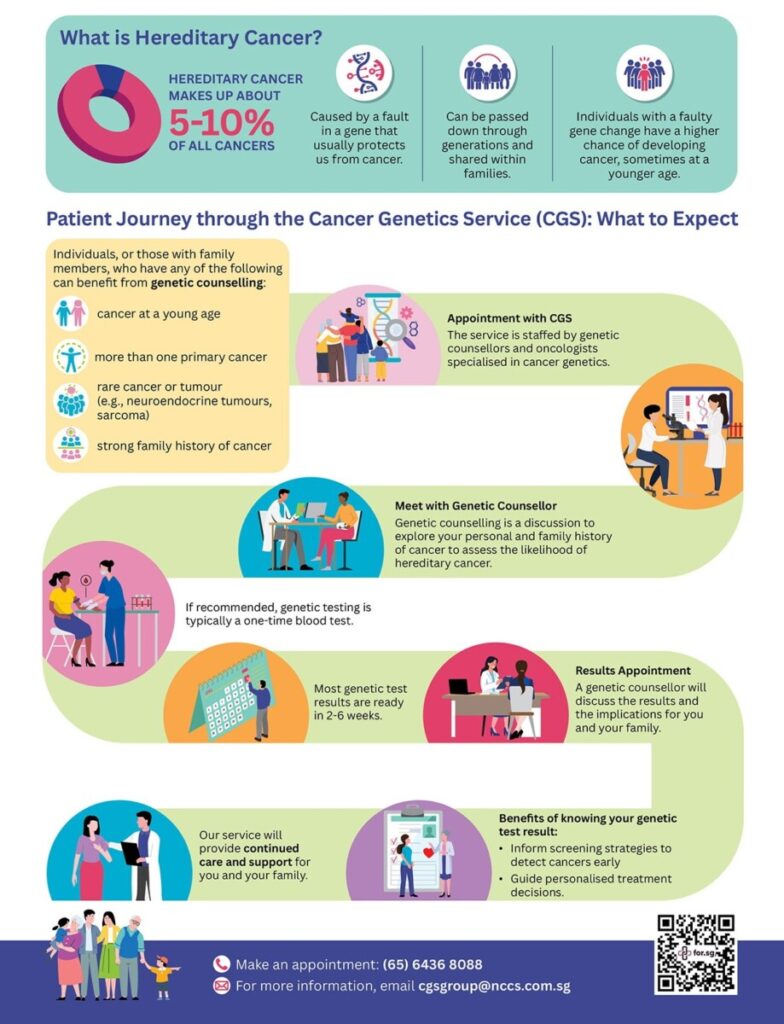
The episode covers more than the blood test. It includes counselling before and after the test, plus the blood draw itself. NCCS says most results come back in two to six weeks.
How much you will pay
Singapore Citizens and Permanent Residents get means-tested subsidies of up to 70% on the test. Pioneer and Merdeka Generation seniors get extra subsidies on top. What is left can be paid with MediSave under the Chronic and Preventive Care scheme.
MOH’s indicative bill sizes look like this:
- Patient tested first (the index patient): about S$1,000 before subsidies, S$0 cash after subsidies and MediSave
- Family member referred for cascade testing: about S$550 before subsidies, S$0 cash after subsidies and MediSave
The S$0 figure assumes you have enough MediSave. The current MediSave500/700 limits will cover the test until 31 December 2026. From 1 January 2027 the basic yearly limit goes up from S$500 to S$700, and the limit for complex chronic patients rises from S$700 to S$1,000. Seniors aged 60 and above can also use Flexi-MediSave for any balance.
What happens after a positive result
A positive result does not mean you will get cancer. It means you can act earlier, and MOH has widened MediShield Life and MediSave cover for the main options:
- Risk-reducing mastectomy, which cuts breast cancer risk by 90% or more in carriers. MediShield Life and MediSave have covered it since 28 September 2026, with claim limits of S$2,310 to S$2,460 depending on the surgery code.
- Risk-reducing removal of the ovaries and fallopian tubes, which cuts ovarian cancer risk by 80% or more. Cover will be extended by the end of 2026, with the surgery codes to be released later.
- Yearly MRI or mammogram checks, claimable under the MediSave outpatient scans limit (doubled to S$600 a year in 2026) and Flexi-MediSave (S$400 a year).
- Risk-reducing drugs, which stay subsidised if listed on the Standard Drug List or the Medication Assistance Fund.
Your doctor will also suggest that parents, siblings and children get tested. That cascade testing gets the same subsidies and MediSave treatment. MOH expects around 2,000 people a year to benefit, family members included.
What this means for your family
For many families, the cost was the thing that made people put this off. A S$1,000 test is a lot to pay on a hunch, especially when several relatives might need one. With the bill now down to S$0 cash for most, the bigger hurdle is starting the conversation at home.
If breast or ovarian cancer has turned up in more than one generation of your family, ask your doctor or polyclinic about a referral to a cancer genetics clinic. For context on how genetic results can and cannot be used by insurers and employers, read our guide to Singapore’s proposed genetic information law. For more on breast cancer awareness, see our write-up of last month’s Pink Ribbon Walk.