
A company whose fires abroad send haze into Singapore can be fined up to S$100,000 for every day of that haze, but no court can fine it more than S$2 million in total. Both limits sit in the Transboundary Haze Pollution Act 2014, the version in force on Tuesday, 3 November 2026.
The law reaches conduct outside Singapore and lets prosecutors rely on satellite data and maps. Its limits are just as precise: it fines companies rather than jailing anyone for the haze, and it applies only when the air here crosses a set line.
When does the Act apply?
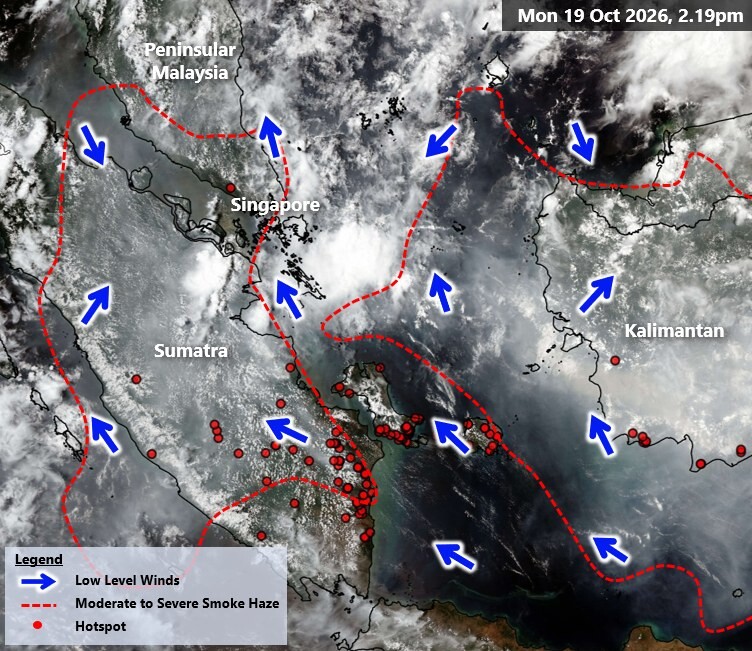
It applies only during “haze pollution in Singapore”. The Act defines that as a poor air quality episode involving smoke from a land or forest fire wholly outside Singapore. Peat, plantation and coal seam fires all count.
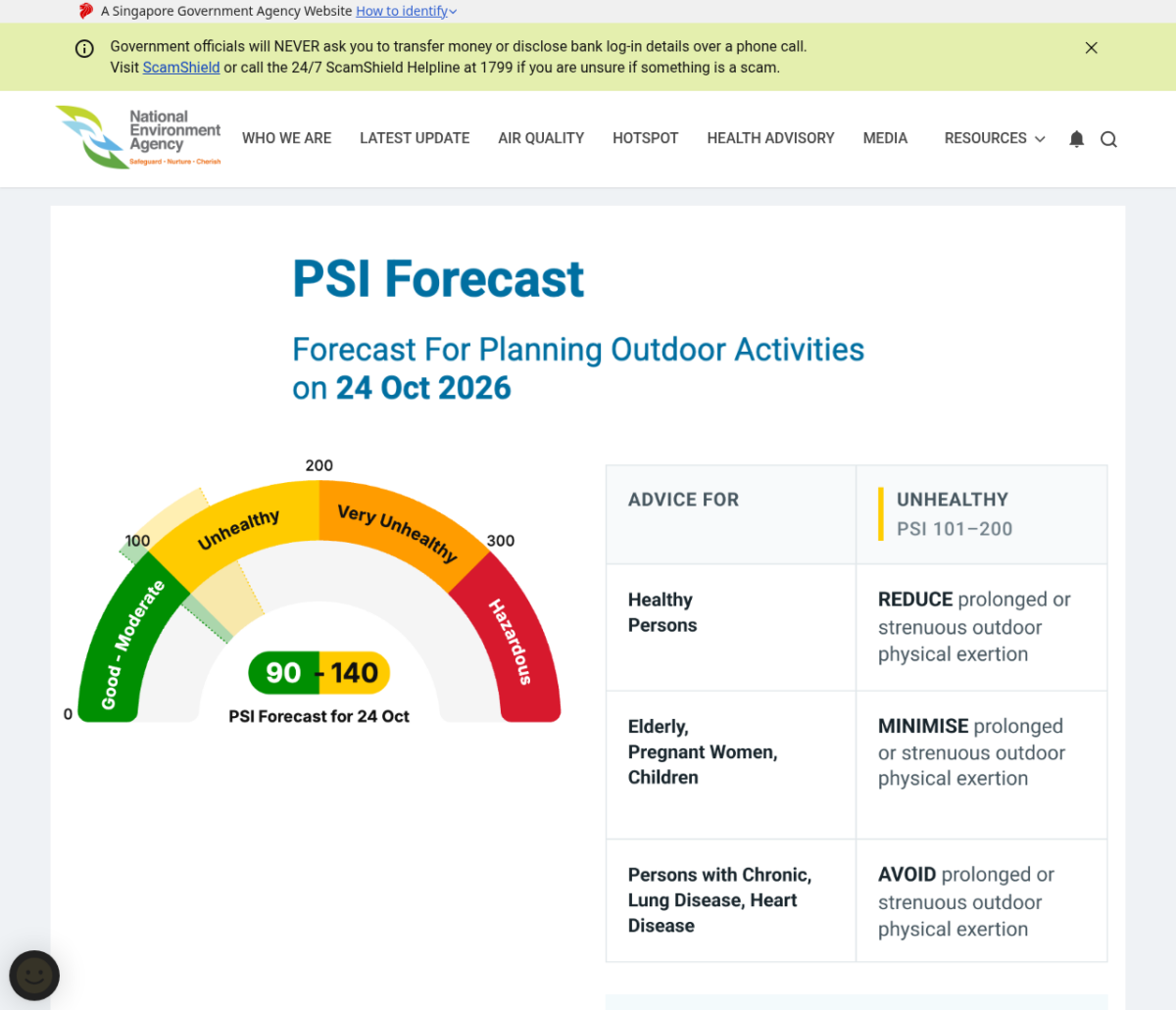
A separate set of rules, the Transboundary Haze Pollution (Air Quality) Regulations 2014, fixes the trigger. The 24-hour PSI for PM2.5 in any part of Singapore has to reach 101, and stay at or above 101, there or elsewhere in Singapore, for at least the next 24 hours.
On 12 February 2026, Minister for Sustainability and the Environment Grace Fu told Parliament that 24-hour PSI readings that year had peaked at 69 on 8 February, and that the haze had not reached levels that would warrant investigation under the Act.
Who can be punished, and how much?
The offence is committed by an “entity”: a company, partnership, sole proprietorship or other body of persons. An entity is guilty if it causes or contributes to haze in Singapore, or condones another party’s conduct that does, whether that conduct happens in Singapore or abroad. That conduct includes lighting fires outdoors for farming or forestry and leaving them unattended.
A parent or manager can be liable too. An entity that takes part in managing, or holds decision-making control over, a landholding company abroad faces the same offence if that company’s conduct produces the haze.
The fine is up to S$100,000 for every day or part of a day of haze. If the entity also ignored a preventive measures notice, a further fine of up to S$50,000 a day can be added. The two daily figures stack, but a court sentencing an entity cannot impose more than S$2 million in aggregate.
What can the National Environment Agency order?
Once a fire abroad is polluting the air, here or in another country, and its smoke is likely to blow towards Singapore, the Director-General of Environmental Protection can serve a preventive measures notice. It can require a company to send firefighters, stop or hold off any burning, and hand in a plan to put the fire out and stop it recurring.
The Director-General can also demand documents and information from any person, in Singapore or abroad. A person who fails to comply without reasonable excuse faces a fine of up to S$5,000, up to a month in jail, or both. Destroying documents or knowingly giving false information carries up to S$5,000 and up to three months.
How does a prosecution prove where the smoke came from?
It relies on presumptions. If there is haze in Singapore, a fire on land abroad at about the same time, and satellite, wind and other weather data showing that fire’s smoke moving towards Singapore, the haze is presumed to involve that smoke.
Whoever owns or occupies that land is then presumed to have caused it. Ownership itself can be presumed from maps supplied by a foreign government or its agencies, or obtained through an information notice. Each presumption holds until the company proves otherwise.
What defences does a company have?
It can prove the haze came solely from a grave natural disaster or an act of war. It can also prove the fire was set by someone acting without its knowledge or consent, though that someone cannot be its own employee, agent or contractor, or a person holding customary land rights who has a farming or forestry arrangement with it. A company accused of condoning another party’s fires has a defence if it took all reasonable steps to prevent and stop them.
Can people in Singapore sue?
Yes. Anyone in Singapore who suffers injury, illness or death, damage to property, or economic loss, including lost profits, because of a breach can bring a civil claim in Singapore. The claim stands even if the same conduct is not actionable in the country where the fire burned.
What can the Act not do?
It cannot reach haze from fires inside Singapore. It cannot compound the haze offence itself either; the composition rules allow only the information-notice and obstruction offences to be settled that way.
Service is the hardest limit. An information notice has to be delivered by hand, and a company with no place of business in Singapore can be served only through an officer or partner who is physically here, or by a method the company has agreed to.
The 2015 haze shows how far that goes. In a written reply on 13 September 2021, Ms Fu stated that NEA had issued legal notices under the Act to six Indonesian companies linked to fires on concession land. NEA announced in March 2017 that it had closed two of those cases on the information the companies provided. Investigations into the other four remain open.