Every outgoing call from the Singapore Police Force now carries one number, 6000 0999, in force from 2 November 2026 and the first single caller ID used by a Singapore government agency.
The force built it with Open Government Products, the Ministry of Digital Development and Information and the Infocomm Media Development Authority. The number is a marker for the public rather than a new hotline. The force says it will be used strictly for outgoing calls, and never on messaging platforms such as WhatsApp or Telegram.
What does a real police call look like?
The screen shows 6000 0999. After the call, an SMS arrives from the gov.sg sender ID with information on how to reach the force about that call, so a household has a written record of the contact and a route back to the Police that did not come from the caller.
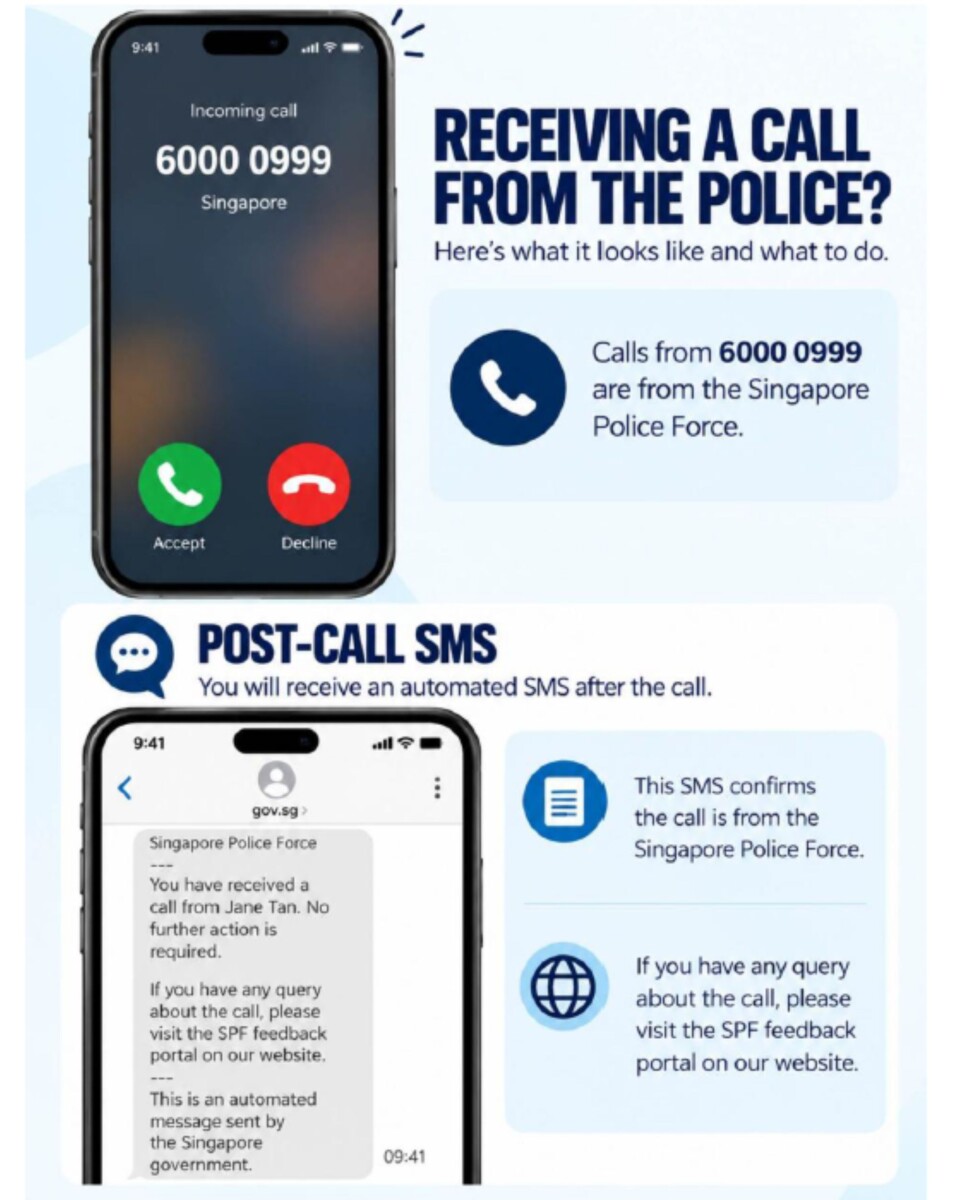
Anyone who wants to confirm a call can use the SPF Feedback Hotline on 1800-358-0000 or the SPF Feedback Portal. Both are published by the force alongside the new number.
Why does one number matter?
The police force is the most frequently impersonated government agency in Singapore. At least 1,310 cases involving people posing as police officers were reported between January and September 2026, with losses of at least S$53.3 million.
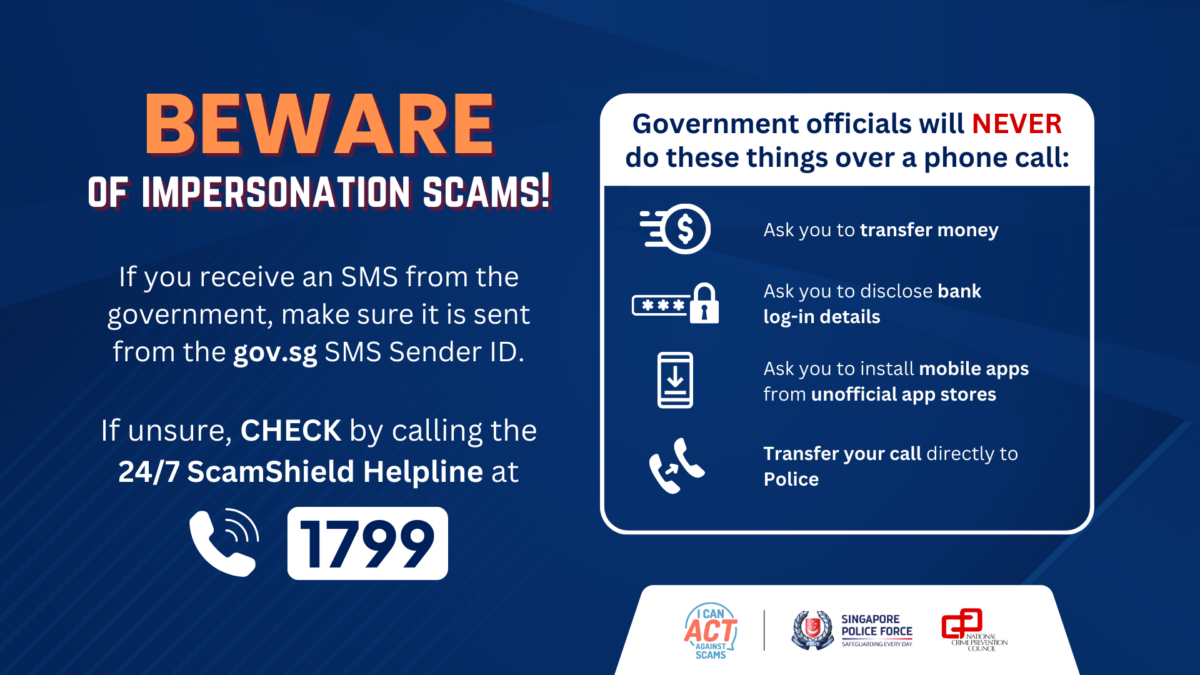
Before 2 November, calls from the force came from individual officers’ office landlines and mobile numbers. A resident had no fixed marker to recognise. The single caller ID sits alongside two earlier measures: the gov.sg SMS Sender ID, and the ScamShield Helpline on 1799, which answers around the clock.
How does an impersonation call usually run?
It opens with an unsolicited call, or an in-app call on WhatsApp or another messaging service, from someone claiming to be from the Police or the Monetary Authority of Singapore. The caller accuses the recipient of involvement in criminal activity, then asks for money to be moved into a “safe account” to assist with investigations.
Some variants move offline, with a meet-up to collect cash, gold, luxury watches or other valuables. Others run on video, with the recipient told to hold up an identity card, work permit or bank card for the “officer” to see. The loss is discovered later, through unauthorised transactions on the account.
One limit is worth knowing for households with relatives overseas. A foreign law enforcement agency has no legal power to require anyone in Singapore to assist in its investigations without the approval of the Singapore government, whatever the caller claims about a case abroad.
What will a police officer never ask for?
The force sets out four things that government officials will not do on a phone call. They will not ask for valuables to be transferred or handed over, including money, luxury watches, gold or cryptocurrency. They will not ask for banking log-in details. They will not ask for mobile applications to be installed from unofficial app stores. And they will not transfer a call to the Police.
A caller who recites a name or an NRIC number proves nothing by doing so. Personal details are not evidence of identity, and the force directs anyone in doubt to verify through the agency’s own channels instead of the ones supplied on the call.
What should a household do with a doubtful call?
End the call and reach the agency by a route the household already holds, not one handed over by the caller. For the Police, that means the feedback hotline or portal. For a second opinion on whether a call is a scam at all, the ScamShield Helpline on 1799 takes the question at any hour.
Mr Tay Paul Hong, Lead Product Manager at Open Government Products, framed the police rollout as a live test: “This launch with the SPF will help us test the solution in practice and inform how similar approaches could be applied more broadly in future.”
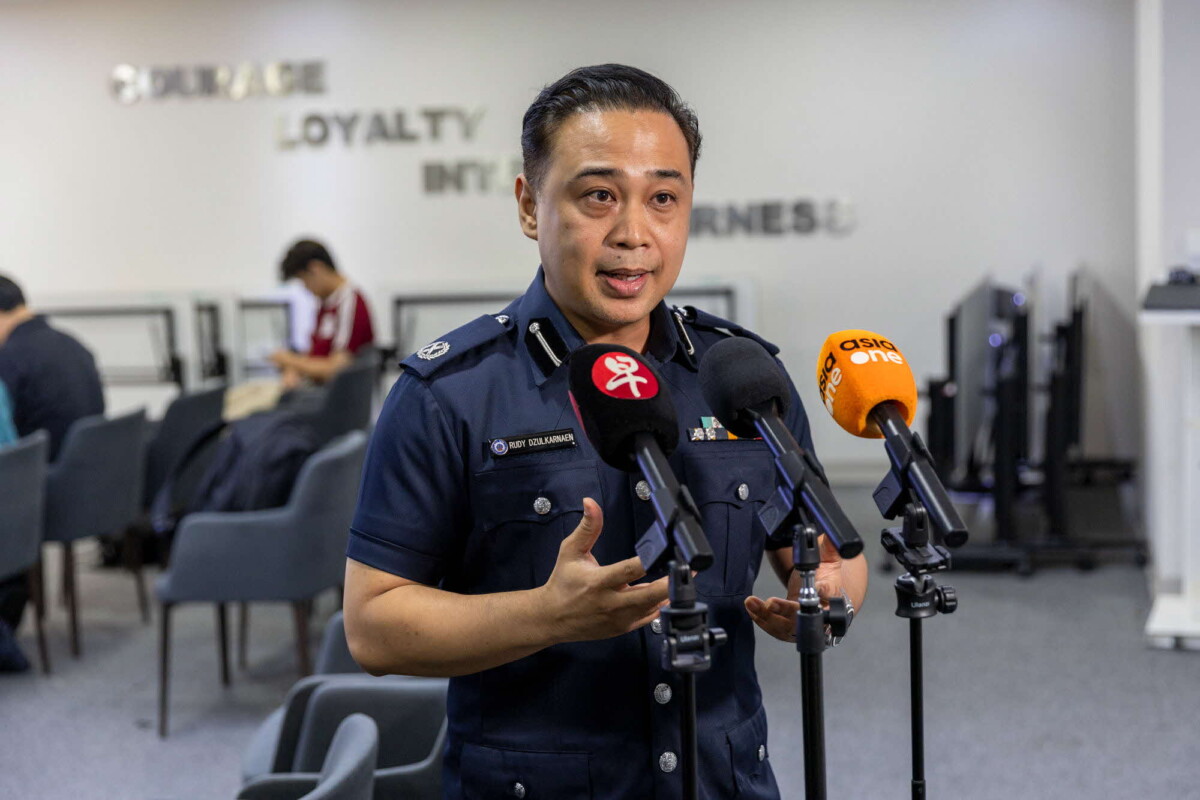
Deputy Assistant Commissioner of Police Rudy Dzulkarnaen, Deputy Director of the Service Delivery Department, set the limit of the new number in similar terms: “Despite all these initiatives, we encourage members of the public to remain vigilant when receiving unexpected calls claiming to be from the government, such as Police.”