
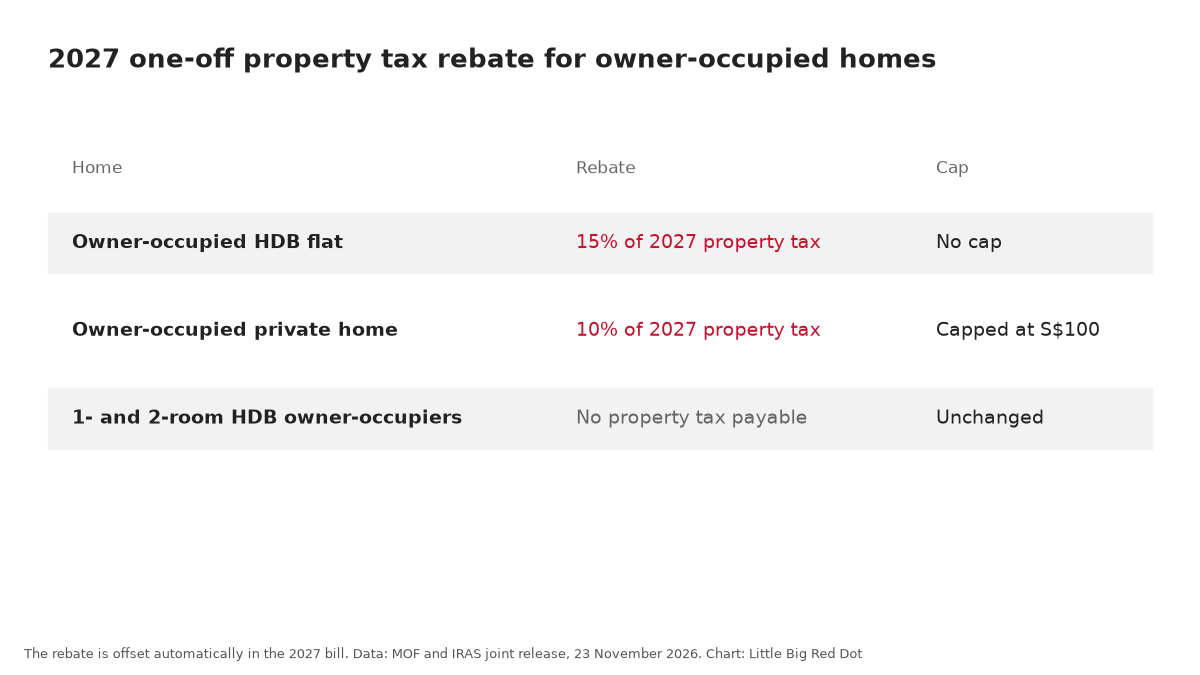
Owner-occupied HDB flats get a one-off 15 per cent rebate on their 2027 property tax, and owner-occupied private homes get 10 per cent, capped at S$100. The Ministry of Finance and the Inland Revenue Authority of Singapore (IRAS) set out the rebate in a joint release on 23 November 2026, alongside new annual values for HDB flats.
The rebate is taken off the 2027 bill automatically. There is no form to fill in.
What the 2027 bill does after the rebate
The rebate softens an increase rather than cancelling it. HDB annual values, the estimated yearly rent a flat would fetch, have been updated to reflect market rents in each HDB town, and property tax is the annual value multiplied by the tax rate.
After the rebate, owner-occupiers in three-room and larger flats will see an average increase of about S$2 to S$4 a month, MOF and IRAS say. Most owner-occupiers of private homes will see an average increase of about S$6 a month. All one-room and two-room HDB owner-occupiers will continue to pay no property tax.
The two rebates work differently. On an HDB flat, 15 per cent comes off the tax, with no cap. On a private home, the 10 per cent rebate is capped at S$100.
The rebate applies only to owner-occupied homes. Owner-occupier tax rates apply to only one property you own and live in, so other homes you own, including those you rent out, are taxed at non-owner-occupier rates. If you live in your home but it is still taxed at non-owner-occupier rates, you can apply for owner-occupier rates through the Apply/Withdraw Owner-Occupier Tax Rates service on myTax Portal.
When the bill arrives and when it is due
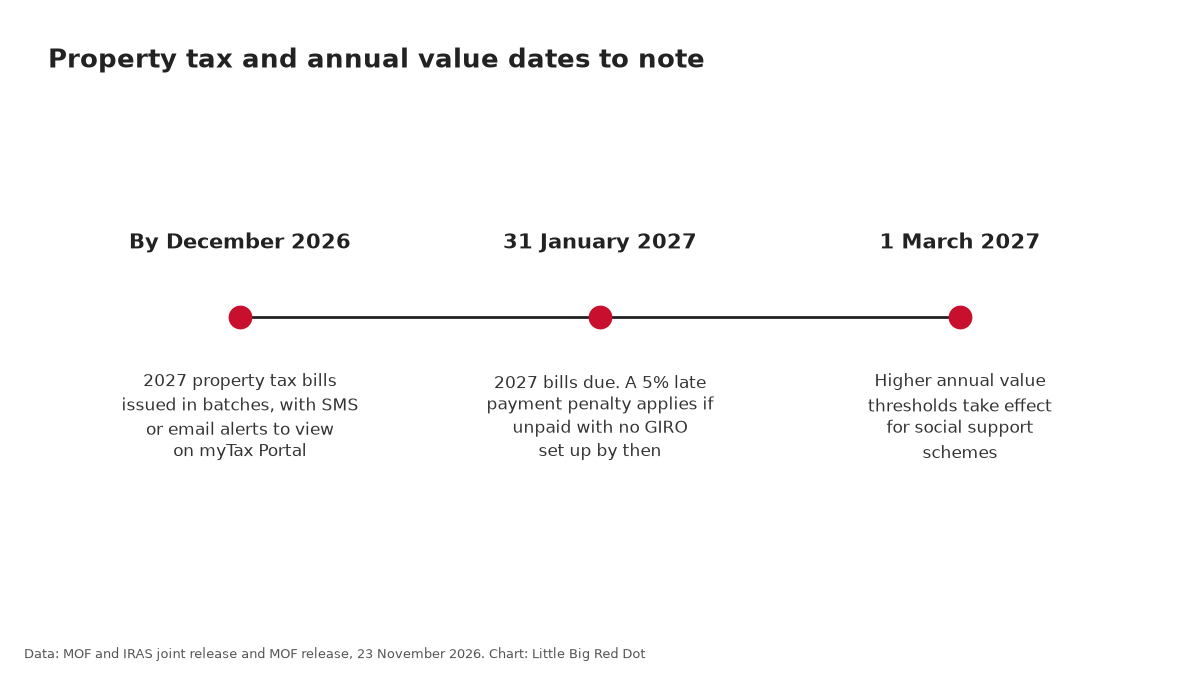
IRAS sends 2027 bills in batches by December 2026, with an SMS or email telling you to view the bill on myTax Portal. Some owners receive theirs earlier than others.
Payment is due by 31 January 2027. GIRO lets you pay in up to 12 interest-free monthly instalments or in one deduction. Retirees who qualify for the Extended GIRO Scheme can stretch payments over up to 24 months: all owners of the property must be 65 or older, and the applicant must live in the property and have an assessable income of no more than S$39,000. Anyone who has neither paid nor set up GIRO instalments by the due date faces a 5 per cent late payment penalty.
The second change: annual value thresholds for support schemes
A higher annual value can push a household into a lower tier of government support, which is why MOF moved on a second front the same day. From 1 March 2027, the first annual value tier for social support schemes rises from S$21,000 to S$24,000. The second tier, which currently covers more than S$21,000 up to S$31,000, becomes more than S$24,000 up to S$32,000.
These tiers are used by schemes such as the permanent GST Voucher, MediShield Life premium subsidies and the Workfare Income Supplement, with lower annual values getting more support.
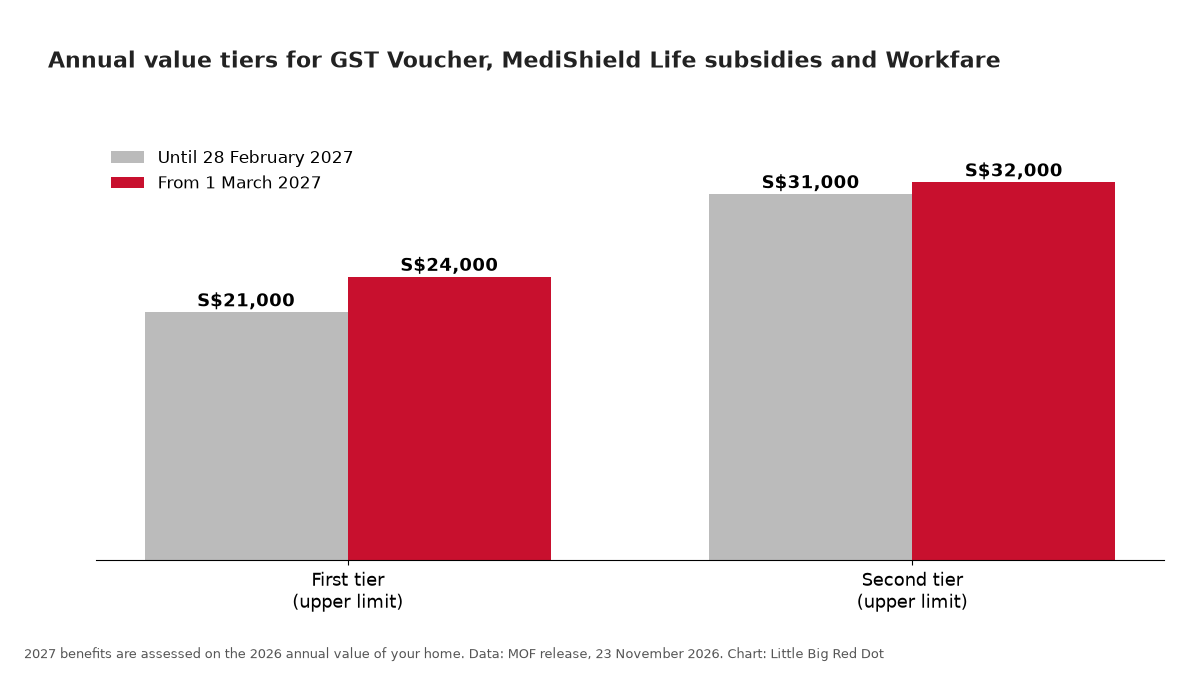
Eligibility in any year rests on the previous year’s annual value. Your 2027 benefits are decided by your home’s 2026 annual value, not the new figure printed on the 2027 bill. The current annual value of a home you own is free to view under View Property Summary on myTax Portal.
Owners who expect trouble paying can ask IRAS for a longer payment plan through the Apply/Manage GIRO Plan service on myTax Portal before 31 January. Questions about a specific support scheme go to the agency running it.