
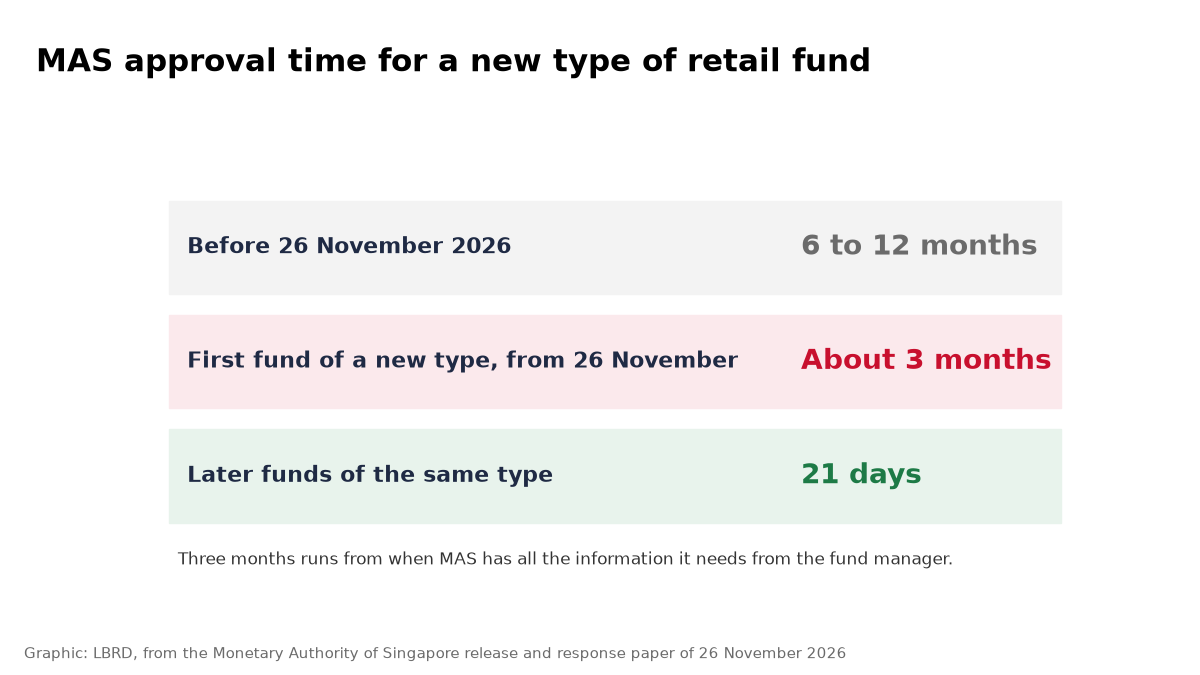
The Monetary Authority of Singapore (MAS) said on 26 November that a new type of retail fund can now be authorised in about three months, down from six to 12 months. Later funds of the same type take 21 days.
The change is in the Code on Collective Investment Schemes (CIS Code), the rulebook for funds sold to retail investors in Singapore, and took effect immediately. Private market funds are not covered.
What changed on 26 November
The CIS Code now carries a Non-Traditional Funds Appendix. A fund whose features fall outside the existing investment guidelines can be authorised under it and allowed to depart from the standard investment requirements, provided it accepts alternative safeguards drawn up for that fund type.
Each new type works the same way. MAS works with the fund manager or an industry association on modified requirements for the fund type, and expects to settle them about three months after it has all the information it needs. The requirements are published in a circular. After that, any fund of the same type that meets them is authorised in 21 days. The three months depends on the quality and completeness of what the manager submits, and on MAS’s comments being answered fully and on time.
The appendix was consulted on from 9 July to 10 August under the name Alternative Funds Appendix. Respondents warned that investors could read “alternative” as private market investments or hedge funds, so MAS renamed it.
The two fund types MAS used as examples
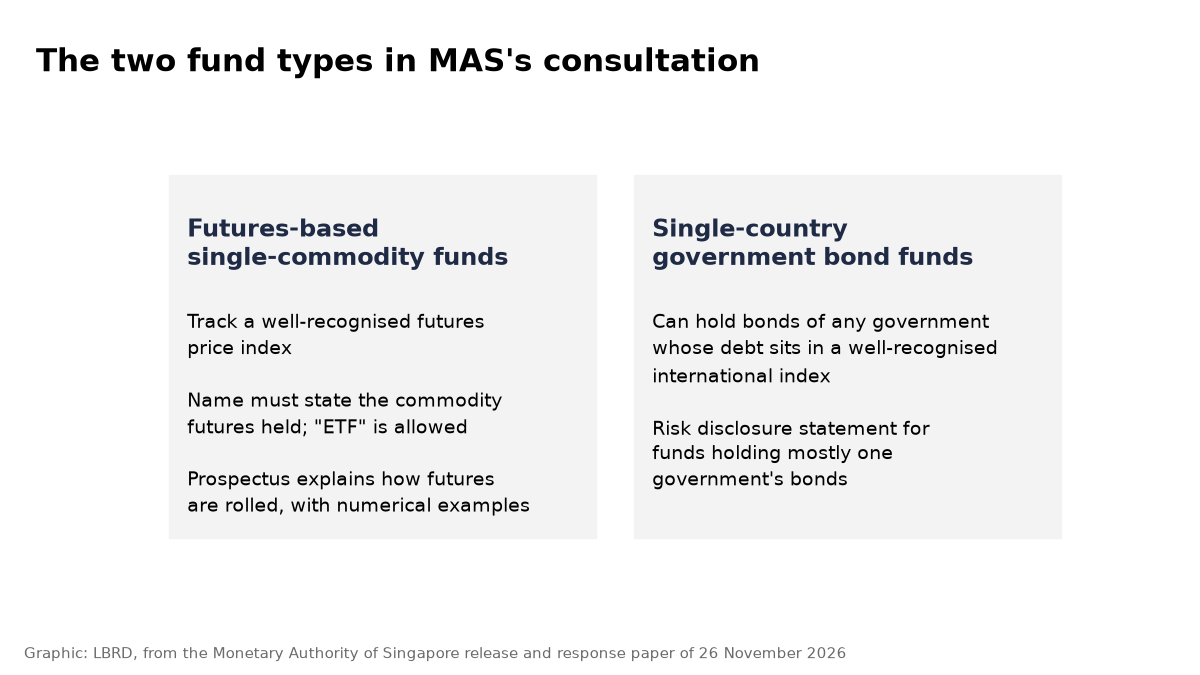
The first is a futures-based single-commodity fund. It has to track a well-recognised futures price index. MAS gave two examples: the S&P GSCI Crude Oil Enhanced Index Excess Return, which follows West Texas Intermediate crude futures on NYMEX, and the DCE Iron Ore Futures Price Index. MAS dropped its proposed ban on using “ETF” in the fund name, but the name must clearly refer to the type of commodity futures the fund holds.
The prospectus has to describe how the fund rolls its futures contracts and, where appropriate, give numerical examples of how contango and backwardation can affect performance under different market conditions.
The second is a single-country government bond fund. Such funds can now hold the public debt of any government whose bonds are constituents of a well-recognised international index. MAS named the JPMorgan Government Bond Index-Emerging Markets and the FTSE World Government Bond Index as examples. A fund that puts most, if not all, of its money into one government’s bonds must carry a risk disclosure statement.
What a retail investor will see
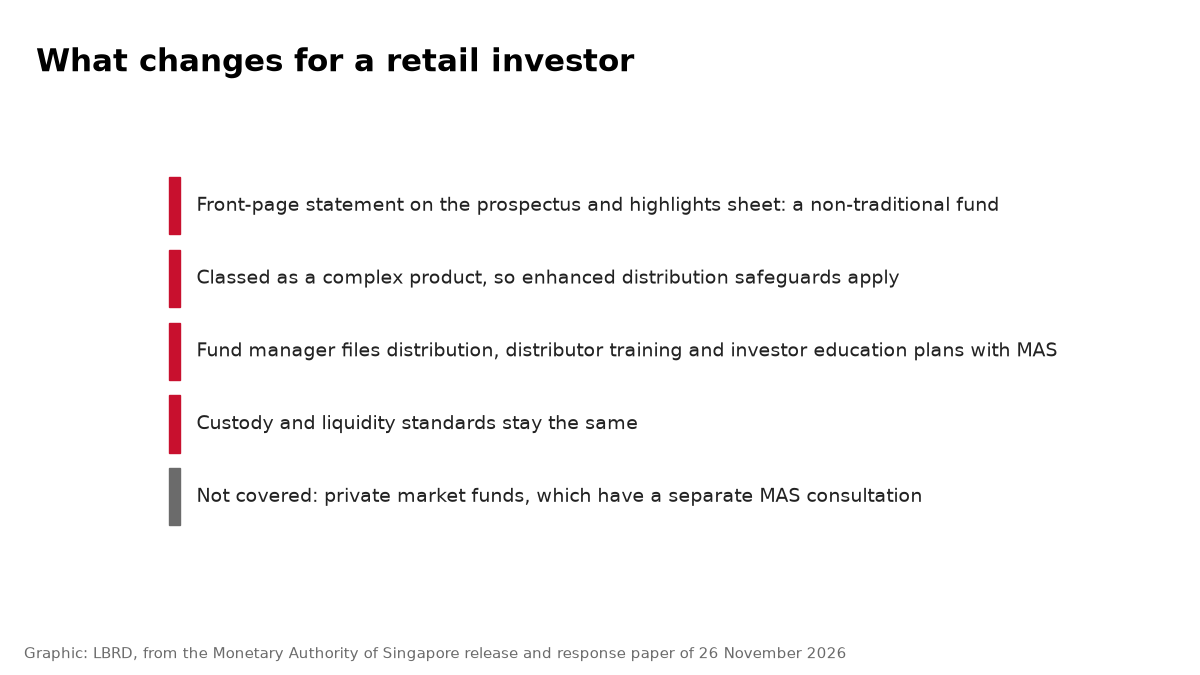
A fund authorised under the appendix has to carry a clear statement on the front page of its prospectus and product highlights sheet, and in its marketing materials, that it is offered as a non-traditional fund. MAS expects these funds to use derivatives heavily, so they are classed as complex products and the enhanced distribution safeguards for complex products apply.
Before authorisation, the manager has to give MAS its distribution plan, including how distributors are chosen and trained and how sales outside the intended customer segment are prevented, along with its investor education plan. MAS said custody and liquidity standards for retail funds stay in place.
What is not covered yet
Private market investment funds stay outside the appendix, because they could not meet certain existing requirements of the CIS Code. MAS consulted separately on retail access to them and will publish its response in due course.
Investment-linked policy sub-funds come later, after amendments to MAS Notice 307. Before a comparable foreign fund of a new type can be considered for recognition here, MAS will put safeguards in the CIS Code for an authorised fund of that type.
This is general information, not financial advice.