
The National Population Health Survey 2025 mental health results, published by MOH and HPB on 3 October 2026, found that 15.9% of Singapore residents aged 18 to 74 had poor mental health. That is up from 15.4% in 2024, though the survey does not call the longer trend from 2020 statistically significant. The number that caught our eye is a different one: willingness to see a healthcare professional when you cannot cope with stress.
National Population Health Survey 2025 mental health: who is struggling
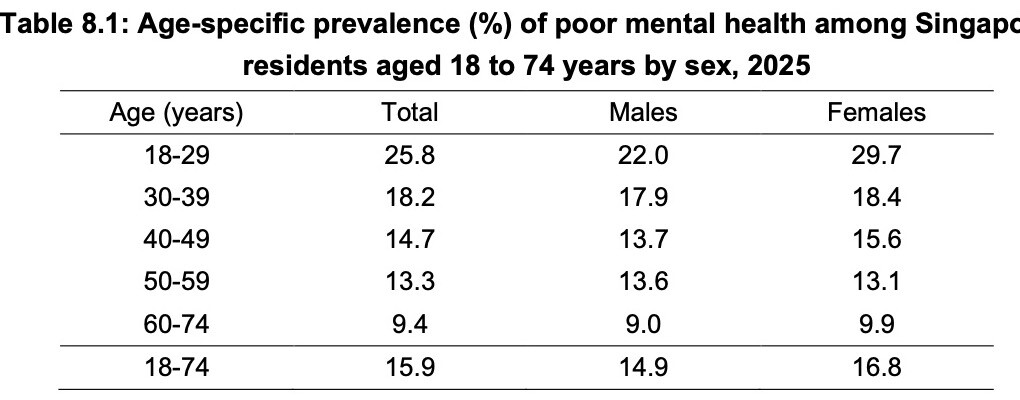
Poor mental health here is measured with the 12-item General Health Questionnaire, where a score of 3 or more counts as poor. Younger adults carry the heaviest load:
- 18 to 29 years: 25.8% (29.7% for young women, 22.0% for young men)
- 30 to 39 years: 18.2%
- 40 to 49 years: 14.7%
- 50 to 59 years: 13.3%
- 60 to 74 years: 9.4%
Women reported poor mental health at 16.8% against 14.9% for men. By ethnic group, the figures were 15.2% for Chinese, 17.4% for Malays and 17.7% for Indians. Residents with post-secondary education had the highest rate at 16.6%.
More people say they would reach out, but mostly to friends
Overall, 87.5% of residents said they would seek help if they were constantly unable to cope with stress, from healthcare professionals, informal networks or both. Informal support (friends, family, colleagues, religious leaders) was the first stop for 80.9%, against 53.6% for professionals such as counsellors, doctors, psychologists and psychiatrists. Women were more willing than men on both counts.
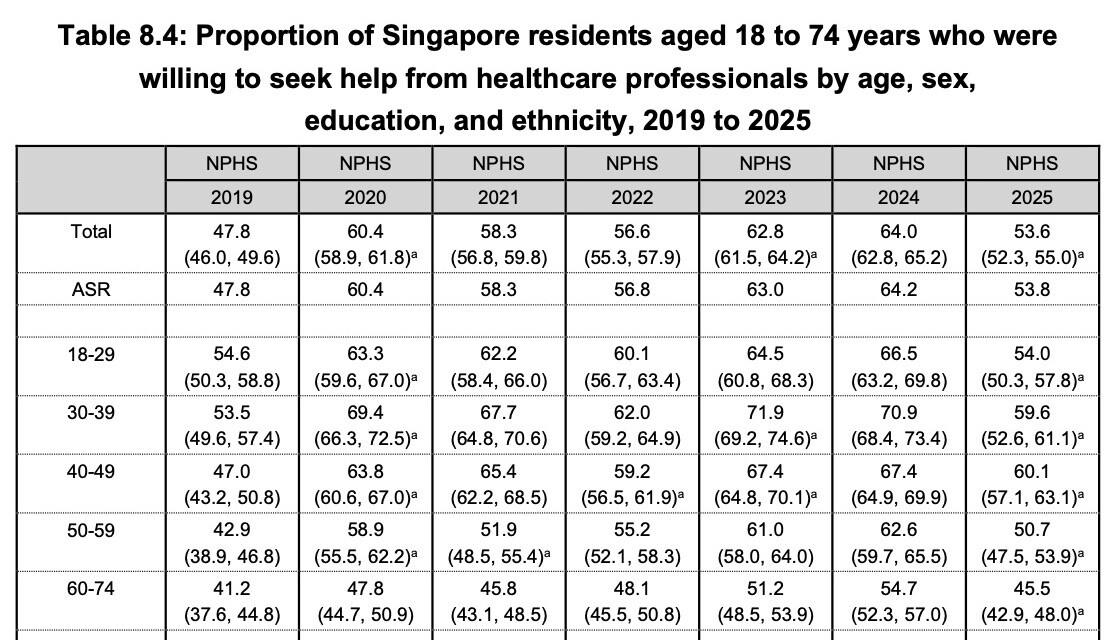
Older adults were the least keen on professional help. Only 45.5% of those aged 60 to 74 said they would go, compared with 60.1% of those aged 40 to 49.
The dip in professional help-seeking
Here is the part the headline summary skips. In Table 8.4 of the report, willingness to seek help from healthcare professionals stands at 53.6% in 2025, down from 64.0% in 2024, and the table marks that year-on-year change as statistically significant. It is higher than the 47.8% recorded in 2019, which is why the report’s text talks about an increase since 2019. We read the 2024 to 2025 drop from the table ourselves, and the report does not explain it.
The 18 to 29 group moved from 66.5% to 54.0%, the biggest swing among the age bands in that table.
What you can do this week
You do not need a diagnosis to talk to someone. If you are not ready for a clinic, the MindSG portal on HealthHub lists self-help tools and programmes, and Mindline.sg (1771, open 24 hours) is there if things feel heavy at 2am. If a friend opens up to you, listen first and suggest a professional gently, since friends are where most people say they would turn.
For the full tables and methodology, the NPHS 2025 report is on the MOH website at moh.gov.sg. The most recent young persons guidelines consultation is a separate matter, which we covered in our post on the MOH mental health guidelines for young persons.