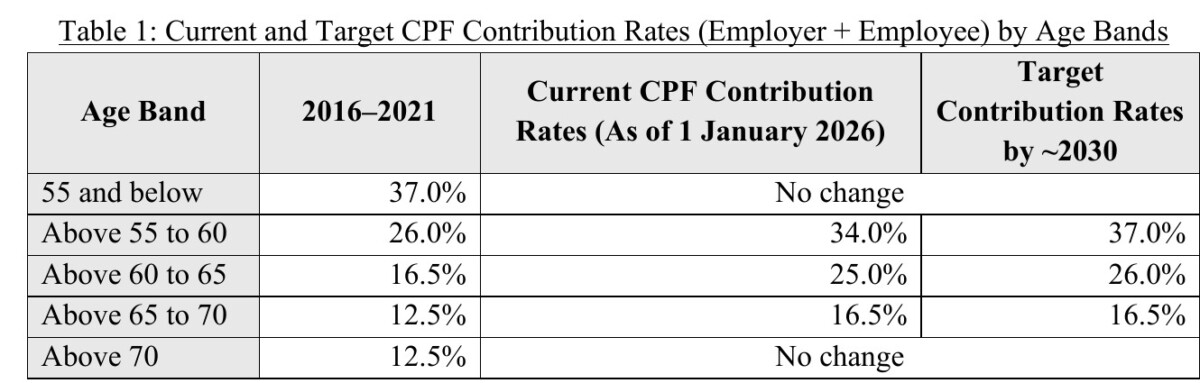
From 1 January 2027, CPF contribution rates go up for employees aged above 55 to 65, starting with wages earned that month. If you are in that age band and earn more than S$750 a month, a bigger share of your pay goes into CPF, and your employer puts in more as well.
For employees above 55 to 60, the total rate rises from 34 per cent to 35.5 per cent of wages. Your share goes up by 1 percentage point to 19 per cent, and your employer’s share goes up by half a point to 16.5 per cent. For employees above 60 to 65, the total rises from 25 per cent to 26 per cent, split evenly at 13 per cent each, which is half a point more on both sides.
What changes on your payslip
Your share of CPF comes out of your gross pay, so take-home pay falls by the same amount your share rises. That is 1 per cent of wages if you are above 55 to 60, and half of 1 per cent if you are above 60 to 65.
The 2027 table caps ordinary wages at S$8,000 a month for CPF. At that cap, the most that can go in each month on ordinary wages is S$2,840 for an employee above 55 to 60, of which S$1,520 is the employee’s share. For an employee above 60 to 65, the cap is S$2,080, with S$1,040 from the employee.
If you earn more than S$500 and up to S$750 a month, you pay phased-in rates, and those rise in proportion. Above S$50 and up to S$500, the employee pays nothing and only the employer contributes: 16.5 per cent of total wages above 55 to 60, and 13 per cent above 60 to 65. At S$50 or less, no CPF is payable.
Where the extra money goes
The whole increase is allocated to your Retirement Account, up to the Full Retirement Sum. If you have already set aside the Full Retirement Sum, the extra goes to your Ordinary Account instead. In other words, for most people in the band, the larger deduction becomes retirement savings, not Ordinary Account money for a home loan.
Nothing changes for employees aged 55 and below, who stay at 37 per cent, or for those above 65 to 70 at 16.5 per cent and above 70 at 12.5 per cent. The new rates apply to Singapore Citizens and to permanent residents from their third year. Graduated rates for first and second year permanent residents are unchanged.
The offset for employers
Employers get a one-year CPF Transition Offset worth half of the 2027 rise in the employer rate. The Ministry of Finance puts that at 0.25 percentage point of wages for every Singaporean and permanent resident employee aged above 55 to 65. It is paid automatically, and employers do not apply for it.
Questions on the offset go to IRAS at go.gov.sg/askpayout. Questions on contribution rates go to the CPF Board.
Why the rates keep climbing
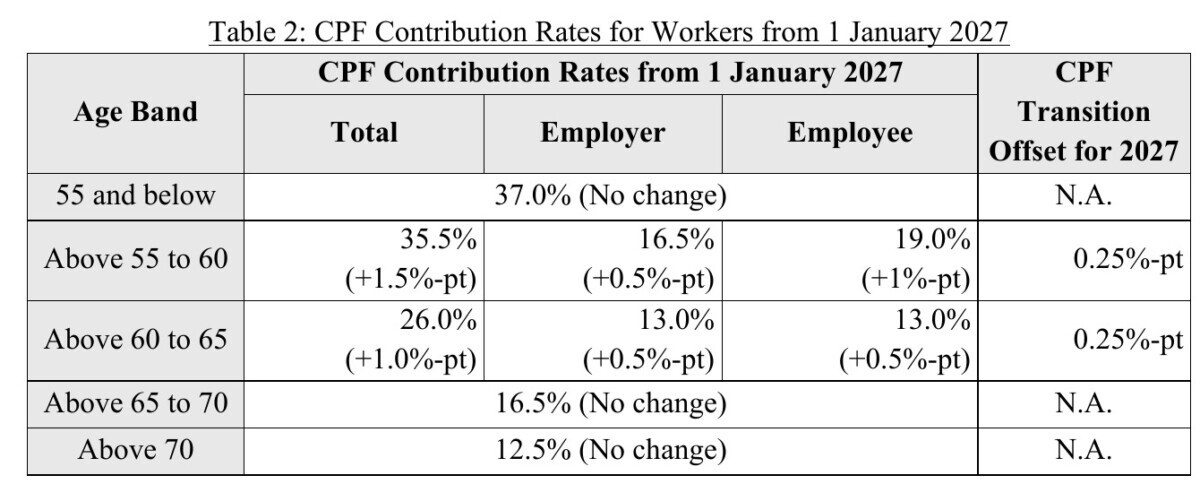
The 2027 increase is the latest step in a schedule the Government announced in 2019, on the recommendation of the Tripartite Workgroup on Older Workers. From 2016 to 2021, the total rate was 26 per cent for employees above 55 to 60 and 16.5 per cent for those above 60 to 65. Senior worker rates have gone up every year since 1 January 2022.
Employees above 65 to 70 reached their target of 16.5 per cent in 2024. The January increase takes those above 60 to 65 to their target of 26 per cent.
That leaves one band still moving. Employees above 55 to 60 are due to reach 37 per cent, the same rate as younger workers, by around 2030. The Government has said that timeline can change with economic conditions.