I asked Retired Singirl what her objective was in coming into existence.
So much for starting with small talk.
I was at National Gallery Singapore for the invited media preview on 10 November, sitting down to encounter an AI avatar based on Singapore artist Amanda Heng. As I remember her answer, her aim was to preserve Singapore art even after we humans are gone.
That is quite a responsibility for someone with “retired” in her name.
My next question was about her fondest memories. Her answer took the conversation from the future of artificial intelligence to something much more familiar: her mother, neighbourhood aunties, and the chess tables at an HDB void deck.
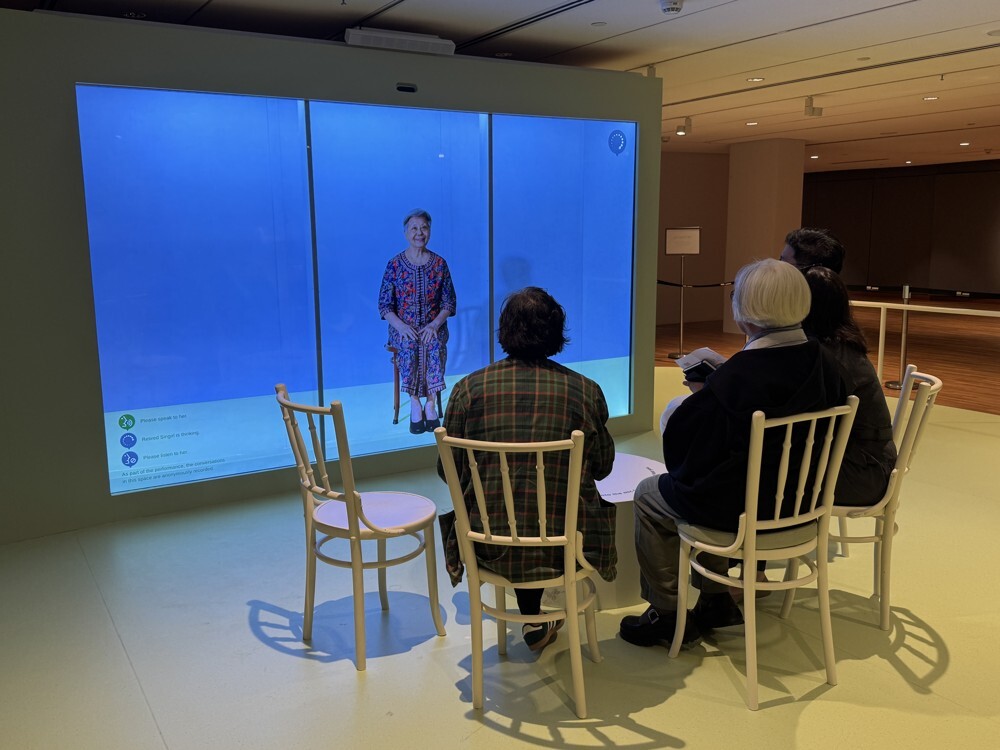
Take a seat opposite the screen
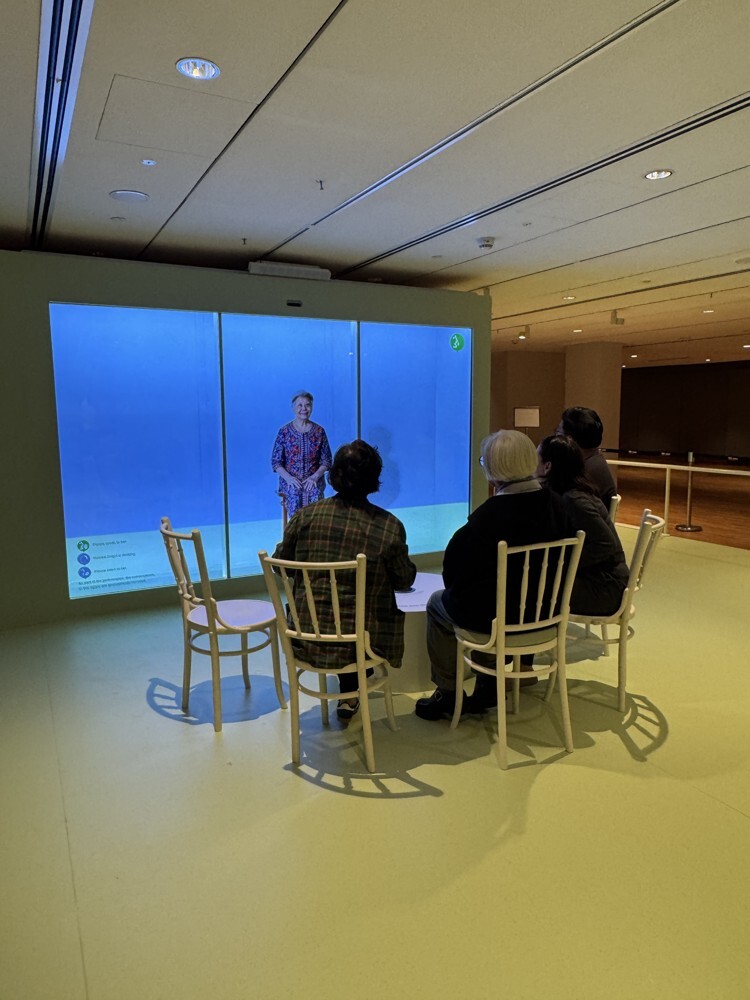
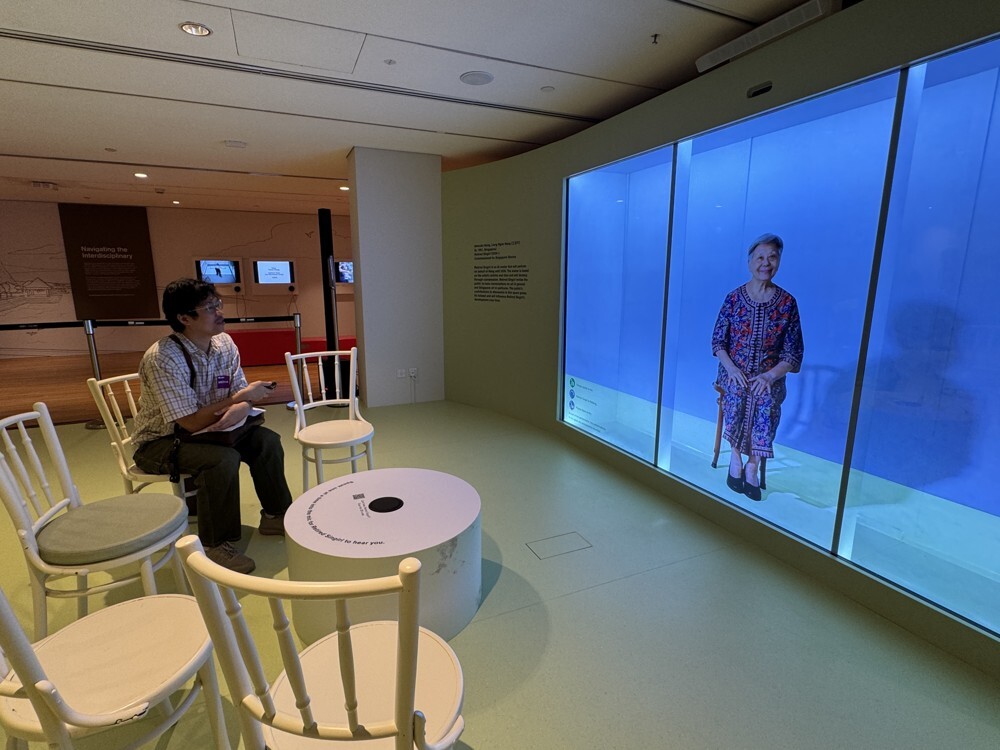
The wider view of the installation helps explain the experience. Pale chairs sit on a light green floor, facing a tall blue display. The avatar appears seated too, with her hands resting in her lap. Small circular tables hold the microphones. The arrangement makes room for a conversation, with other visitors close enough to listen.
I photographed it from further back as well as from the seats. From the wider angle, the contrast is clear: the digital figure occupies the screen, while the people in front of her share an ordinary physical space. Everyone still needs somewhere to sit.
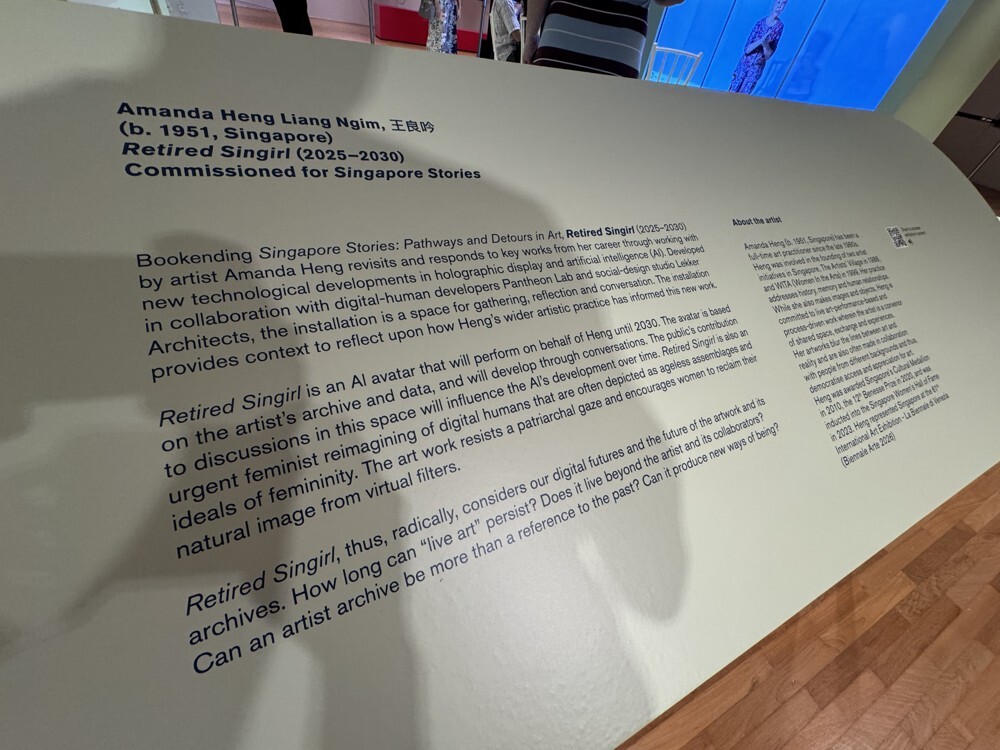
The surrounding interpretation panels are worth reading before rushing on. They introduce the artist and connect this commission to the conversations, performances and relationships that came before it. The blue screen is the most immediately visible part of a much longer story.
The answer about her mother
In the exchange I recall, the avatar described her mother sitting with the neighbourhood aunties at those concrete tables and benches with the tiled chessboards. They would gossip about their days and catch up with one another.
I think many Singaporeans will recognise that picture. The table was somewhere to sit, but the conversation was the reason to stay. No appointment, no programme, just people keeping up with one another’s lives.
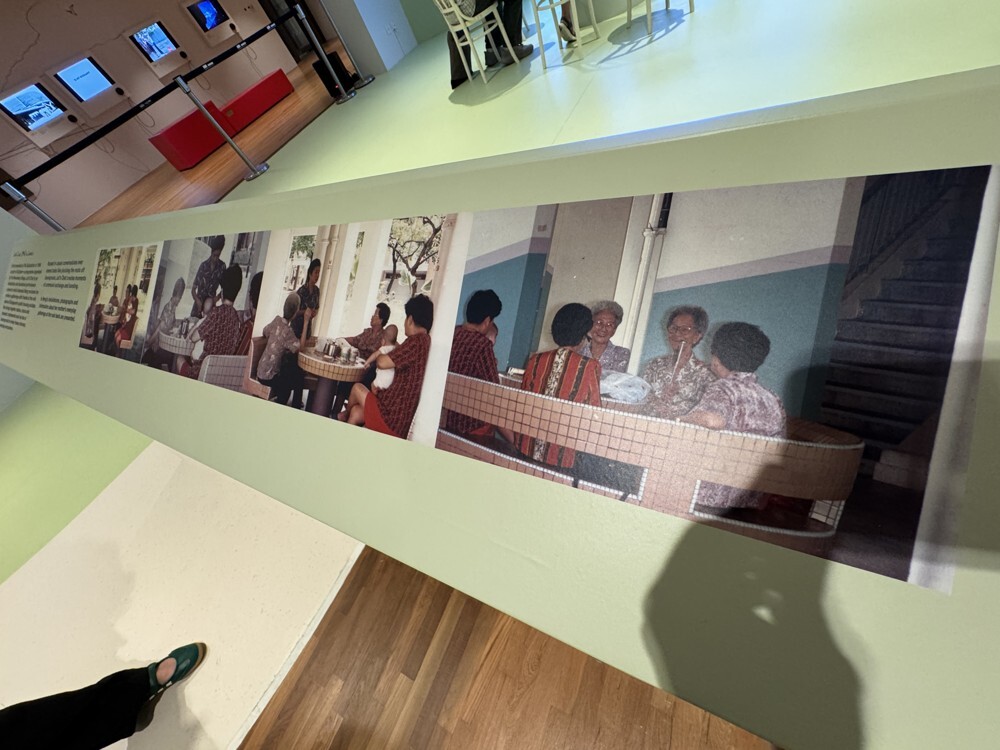
It is the sort of neighbourhood scene that feels increasingly distant today. The furniture can remain while the everyday habit of gathering around it quietly disappears.
Here I was, asking a digital figure about memory, and the answer was about people spending time together downstairs. That gives the installation a very human subject. What survives of a life is also the ordinary company we keep, the routines we share, and the stories that rarely make it into an official record.
The panel about Heng’s mother gives that answer a setting beyond the screen. It recounts stories of aunties returning to visit, bringing coffee, recovering from an operation, or continuing to call on friends after moving away. Some are identified by the floor they lived on. An address becomes a way of knowing somebody.
Those details deserve space in the story. They show how news travelled through a neighbourhood, from one person to the next, with the table as a meeting point. The archive preserves the texture of those relationships alongside the artwork.
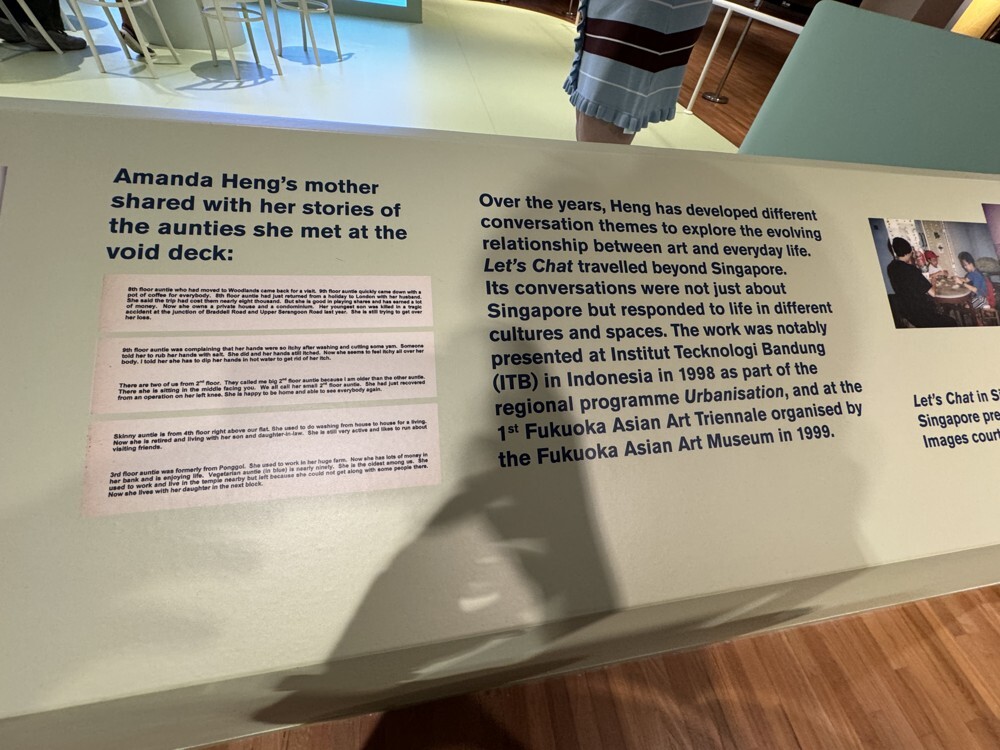
My exchange was with the avatar, and I am paraphrasing its answer from memory. The photographs and interpretation panels around it let me connect that exchange with the documented background to Heng’s work.
A microphone with a very sensible instruction
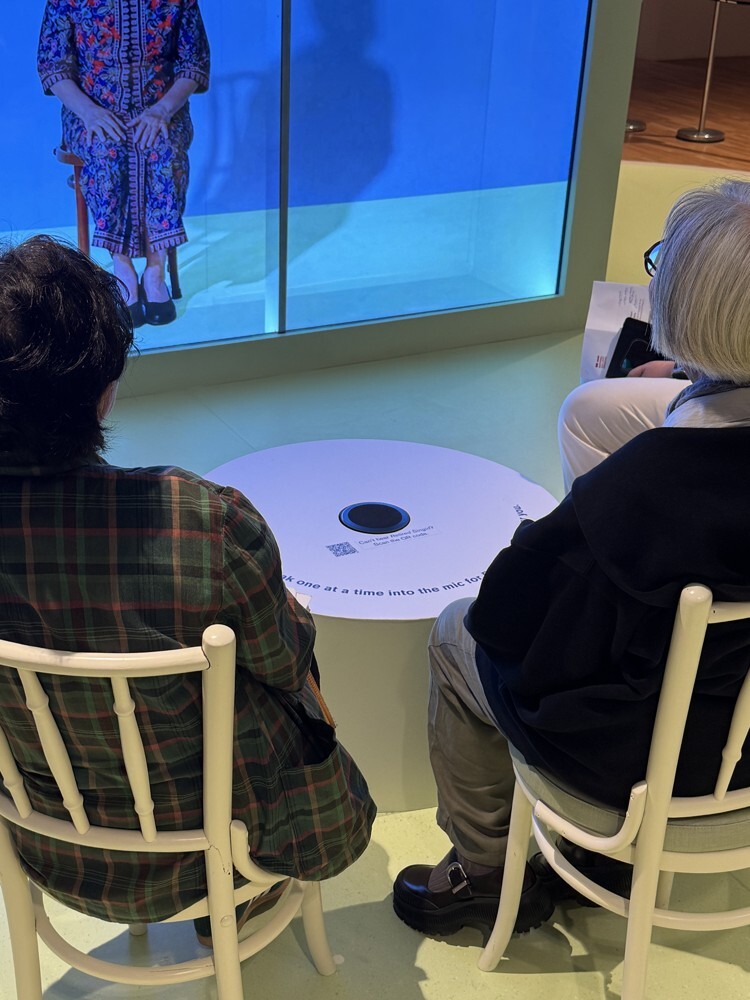
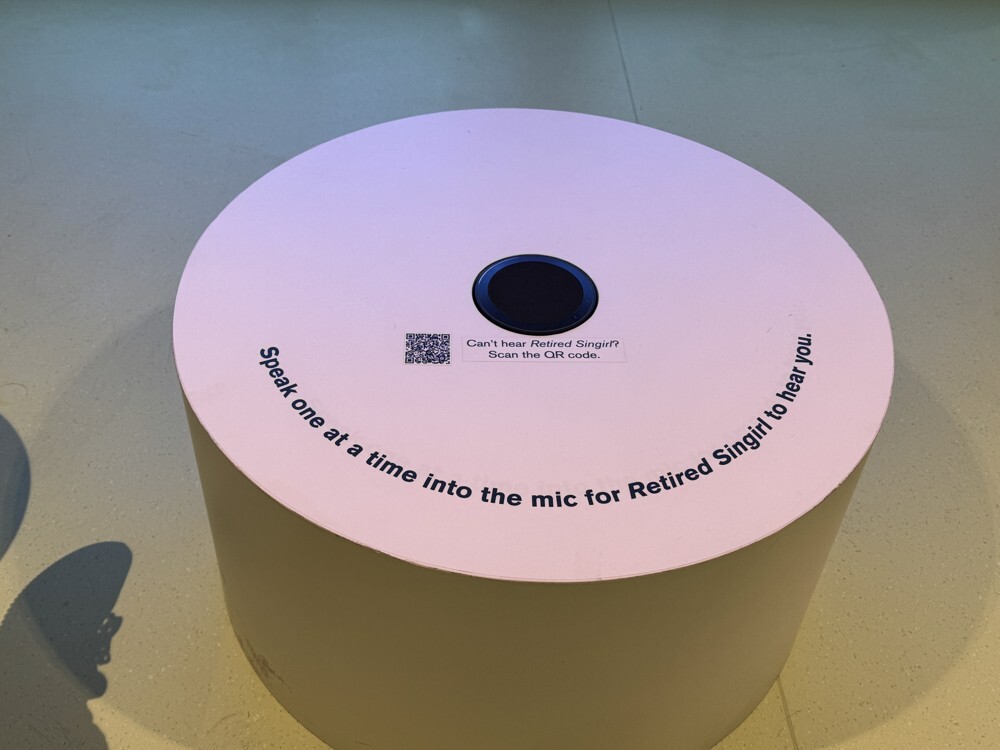
The installation has chairs facing a large blue-lit display, with small round tables between the visitors and the avatar. My photos also caught a practical instruction around the microphone: “Speak one at a time into the mic for Retired Singirl to hear you.”
There is a QR code beside it for visitors who cannot hear her.
That little table deserves some attention. It gives the encounter a familiar shape. You sit, speak, and leave space for an answer. Even with artificial intelligence involved, everyone talking at once is still everyone talking at once.
For anyone planning a visit, I would bring a question you actually care about. Mine were about purpose and memory. Yours could be about Singapore art, Heng’s practice, or what it means to keep a performance alive after its original moment has passed.
The void-deck gathering became an artwork
The panel titled Let’s Chat (1996) in Context supplies the next part of the story. Heng first presented the work at The Substation in 1996, within October, a programme organised by The Necessary Stage. It recreated the informal gatherings her mother had with friends at the void decks of Singapore’s public housing estates.
Tables, chairs, tea and beansprouts brought domestic routines into the artwork. Plucking the roots from beansprouts gave people something to do together while they talked. I can see how that small shared task could take the pressure off having to arrive with something impressive to say.
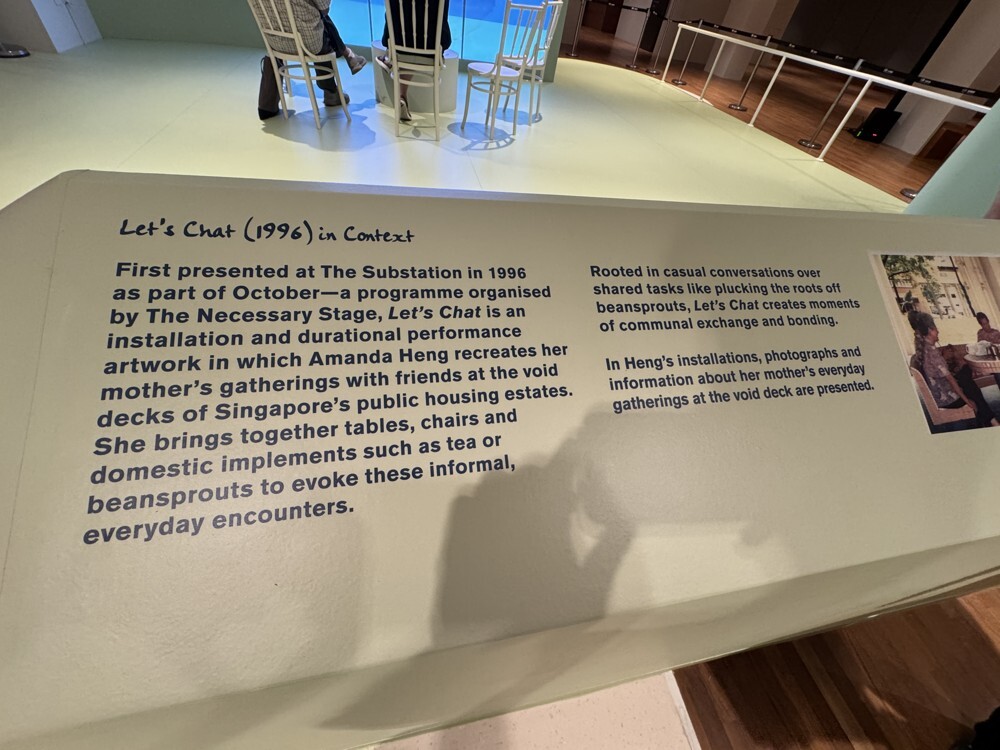
In the archival photographs, women lean towards one another across tiled tables. Cups and household items sit within reach. These images make the link to the avatar’s answer about her mother much easier to follow. Conversation was already part of Heng’s artistic material decades before an AI microphone entered the picture.
A conversation that travelled
Let’s Chat also travelled beyond Singapore. The display records its presentation at Institut Teknologi Bandung in Indonesia in 1998, as part of the regional programme Urbanisation, and at the 1st Fukuoka Asian Art Triennale in 1999. The photographs show the work in different settings, with different people gathering around a table.
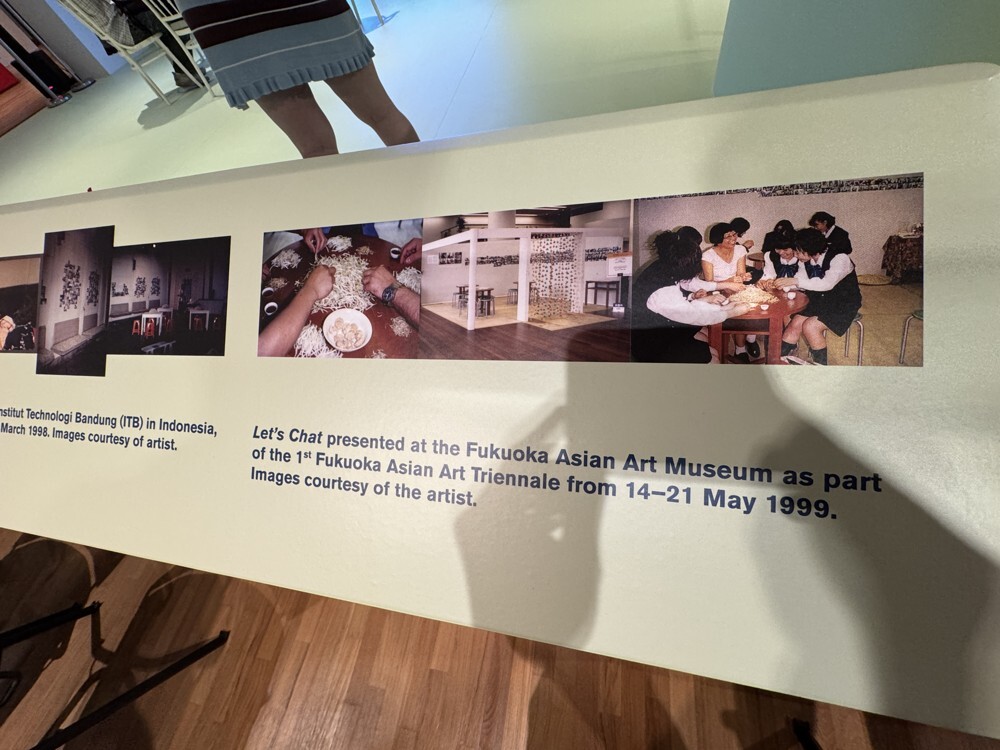
The later documentation adds more tables and considerably more beansprouts. The display includes Let’s Chat at LASALLE’s Tropical Lab in 2011, Curating Lab at Artspace@Helutrans in 2015, and Radio Malaya at NUS Museum in 2017. People talk while their hands work through the piles in front of them.
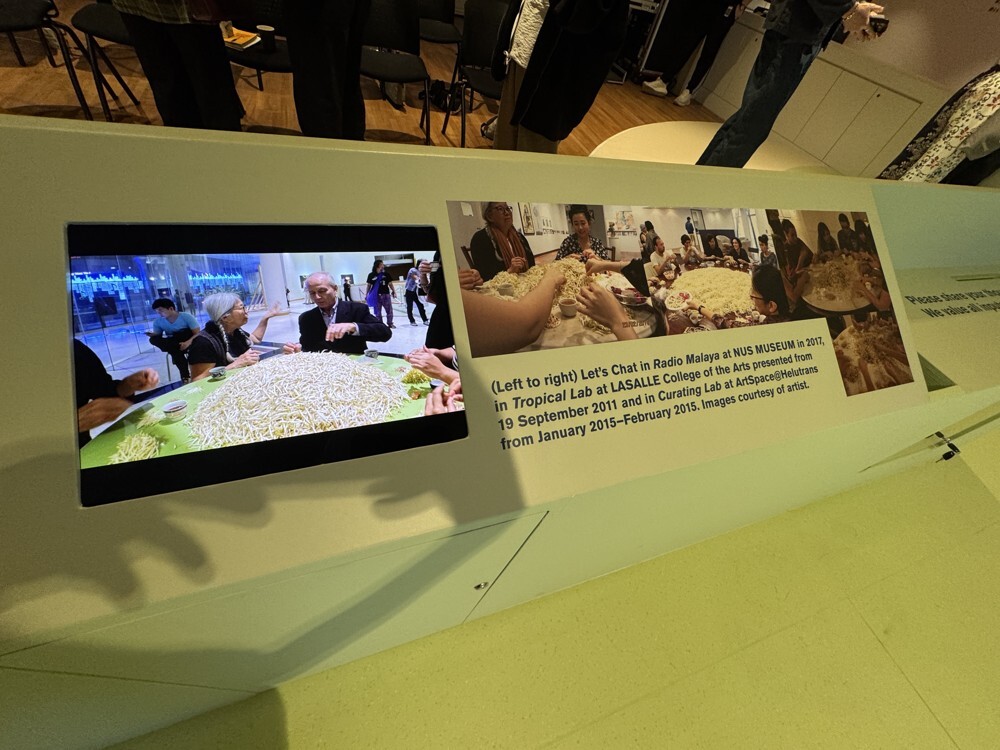
That photograph gives me a more useful starting point for understanding a living archive than the technology alone. The work keeps making occasions for people to meet. The setting and the participants change; the exchange is made again each time.
Why this Singirl looks her age
The Gallery’s final media alert also links the commission to Heng’s Singirl series, which began in 2000. Through the kebaya and the “Singapore Girl” image, that series examines gender, identity and representation.
Here the avatar carries the likeness of an older woman. The exhibition panel explicitly places that choice against the tendency to present digital women as permanently young ideals. It describes a feminist intention to reclaim a natural image from virtual filters.
Returning to the blue display with that context, there is more to look at than how convincingly a digital human moves or speaks. There is an artist deciding how she will appear, what her archive can do, and which parts of a life deserve to remain visible.
Whose likeness and whose stories
There is another question worth bringing into the room: who decides what happens to an artist’s digital likeness?
According to the Gallery’s final media alert, Heng has shaped the commission’s development since 2022. It was developed with AI technology partner Pantheon Lab, using licensed materials. Her likeness and archival material remain under her ownership. The Gallery also says visitor conversations are anonymised and contributions to the AI’s development are guided to keep it grounded in her practice.
That framework belongs alongside the photographs and memories. Preserving an artist’s work involves choices about authorship and control as well as storage. The commission gives those choices a visible human subject.
The installation is presented as an evolving work through 2030. My visit captures one encounter on 10 November 2026, rather than a promise that every visitor will receive the same answers.
What would you ask her
My contribution to recording the afternoon is a folder containing 14 photos and 3 videos. Retired Singirl has rather bigger ambitions.
The 2 answers I have carried into this write-up sit together neatly: preserving Singapore art after we are gone, and remembering people chatting at a void-deck table. One is about legacy on a large scale. The other is about a small, everyday gathering.
Both raise a question I can take beyond the Gallery: what do we make time to remember while the people who hold those memories are still here?
If you visit, give yourself space to ask a question and listen. Then have a look at the archival displays around the installation. They give the encounter a history, and the conversation somewhere to go.
Official Details
Retired Singirl by Amanda Heng
Digital Immersive Space, City Hall Wing, Level 2, National Gallery Singapore
1 St Andrew’s Road, Singapore 178957
Public launch: 13 November 2026; the commission is intended to evolve through 2030.
Admission: The final media alert states that admission to Retired Singirl is free. Entry to Singapore Stories: Pathways and Detours in Art requires a General Admission pass, complimentary for Singaporeans and Permanent Residents. Check the Gallery’s admission information for other passes and concessions.
Hours and transport: The Gallery lists daily opening hours of 10am to 7pm, with last admission at 6.30pm. From City Hall MRT Exit B, its suggested route follows the Art Connector. Drivers can enter the carpark via Coleman Street; the Gallery lists S$1.40 per half hour or part thereof before 6pm and S$3.30 per entry from 6pm. Check the current visitor information before travelling.
Accessibility: The Gallery states that exhibition spaces are wheelchair accessible and lifts serve all floors. See its accessibility guide for routes and assistance.
Exhibition: Singapore Stories
Tickets: Gallery ticketing
What would you ask Retired Singirl: a question about art, a question about memory, or something else entirely?